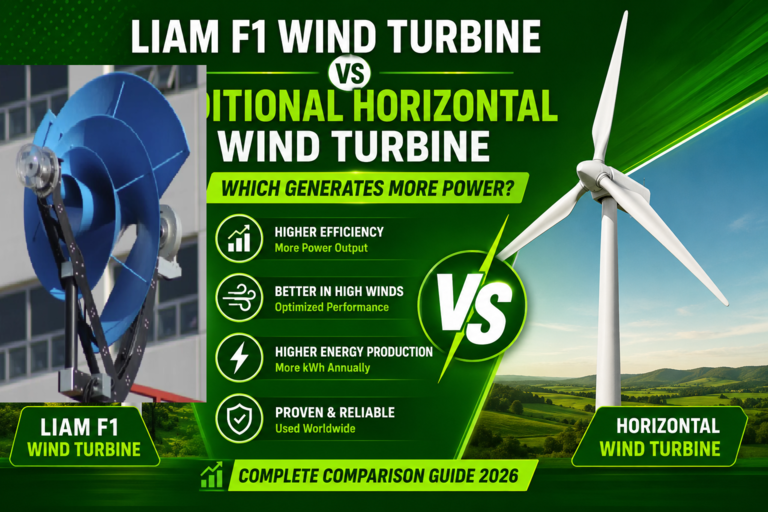
Vertical vs Horizontal Wind Turbine: Which Is Better for Pakistan?
Wind energy is becoming more popular in Pakistan, especially for farmhouses, coastal properties, remote sites, industries, schools, and solar-wind hybrid systems. Vertical vs Horizontal axis Wind Turbine.
One of the most common questions is:
Should you install a horizontal wind turbine or a vertical wind turbine?
Both systems generate electricity from wind, but their design, efficiency, cost, maintenance, space requirement, and energy output can be very different.
This article provides a detailed and easy-to-understand comparison of horizontal-axis and vertical-axis wind turbines for use in Pakistan. Vertical vs Horizontal axis Wind Turbine
What Is a Horizontal Wind Turbine?
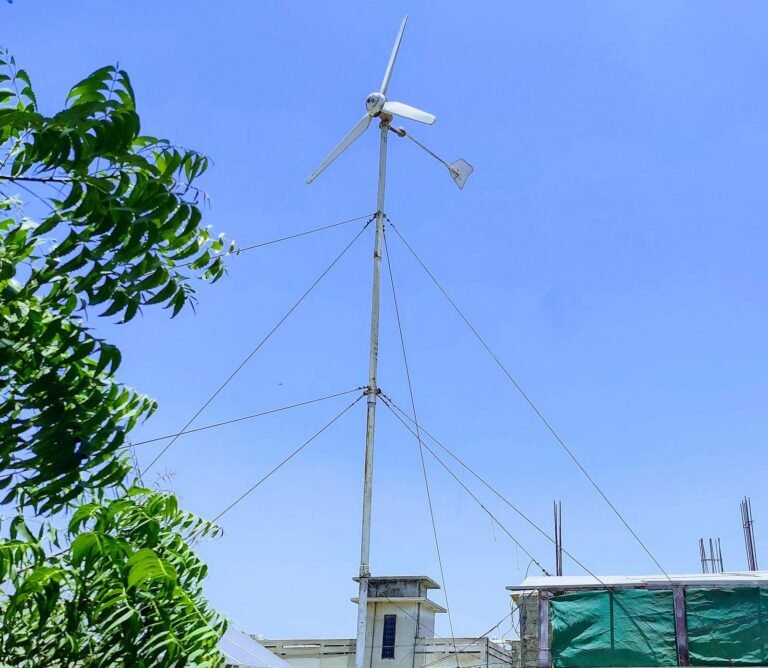
A horizontal-axis wind turbine, also called a HAWT, has a rotor shaft that is parallel to the ground.
It usually looks like a traditional windmill or a large fan.
Most horizontal turbines have:
- Two or three blades
- A tail vane or yaw system
- A generator installed near the rotor
- A tower or pole
- A controller and dump-load system
The turbine must face the wind to generate electricity efficiently.
Horizontal-axis turbines are the most commonly used wind turbines in the world. They are used in small home systems, commercial projects, and large wind farms.
What Is a Vertical Wind Turbine?
A vertical-axis wind turbine, also called a VAWT, has a rotor shaft that stands vertically.
It can receive wind from different directions without turning toward the wind.
Common vertical turbine designs include:
- Savonius turbine
- Tulip or flower turbine
- H-type turbine
- Darrieus turbine
- Spiral or helical turbine
Vertical turbines are often promoted for rooftops, urban locations, schools, parks, and architectural projects.
Wind Turbine Price in Pakistan https://windturbine.pk/prices-of-wind-turbine-in-pakistan/
Quick Comparison
| Feature | Horizontal Wind Turbine | Vertical Wind Turbine |
|---|---|---|
| Rotor direction | Parallel to the ground | Vertical to the ground |
| Common design | Two or three propeller blades | H-type, tulip, spiral, or Savonius |
| Must face the wind | Yes | Usually no |
| Yaw system required | Yes | Usually not |
| Efficiency in clean wind | Generally higher | Usually lower |
| Performance in changing wind direction | Moderate | Better |
| Use in large wind farms | Very common | Very limited |
| Rooftop use | Difficult in turbulent wind | Sometimes more suitable |
| Annual energy output | Usually higher | Depends strongly on design |
| Starting torque | Moderate | Often better in Savonius types |
| Tower requirement | Usually required | Often still required |
| Maintenance | Well understood | Depends on design |
| Best use | Farms, coastal sites, open land | Special urban and architectural projects |
1. Which Turbine Produces More Electricity?
For most open and properly exposed sites, a horizontal wind turbine usually produces more electricity than a vertical wind turbine of the same rated capacity.
This is because horizontal turbines generally have:
- Better aerodynamic efficiency
- A larger effective swept area
- Higher rotor speed
- More mature generator design
- Better tested power curves
- More commercial field experience
A vertical turbine may rotate in light wind, but rotation alone does not mean it is producing useful electrical power.
The most important measurement is not how easily the turbine spins. The important measurement is:
How many kilowatt-hours does the turbine generate in one day, one month, or one year? Feasibility Check for free. https://windturbine.pk/feasibility/
Energy-production winner
Horizontal wind turbine
However, the final result depends on the exact model, rotor size, wind speed, tower height, and installation quality. Vertical vs Horizontal axis Wind Turbine
2. Rated Power Does Not Tell the Full Story
A 5 kW horizontal turbine and a 5 kW vertical turbine may not produce the same amount of electricity.
Both may be called 5 kW turbines, but they may reach their rated output at different wind speeds.
For example:
- Turbine A produces 5 kW at 10 m/s
- Turbine B produces 5 kW at 13 m/s
If the installation site rarely receives 13 m/s wind, Turbine B may spend very little time producing its full rated power.
Before buying a wind turbine, ask:
- At what wind speed does it produce rated power?
- What is the cut-in wind speed?
- What is the rotor diameter?
- What is the rotor height?
- Is a full power curve available?
- Has the turbine been independently tested?
- What is the estimated annual energy output?
The rated capacity alone is not enough to judge performance.
3. Rotor Swept Area
The rotor swept area is the area through which the blades capture wind.
Horizontal turbine swept area
For a horizontal turbine, the swept area is circular.
The formula is:
Swept Area = π × Radius²
A larger rotor diameter allows the turbine to capture more wind.
Vertical turbine swept area
For an H-type or Darrieus vertical turbine, the approximate swept area is:
Rotor Height × Rotor Diameter
For vertical turbines, both height and width are important.
A tall but narrow turbine may have a smaller swept area than expected.
Swept-area winner
There is no automatic winner.
The better turbine is the one with:
- A larger useful swept area
- A tested power curve
- Better efficiency
- Suitable wind conditions
However, horizontal turbines normally use rotor area more efficiently in clean wind.
4. Wind Direction
Horizontal turbine
A horizontal turbine must face the wind.
Small turbines normally use a tail vane to turn the rotor toward the wind. Larger turbines use an active yaw system.
When the wind direction changes, the turbine must also change direction.
Vertical turbine
A vertical turbine can usually accept wind from any horizontal direction.
This can be useful where:
- Wind direction changes frequently
- Airflow comes from different directions
- A yaw system is not preferred
- The turbine is installed as part of an architectural project
Wind-direction winner
Vertical wind turbine
However, changing wind direction does not always mean good wind energy. Very turbulent wind can reduce output and increase mechanical stress.
5. Performance in Turbulent Wind
Turbulence is common near:
- Buildings
- Boundary walls
- Trees
- Water tanks
- Rooftop parapets
- Billboards
- Narrow streets
- Other tall structures
Turbulent wind changes speed and direction very quickly.
This can cause:
- Lower electricity production
- More vibration
- Uneven blade loading
- Higher bearing wear
- More structural fatigue
- Increased maintenance
Vertical turbines can accept wind from different directions, but that does not mean they automatically work well in heavy turbulence.
A vertical turbine may continue spinning in changing wind, but its electrical output can still remain low.
Turbulence verdict
Vertical turbines may handle changing wind direction better, but both turbine types perform best in smooth, open airflow.
6. Rooftop Installation
Many people believe that vertical turbines are always best for rooftops.
This is not always correct.
Rooftops often have:
- Turbulent air
- Weak airflow behind parapet walls
- Vibration problems
- Structural limitations
- Waterproofing risks
- Limited blade clearance
- Difficult maintenance access
A rooftop turbine should never be installed only by fixing a pole into a concrete slab.
The turbine loads should be transferred safely into:
- RCC beams
- Columns
- Steel grillage
- Structural pedestals
- Building foundations
Horizontal turbine on a rooftop
A horizontal turbine usually requires:
- More height
- Clear airflow
- Sufficient blade clearance
- Strong structural support
Vertical turbine on a rooftop
A vertical turbine may be easier to place in a limited area, but it still requires:
- Structural assessment
- Vibration analysis
- Safe clearance
- Wind measurement
- Proper mounting
- Maintenance access
Rooftop winner
Site-dependent
For many urban homes in Pakistan, solar panels may provide better value than either type of rooftop wind turbine.
7. Tower Height
Wind normally becomes stronger and smoother at greater height.
Near the ground, wind is slowed and disturbed by buildings, trees, walls, and other obstacles.
Horizontal turbine
A horizontal turbine usually needs a proper tower to reach clean airflow.
Common small-system tower heights may range from:
- 6 metres
- 9 metres
- 12 metres
- Higher, depending on the site
Vertical turbine
A vertical turbine is sometimes marketed as a low-height turbine.
However, it follows the same laws of wind energy.
If the wind is weak at low height, electricity production will also be low.
Tower-height verdict
Both turbine types benefit from height.
A vertical turbine does not remove the need for good wind exposure.
How much electricity 1 kw wind turbine generate https://windturbine.pk/blog/1kw-wind-turbine-electricity-generation-pakistan/
8. Starting Wind Speed and Cut-In Wind Speed
These terms are often confused.
Start-up wind speed
The wind speed at which the rotor begins to move.
Cut-in wind speed
The wind speed at which the turbine begins producing useful electrical power.
Rated wind speed
The wind speed at which the turbine reaches its advertised rated output.
A turbine may begin rotating at 1.5 or 2 m/s, but its electrical output at that speed may be very small.
This is why low start-up wind speed should not be the main reason for buying a turbine.
Starting-performance comparison
| Feature | Horizontal | Vertical |
|---|---|---|
| Rotor starts easily | Model-dependent | Often better in Savonius types |
| Useful electrical output at low wind | Usually limited | Usually limited |
| Rated output | Requires stronger wind | Requires stronger wind |
| Best specification to check | Full power curve | Full power curve |
9. Main Types of Vertical Wind Turbines
Savonius or Tulip Type
Savonius turbines use wind drag.
They often have curved or scoop-shaped blades.
Advantages
- Good starting torque
- Simple design
- Can receive wind from different directions
- Low rotor speed
- Attractive appearance
- Useful for educational or display projects
Limitations
- Lower aerodynamic efficiency
- Usually lower annual electricity production
- Large physical size may be required
- Heavy structure for higher power ratings
Best applications
- Science centres
- Educational projects
- Parks
- Small sensors
- Demonstration systems
- Mechanical pumping
H-Type Vertical Turbine
An H-type turbine uses straight vertical blades connected to a central shaft.
Advantages
- Compact appearance
- Wind direction independent
- Better energy potential than simple Savonius designs
- Generator may be installed at a lower level
- Suitable for some architectural projects
Limitations
- Complex blade loading
- Cyclic stress
- Support-arm drag
- Possible starting difficulties
- Requires careful balancing
- Limited independent field data for many low-cost models
Spiral or Helical Turbine
A spiral turbine uses twisted blades.
Advantages
- Smooth appearance
- Reduced torque pulsation in some designs
- Wind direction independent
- Lower visual impact
- Suitable for public and architectural projects
Limitations
- More difficult manufacturing
- Higher blade cost
- Complex structural loading
- Performance claims must be verified
- Imported replacement blades may be expensive
10. Horizontal Turbine Design
A traditional three-blade horizontal turbine is the most commercially proven design.
Advantages
- High energy efficiency
- Mature technology
- Suitable for small and large systems
- Strong global service experience
- More certified models available
- Better suitability for open land
- Commonly used in wind farms
- Good annual energy production
FOr wind Turbine in Pakistan visit https://www.windturbine.pk
Limitations
- Must face the wind
- Requires a tower
- Generator may be difficult to access
- Blade tips can produce noise
- Rooftop turbulence can reduce output
- More space may be required for safe blade clearance
11. Efficiency Comparison
Efficiency depends on turbine design, wind conditions, and installation quality.
In general:
| Turbine Type | General Efficiency Level |
|---|---|
| Three-blade horizontal turbine | High |
| H-type vertical turbine | Medium |
| Spiral or helical vertical turbine | Medium |
| Savonius vertical turbine | Low to medium |
A well-designed vertical turbine can perform well in a suitable application, but horizontal turbines normally produce more electricity per square metre of rotor area.
Efficiency winner
Horizontal wind turbine
12. Noise Comparison
Horizontal turbine noise
Possible noise sources include:
- Blade-tip sound
- Generator
- Bearings
- Yaw movement
- Tower vibration
- Braking system
Higher rotor speed may create more aerodynamic sound.
Vertical turbine noise
Some low-speed vertical turbines may be quieter.
However, they can still produce:
- Bearing noise
- Generator hum
- Blade-pass sound
- Structural vibration
- Support-arm turbulence
Noise winner
A low-speed vertical turbine may be quieter, but noise depends on the exact model.
A claim such as “completely silent” should not be accepted without measured sound data.
13. Vibration and Structural Loads
Wind turbines create dynamic loads, not only static weight.
Horizontal turbine loads
- Rotor thrust
- Generator torque
- Yaw loads
- Blade imbalance
- Emergency braking
- Tower bending
Vertical turbine loads
- Cyclic blade loads
- Alternating torque
- Bearing loads
- Support-arm drag
- Rotor imbalance
- Structural resonance
Vertical turbines may create repeated sideways forces as the blades move around the rotor.
Spiral turbines can sometimes produce smoother torque, but this depends on the blade shape and manufacturing quality.
Structural verdict
Both systems need proper engineering.
Ground-mounted installation is usually easier and safer than rooftop installation.
14. Maintenance Comparison
| Maintenance Item | Horizontal Turbine | Vertical Turbine |
|---|---|---|
| Blade inspection | Required | Required |
| Bearing inspection | Required | Required |
| Rotor balancing | Required | Required |
| Yaw-system inspection | Required | Usually not required |
| Tail-vane inspection | Often required | Not required |
| Support-arm inspection | Limited | Important |
| Tower-bolt inspection | Required | Required |
| Foundation inspection | Required | Required |
| Controller inspection | Required | Required |
| Dump-load testing | Required | Required |
| Corrosion inspection | Required | Required |
| Brake-system testing | Required | Required |
Some vertical turbines may provide easier generator access if the generator is located near the bottom.
Horizontal turbines can also be easy to maintain when installed on a tilt-down tower.
Maintenance winner
There is no clear winner.
The quality of the turbine, tower, and installation matters more than the basic rotor direction.
Wind Turbine in Hyderabad https://windturbine.pk/blog/small-wind-turbine-hyderabad-pakistan/
15. Cost Comparison in Pakistan
The final cost of a wind turbine includes more than the turbine itself.
Horizontal system costs may include
- Turbine and generator
- Blades and hub
- Controller
- Dump load
- Tower
- Foundation
- Guy wires
- Electrical cable
- Earthing
- Installation
- Transportation
- Lifting equipment Vertical vs Horizontal axis Wind Turbine
Vertical system costs may include
- Rotor and blades
- Generator
- Controller
- Dump load
- Support structure
- Tower or pedestal
- Foundation
- Electrical cable
- Earthing
- Installation
- Transportation
- Lifting equipment Vertical vs Horizontal axis Wind Turbine
Vertical turbines often look compact, but they may still be expensive because of:
- More blade material
- Heavy support arms
- Custom fabrication
- Imported components
- Limited local spare parts
- Complex balancing
Cost comparison rule
Do not compare only the price per rated kilowatt.
Compare:
Total installed cost divided by expected annual electricity generation.
This gives a better idea of real value. Vertical vs Horizontal axis Wind Turbine
16. Estimated Value Comparison
| Factor | Horizontal Turbine | Vertical Turbine |
|---|---|---|
| Equipment cost | Moderate | Moderate to high |
| Tower cost | Moderate to high | Moderate |
| Foundation cost | Moderate to high | Moderate to high |
| Energy output | Usually higher | Usually lower |
| Maintenance availability | Better | More limited |
| Spare parts | Easier for common models | Model-dependent |
| Cost per annual kWh | Usually better | Often higher |
| Architectural value | Moderate | High |
17. Suitability for Pakistan
Pakistan has some very good wind-energy regions, especially in:
- Coastal Sindh Vertical vs Horizontal axis Wind Turbine
- Thatta
- Badin
- Gharo
- Jhimpir
- Karachi outskirts
- Coastal Balochistan
- Gwadar
- Open agricultural areas
- Elevated and unobstructed sites
However, a windy region does not mean every building or plot is suitable.
The actual performance depends on:
- Local obstacles
- Tower height
- Wind direction
- Seasonal wind pattern
- Average wind speed
- Turbulence
- Rotor size
- Power curve
Wind should ideally be measured at the planned turbine height. Vertical vs Horizontal axis Wind Turbine
18. Best Turbine for a Farmhouse
For most open farmhouses, a horizontal turbine is usually the better choice.
Reasons include:
- More open space
- Better tower options
- Cleaner airflow
- Higher annual energy potential
- Easier guy-wire installation
- Better solar-wind hybrid integration
- Easier maintenance access, Vertical vs Horizontal axis Wind Turbine
Farmhouse winner
Horizontal wind turbine
A vertical turbine may still be useful if appearance, low rotor speed, or multidirectional airflow is more important than maximum energy production.
19. Best Turbine for an Urban Home
For a dense urban home, both turbine types can face problems.
Common problems include: Vertical vs Horizontal axis Wind Turbine
- Low wind speed
- Turbulence
- Nearby buildings
- Noise concerns
- Structural limitations
- Small rooftop area
- Difficult maintenance
A vertical turbine may look more suitable for a rooftop, but its annual output must be carefully checked.
For most urban homes in Pakistan, solar panels usually provide:
- Lower cost
- Easier installation
- More predictable output
- Less maintenance
- No moving parts
- No noise
Urban-home verdict
Solar is usually the first choice.
Wind should only be added after proper wind assessment.
20. Best Turbine for Coastal Areas
Coastal areas may have better wind conditions.
For open coastal properties:
- Horizontal turbines usually provide better energy production
- Vertical turbines may be useful for architectural projects
- Corrosion protection is essential
- Hot-dip galvanizing is recommended
- Stainless-steel hardware may be required
- Marine-grade coating may be necessary
- Frequent inspection is important
Coastal power-generation winner
Horizontal wind turbine
21. Best Turbine for Schools and Science Centres
Vertical turbines may be attractive for schools and science centres because they:
- Have a modern appearance
- Clearly show rotor movement
- Can demonstrate different turbine designs
- Are suitable for educational displays
- Can become part of a sustainability project
- Can be installed with monitoring screens
Horizontal turbines may be better when the main objective is maximum energy generation.
Educational-project winner
Vertical wind turbine
Energy-generation winner
Horizontal wind turbine
22. Best Turbine for Large Commercial Projects
For 1 MW, 2 MW, or larger wind-energy projects, horizontal turbines are the industry standard.
They offer:
- Proven technology
- Certified models
- Better financeability
- Better insurance acceptance
- Mature maintenance systems
- Higher commercial reliability
- Strong global supply chains
- Better long-term field data
Vertical turbines are still limited in utility-scale commercial use. More about verticl wind turbine in Pakistan visit https://windturbine.pk/blog/vertical-wind-turbine-for-homes-apartment-balconies-in-karachi/
Large-project winner
Horizontal wind turbine
Detailed Scorecard
| Category | Horizontal | Vertical | Winner |
|---|---|---|---|
| Annual energy production | 9/10 | 6/10 | Horizontal |
| Efficiency in clean wind | 9/10 | 6/10 | Horizontal |
| Changing wind direction | 6/10 | 9/10 | Vertical |
| Large-project suitability | 10/10 | 3/10 | Horizontal |
| Certified models | 9/10 | 5/10 | Horizontal |
| Architectural appearance | 6/10 | 9/10 | Vertical |
| Low-speed starting torque | 7/10 | 9/10 | Vertical |
| Farmhouse suitability | 9/10 | 6/10 | Horizontal |
| Rooftop suitability | 5/10 | 6/10 | Site-dependent |
| Maintenance familiarity | 9/10 | 6/10 | Horizontal |
| Commercial field history | 10/10 | 4/10 | Horizontal |
| Overall value | 9/10 | 6/10 | Horizontal |
These scores are general. The exact model and site conditions can change the result.
Common Marketing Claims and Reality
| Marketing Claim | Reality |
|---|---|
| Vertical turbines work from every direction | Correct, but useful wind energy is still required |
| Starts at 1.5 m/s | Starting rotation does not mean useful electricity |
| No tower required | Better height usually means better wind |
| Maintenance-free | All rotating machines require inspection |
| Completely silent | Bearings, generator, blades, and structure can produce sound |
| Perfect for rooftops | Structural and wind assessment is still required |
| More blades produce more power | Rotor area and aerodynamic design are more important |
| 5 kW means 5 kW all day | Rated output is only reached at a specified wind speed |
Questions to Ask Before Buying
Before purchasing any wind turbine, ask the supplier:
- What is the exact model?
- Is it horizontal or vertical?
- What is the rotor diameter?
- What is the rotor height?
- What is the swept area?
- What is the turbine weight?
- What is the cut-in wind speed?
- What is the rated wind speed?
- Is a full power curve available?
- Has the power curve been independently tested?
- What is the survival wind speed?
- What tower height is recommended?
- Is the tower included?
- Is the foundation included?
- Is the controller included?
- Is the dump load included?
- Is the brake system included?
- What is the warranty?
- Are spare parts available in Pakistan?
- What is the estimated annual electricity generation?
Final Verdict
Choose a horizontal wind turbine when:
- Your main goal is electricity generation
- The site is open and windy
- A proper tower can be installed
- You are installing at a farmhouse
- You are working on a commercial project
- You need a 5 kW, 10 kW, or larger system
- Long-term value is important
- A tested power curve is available
Choose a vertical wind turbine when:
- Wind direction changes frequently
- Appearance is important
- The turbine is part of an educational project
- The installation is for a science centre or public display
- A low-speed rotor is preferred
- A tested H-type or spiral model is available
- Electricity production is not the only objective
Can I attach my sollar system with wind turbine?
https://windturbine.pk/blog/can-i-add-a-wind-turbine-to-my-existing-solar-system-in-pakistan/
Overall recommendation for Pakistan
For serious electricity production in Pakistan, especially at farmhouses, coastal properties, remote sites, and commercial locations, a horizontal-axis wind turbine will usually provide better value.
A vertical turbine can still be a good choice for:
- Schools
- Science centres
- Eco-parks
- Corporate sustainability projects
- Architectural installations
- Small demonstration systems
- Selected urban applications
The final decision should not be based only on turbine shape.
It should be based on:
- Measured wind speed
- Tower height
- Rotor swept area
- Tested power curve
- Annual energy output
- Total installation cost
- Maintenance support
- Site conditions
A well-designed turbine at a good site can perform successfully. A poorly selected turbine at a bad site can fail, whether it is horizontal or vertical. Wind Turbine in DHA Karachi https://windturbine.pk/blog/wind-turbine-in-dha-karachi/
- Horizontal wind turbine in Pakistan
- Vertical wind turbine in Pakistan
- Best wind turbine for home
- Wind turbine for farmhouse
- HAWT vs VAWT
- Spiral wind turbine
- H-type wind turbine
- Tulip wind turbine
- Rooftop wind turbine Pakistan
- Wind turbine efficiency comparison https://www.windturbine.pk