Liam F1 Wind Turbine vs Horizontal Wind Turbine is a common comparison for homeowners, farmers, and businesses in Pakistan looking for renewable energy solutions in 2026–2027. Both turbine types have unique advantages in terms of efficiency, power output, installation requirements, and performance in low-wind conditions. This guide compares the two technologies to help you choose the best option for your needs.
The wind energy industry is evolving rapidly. New designs such as the Liam F1 Wind Turbine have attracted significant attention because of their compact shape, quiet operation, and modern appearance. However, the critical question remains:
Can the Liam F1 Wind Turbine generate more power than a traditional horizontal wind turbine?
When comparing Liam F1 Wind Turbine vs Horizontal Wind Turbine. As someone who has analyzed wind turbine technologies from large-scale wind farms in the United States to advanced manufacturing facilities in China, the answer comes down to one fundamental principle:
The turbine that captures more wind energy through a larger swept area will usually generate more electricity.
Let’s examine the facts.
Liam F1 Wind Turbine vs Horizontal Wind Turbine: Which Generates More Power?
What Is the Liam F1 Wind Turbine?
The Liam F1 Wind Turbine is a compact helical-style wind turbine designed for residential and urban applications.
- Spiral aerodynamic design
- Compact footprint
- Lower noise levels
- Attractive architectural appearance
- Better performance in turbulent urban winds
Unlike conventional turbines, the Liam F1 focuses on operating efficiently where wind direction changes frequently.
What Is a Horizontal Wind Turbine?
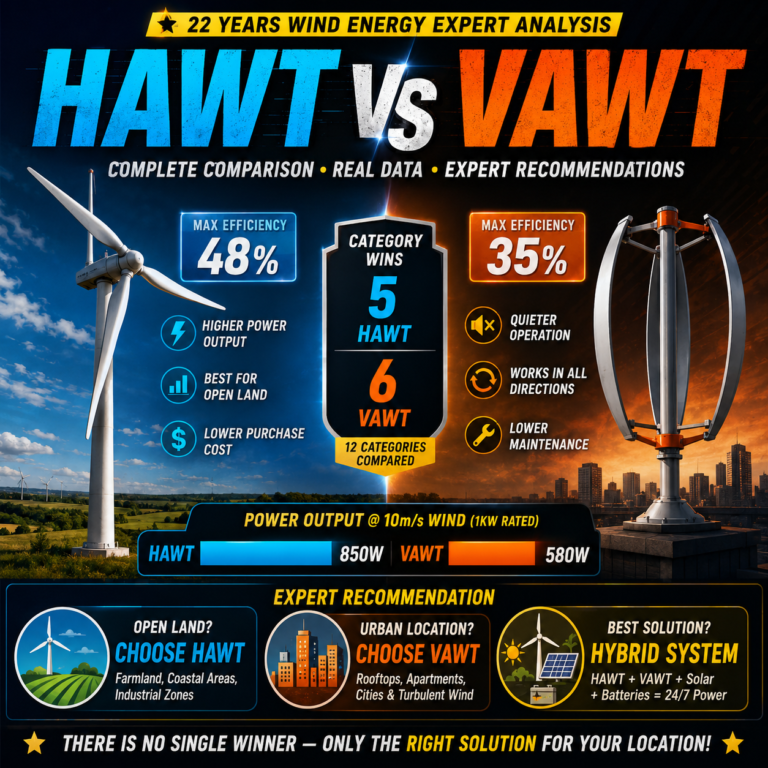
A Horizontal Axis Wind Turbine (HAWT) is the most common wind turbine design used worldwide.
- Two or three aerodynamic blades
- Rotor faces directly into the wind
- High aerodynamic efficiency
- Proven commercial technology
- Used in nearly all utility-scale wind farms
From Texas to Inner Mongolia, the vast majority of wind farms use horizontal turbines because they convert wind energy into electricity more efficiently.
The Real Measure: Power Generation
Many buyers focus on appearance.
Engineers focus on energy production.
The amount of power a turbine generates depends primarily on:
- Rotor swept area
- Wind speed
- Aerodynamic efficiency
- Generator quality
- System losses
The power available in wind is calculated by:
Power = 0.5 × Air Density × Swept Area × Wind Speed³
Notice the most important factor:
Wind Speed Cubed
If wind speed doubles, available wind energy increases by approximately eight times. This is why turbine efficiency matters.
Liam F1 vs Horizontal Wind Turbine Comparison
| Feature | Liam F1 Wind Turbine | Horizontal Wind Turbine |
|---|---|---|
| Efficiency | Moderate | High |
| Power Output | Lower | Higher |
| Low Wind Performance | Good | Good |
| Urban Installation | Excellent | Limited |
| Noise Level | Low | Moderate |
| Maintenance | Moderate | Low |
| Commercial Proven Record | Limited | Excellent |
| Cost Per kWh | Higher | Lower |
| Scalability | Limited | Excellent |
Which Generates More Power?
Liam F1 Wind Turbine vs Horizontal Wind Turbine – Winner: Traditional Horizontal Wind Turbine
For the same rated capacity and wind conditions, a horizontal wind turbine generally produces more electricity annually.
Why?
- Captures more wind energy
- Higher aerodynamic efficiency
- Better tip-speed ratios
- Lower energy losses
- Decades of engineering optimization
A properly designed horizontal turbine can achieve significantly higher annual energy production than most compact helical or architectural turbine designs.
Example: 5kW Liam F1 vs 5kW Horizontal Turbine
| Parameter | 5kW Liam F1 | 5kW Horizontal Turbine |
|---|---|---|
| Capacity Factor | 15% – 20% | 25% – 35% |
| Annual Production | 6,500 – 8,700 kWh | 11,000 – 15,000 kWh |
| Power Generation | Lower | Higher |
Result: A quality horizontal turbine may generate nearly twice as much electricity annually under similar conditions.
Why Do People Still Like the Liam F1?
Because power output is not the only consideration.
Better Urban Compatibility
Buildings create turbulence. Traditional turbines dislike turbulent airflow. The Liam F1 design can tolerate changing wind directions more effectively.
Lower Visual Impact
Many homeowners want renewable energy without installing a large industrial-looking turbine.
Reduced Noise
Urban neighborhoods often prioritize quiet operation.
Conclusion – Best Choice for Pakistan
For Maximum Energy Production
Choose a Horizontal Wind Turbine.
- Karachi Coastline
- Gharo-Keti Bandar Wind Corridor
- Balochistan Coastal Areas
- Open Agricultural Land
To explore commercial and residential wind turbine solutions in Pakistan, visit:
For Rooftops and Urban Areas
The Liam F1 design may be more practical where:
- Space is limited
- Wind is turbulent
- Aesthetic appearance matters
The Engineering Reality
Many modern turbine startups market revolutionary designs. However, physics does not change.
The global wind industry has invested hundreds of billions of dollars into horizontal-axis turbines because they consistently deliver the highest energy output per dollar invested.
If your goal is:
- Maximum Electricity Production: Choose a Horizontal Wind Turbine.
- Architectural Design and Urban Integration: Consider the Liam F1 Wind Turbine.
Wind Turbine Prices in Pakistan
Before selecting a turbine, it is important to compare current market prices, installation costs, and expected energy generation. You can check the latest pricing guide here:
Wind Turbine Prices in Pakistan
Final Verdict
When comparing Liam F1 Wind Turbine vs Traditional Horizontal Wind Turbine, the winner in pure energy generation is clear.
Horizontal wind turbines generate more electricity, achieve higher efficiency, and provide better long-term returns on investment.
The Liam F1 offers advantages in aesthetics, urban installation, and noise reduction, but when the goal is maximizing kilowatt-hours, traditional horizontal turbines remain the industry benchmark in 2026.
For more wind turbine guides, performance analysis, and technical comparisons, visit www.windturbine.pk.