Home Wind Turbine in Pakistan: A Simple Technical Guide for Homeowners
Home Wind Turbine Technical Guide. Wind turbines often look simple. Wind turns the blades, the generator rotates and electricity comes out.
But choosing the right wind turbine for a house is not as simple as choosing a 1kW, 3kW or 5kW machine from a catalogue.
A turbine labelled “5kW” does not produce 5kW all day. Its real output depends mainly on wind speed, rotor size, tower height, turbine design and the electrical system connected to it.
This guide explains the most important technical concepts in very simple language so that a homeowner can understand what they are actually buying.
What Does 1kW, 3kW or 5kW Wind Turbine Mean?
Suppose a seller says:
3kW Wind Turbine
Many people understand this to mean:
The turbine will continuously produce 3,000 watts.
That is incorrect.
Usually, 3kW is the rated power of the turbine.
Rated power means that the manufacturer says the turbine can produce approximately 3kW at a particular wind speed.
For example:
| Specification | Example |
|---|---|
| Rated Power | 3 kW |
| Rated Wind Speed | 11 m/s |
| Start Wind Speed | 2.5 m/s |
| Rotor Diameter | 4 m |
This turbine may produce around 3kW when the wind reaches approximately 11 m/s.
At 5 m/s wind, it may produce only a small fraction of 3kW.
That is why the first question to ask a supplier should not be:
“How many kW is the turbine?”
A better question is:
“At what wind speed does it produce that power?”
Rated Wind Speed Is Extremely Important
Imagine two different 3kW turbines.
| Turbine | Rated Power | Rated Wind Speed |
|---|---|---|
| Turbine A | 3 kW | 9 m/s |
| Turbine B | 3 kW | 12 m/s |
Both have “3kW” written on them.
But they are not necessarily equal.
If your site normally has winds around 5–6 m/s, a turbine designed to reach rated output at 9 m/s may potentially be more useful than one that requires 12 m/s.
However, even this comparison is incomplete. We still need to check rotor size and the power curve.
Why Wind Speed Matters So Much
Wind energy increases very quickly as wind speed increases.
The basic formula is:
You do not need to memorize the formula.
The most important part is:
Wind speed is cubed.
That means a small increase in wind speed can create a very large increase in available energy.
For example:
| Wind Speed | Relative Wind Energy |
|---|---|
| 4 m/s | 64 |
| 5 m/s | 125 |
| 6 m/s | 216 |
| 8 m/s | 512 |
| 10 m/s | 1,000 |
| 12 m/s | 1,728 |
This is why a site with 6 m/s average wind can be dramatically better than a site with 4 m/s.
It also explains why placing a turbine higher on a tower can make such a large difference.
Start Wind Speed Does Not Mean Useful Power
Some turbine advertisements often show:
Start Wind Speed: 2.0 m/s
or
Start Wind Speed: 2.5 m/s
This sounds impressive.
But start wind speed usually means only that the blades begin rotating.
It does not necessarily mean that useful electricity is being generated.
For example, a turbine may start rotating at 2.5 m/s but produce only a very small amount of power.
The important numbers are the actual outputs at:
3 m/s, 4 m/s, 5 m/s, 6 m/s, 8 m/s and 10 m/s.
That information should be shown in the turbine’s power curve
. 2KW Wind Turbine in Pakistan
What Is a Wind Turbine Power Curve?
A power curve is probably one of the most important documents you should request before buying a turbine.
It tells you approximately how much power the turbine produces at different wind speeds. Home Wind Turbine Technical Guide
An example might look like this:
| Wind Speed | Turbine Output |
|---|---|
| 3 m/s | 30 W |
| 4 m/s | 120 W |
| 5 m/s | 300 W |
| 6 m/s | 600 W |
| 7 m/s | 1,000 W |
| 8 m/s | 1,500 W |
| 9 m/s | 2,100 W |
| 10 m/s | 2,700 W |
| 11 m/s | 3,000 W |
These are only example numbers, not a specification for a particular turbine.
But this table shows why simply saying “3kW turbine” tells us very little.
If your location normally has 5 m/s wind, the important number is the turbine’s output around 5 m/s, not its maximum output at 11 m/s.
Generator Rating Is Not Turbine Rating
This is another common misunderstanding.
A manufacturer may install a generator capable of handling 5kW.
That does not automatically make the complete machine a 5kW wind turbine.
The rotor must first capture enough wind power to drive that generator.
Think of a water pump.
You could connect a huge motor to a tiny water wheel, but the tiny water wheel cannot magically provide enough mechanical power to operate the motor at full capacity.
Wind turbines work the same way.
The system includes:
Wind → Rotor → Shaft → Generator → Controller → Electrical Load
The rotor must collect enough energy first.
A Simple Example
Suppose a turbine has:
Rotor diameter: 2 metres
At 5 m/s wind, only a limited amount of total wind power passes through that small rotor area.
So if someone claims that this 2-metre rotor continuously produces 5kW at 5 m/s, the claim would violate basic physics.
This is one reason WindTurbine.pk recommends checking:
rotor diameter + rated wind speed + power curve
together.
What Is the Betz Limit?
A wind turbine cannot extract 100% of the energy from the wind.
If it did, the air behind the turbine would stop completely and no new air could pass through.
Physics places a theoretical maximum on how much energy a wind turbine can capture.
This is called the Betz Limit.
The maximum theoretical value is approximately:
59.3%
Real turbines achieve less than this.
So if 5,000 watts of wind energy is physically passing through a rotor, the turbine cannot convert all 5,000 watts into shaft power.
After aerodynamic, mechanical and electrical losses, usable electricity will be lower.
Home Wind Turbine Technical Guide
What Is Cp?
Cp means Coefficient of Performance or power coefficient.
In simple language:
It tells us what percentage of the available wind energy the rotor is actually capturing.
A very poor turbine may capture little energy.
A well-designed rotor can capture considerably more.
But no conventional wind turbine can exceed the Betz limit.
This is useful when checking unrealistic manufacturer claims.
Why Tower Height Matters
Wind near the ground is slowed by:
houses, walls, trees, buildings and uneven terrain.
Higher above the ground, the wind usually becomes stronger and smoother.
Consider an example location: Home Wind Turbine Technical Guide
| Height | Average Wind |
|---|---|
| 10 m | 3.2 m/s |
| 20 m | 3.7 m/s |
| 30 m | 4.0 m/s |
| 50 m | 4.5 m/s |
A change from 3.2 m/s to 4.5 m/s may not sound very large.
But because wind power changes approximately with the cube of wind speed:
The moving air at 4.5 m/s contains almost three times as much power as the air at 3.2 m/s.
This is why spending money on a better tower can sometimes be smarter than buying a larger generator.
Is a 20-Foot Tower Enough?
A 20-foot tower is approximately 6 metres high.
For a small demonstration turbine it may be acceptable.
For serious residential energy production, it can often be too low, especially where there are houses or trees nearby.
The turbine should ideally be placed where the rotor receives clean and unobstructed wind.
There is no single correct tower height for every property.
It depends on the surrounding buildings, terrain, turbine size and local wind conditions. Home Wind Turbine Technical Guide
What Is Turbulence?
Imagine water flowing smoothly through a pipe.
Now place rocks inside the stream.
Behind those rocks, the water spins and swirls.
Wind behaves similarly around:
buildings, walls, trees, water tanks and other obstacles.
This disturbed air is called turbulence.
Turbulent wind can cause:
unstable output, vibration, noise, changing rotor loads and more wear on bearings and blades.
That is why installing a turbine directly behind a building may give poor results even if the area feels windy.https://windturbine.pk/prices-of-wind-turbine-in-pakistan/
Rooftop Wind Turbine vs Ground-Mounted Tower
People often ask:
Can I put a wind turbine on my roof?
Technically, yes in some cases.
But a rooftop is not automatically the best location.
| Rooftop | Ground-Mounted Tower |
|---|---|
| Less land required | Needs open space |
| Lower tower cost possible | Better access to clean wind |
| Building may create turbulence | Usually smoother airflow |
| Vibration may enter building | Vibration separated from house |
| Structural analysis required | Dedicated foundation can be designed |
For serious 1–10kW residential turbines, an open ground-mounted tower is often worth considering. https://windturbine.pk/blog/1kw-wind-turbine-cost-in-pakistan/
What Is RPM?
RPM means:
Revolutions Per Minute
It tells us how fast the rotor or generator is rotating.
For example:
300 RPM
means the shaft rotates 300 times every minute.
Different generators are designed to produce their rated power at different RPM.
So rotor and generator must be properly matched.
Why RPM Matching Matters
Suppose a generator is labelled:
3kW at 400 RPM
But the turbine rotor can reach only 200 RPM under normal conditions.
The generator may never reach its intended 3kW operating point.
This is why a serious technical datasheet should provide information about:
rotor speed, rated RPM, generator voltage and power.
Voltage Alone Does Not Prove Turbine Power
A seller may show a video:
“Look! Generator producing 60 volts!”
That doesn’t prove it is producing significant power.
Electrical power is:
Where:
V = voltage
I = current
For example:
But:
Both systems show 60 volts.
Their actual power is completely different.
Always check voltage and current under load.
What Is a PMG or PMSG Generator?
Small wind turbines often use permanent-magnet generators.
PMG means:
Permanent Magnet Generator
PMSG means:
Permanent Magnet Synchronous Generator
Permanent magnets inside the machine help generate electricity as the rotor turns.
These generators are popular in small wind systems because they can work efficiently at relatively low rotational speeds and do not require a separate excitation supply.
Why Does a Wind Turbine Produce 3-Phase AC?
Many small wind turbines produce variable three-phase AC electricity.
The voltage and frequency change as wind speed and rotor speed change.
This electricity cannot always be connected directly to a house or battery.
It normally goes through:
Wind Turbine → Rectifier/Controller → Battery/Inverter or Grid Inverter
The controller manages this changing electrical output.
What Is a Wind MPPT Controller?
MPPT means:
Maximum Power Point Tracking
A wind MPPT controller tries to operate the turbine at a useful combination of rotor speed, voltage and electrical load.
Its job is different from simply converting voltage.
A good wind controller can help the turbine extract more usable power while also managing battery charging and safety functions.
Is Solar MPPT the Same as Wind MPPT?
No.
This is very important.
Solar panels and wind turbines behave differently.
A solar panel is a relatively stable DC source.
A wind turbine is a rotating machine whose voltage and frequency change with rotor speed.
Therefore:
Do not connect a wind turbine directly to a normal solar PV MPPT input unless the inverter manufacturer specifically supports that configuration. Home Wind Turbine Technical Guide.
For many residential systems the architecture looks like:
Wind Turbine → Wind Controller → Battery/System
while:
Solar Panels → Solar Hybrid Inverter MPPT
Both energy sources can then contribute to the same household system when properly designed.
What Is a Dump Load?
A wind turbine cannot always simply be disconnected when the battery becomes full.
Why?
Because the wind is still pushing the rotor.
If electrical load suddenly disappears, the turbine may speed up excessively.
A dump load provides somewhere for excess electrical energy to go.
Usually this energy is converted into heat through resistive elements.
A simplified system looks like:
Wind Turbine → Controller → Battery
and when excess energy exists:
Controller → Dump Load
Why Does a Wind Turbine Need Brakes?
Solar panels simply sit still.
Wind turbines contain a rotating machine exposed to storms.
The turbine therefore needs some method of controlling excessive rotor speed.
Different designs use different systems.
| Braking / Protection Type | Simple Explanation |
|---|---|
| Electromagnetic braking | Generator creates resistance |
| Dump load | Excess energy sent to resistors |
| Furling | Rotor turns partly away from wind |
| Side deviation | Turbine moves away from direct wind |
| Pitch control | Blade angle changes |
| Mechanical brake | Physical braking mechanism |
| Short-circuit braking | Generator phases create braking torque |
A good small wind turbine often uses more than one protection method.
What Is Survival Wind Speed?
You may see:
Survival Wind Speed: 45 m/s
This does not mean the turbine produces electricity at 45 m/s.
45 m/s is approximately:
162 km/h
Survival wind speed is mainly a structural safety specification.
It means the turbine is claimed to withstand approximately that wind condition under the manufacturer’s specified operating/protection conditions.
Rated wind speed and survival wind speed are two completely different specifications. https://windturbine.pk/
48V vs 96V Wind Turbine
Small home wind turbines often come in:
24V, 48V, 96V, 120V or higher-voltage versions.
Why increase voltage?
Because higher voltage reduces current for the same power.
For example, consider 5kW.
At 48V:
At 96V:
The 96V system carries roughly half the current.
Lower current can reduce cable size requirements and electrical losses.
For small systems such as 1–3kW, 48V is common.
For larger 5–10kW systems, higher voltage can become attractive depending on the controller, battery and inverter architecture.
Battery Capacity: Ah vs kWh
Many people compare batteries only by amp-hours.
For example:
200Ah battery
But 200Ah does not tell us the total energy without knowing voltage.
The more useful measure is:
kilowatt-hours (kWh)
Formula:
For example:
or:
10.24 kWh
So a 51.2V 200Ah lithium battery stores approximately 10.24kWh before considering usable depth-of-discharge limits and system losses.
How Big Should the Battery Be?
Battery size should be based on household consumption, not turbine rating alone.
Suppose a house consumes:
10 kWh every night
If the owner wants approximately one night’s backup, the storage system should be designed around that demand with suitable reserve and battery limits.
A 5kW turbine does not automatically require a 5kWh battery.
Power and energy are different concepts.
kW = how fast electricity is being produced or consumed
kWh = how much energy is produced or consumed over time
https://windturbine.pk/blog/wind-turbine-in-thatta-sindh/
Can Wind and Solar Work Together?
Yes.
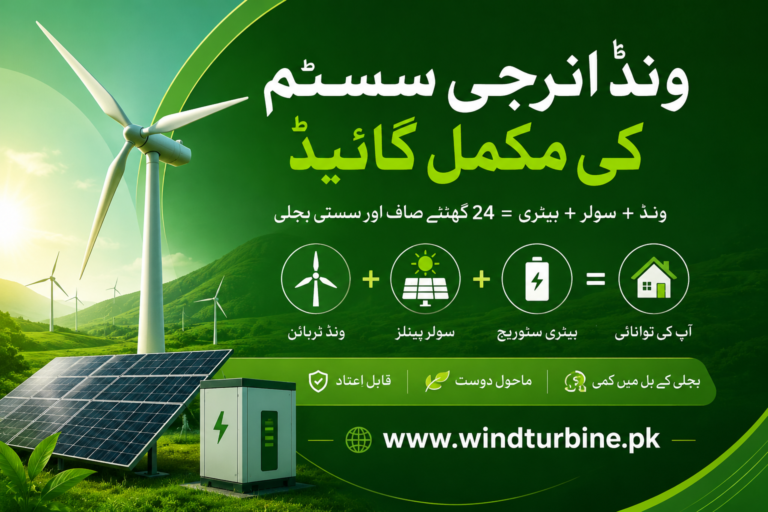
In fact, in many parts of Pakistan a solar + wind hybrid system can make more sense than wind alone.
Solar works mainly during daylight.
Wind can operate:
during cloudy weather, afternoon/evening winds and at night when suitable wind is available.
A typical hybrid system might be:
Solar Panels → Hybrid Inverter
and:
Wind Turbine → Wind Controller → Battery / Compatible Hybrid System
with:
Battery ↔ Hybrid Inverter ↔ House
The exact architecture depends on inverter compatibility.
Can One Inverter Handle Both Solar and Wind?
Some specialized wind-solar hybrid systems can.
But most common Pakistan-market “hybrid solar inverters” have dedicated solar PV MPPT inputs, not native wind-turbine inputs.
So when a seller says:
“This is a hybrid inverter”
remember that “hybrid” often means:
Solar + Battery + Grid
not necessarily:
Solar + Wind
For direct wind input, the datasheet should clearly mention:
wind input, wind MPPT, rectifier, braking or dump-load control.
wind-turbine-hyderabad-pakistan
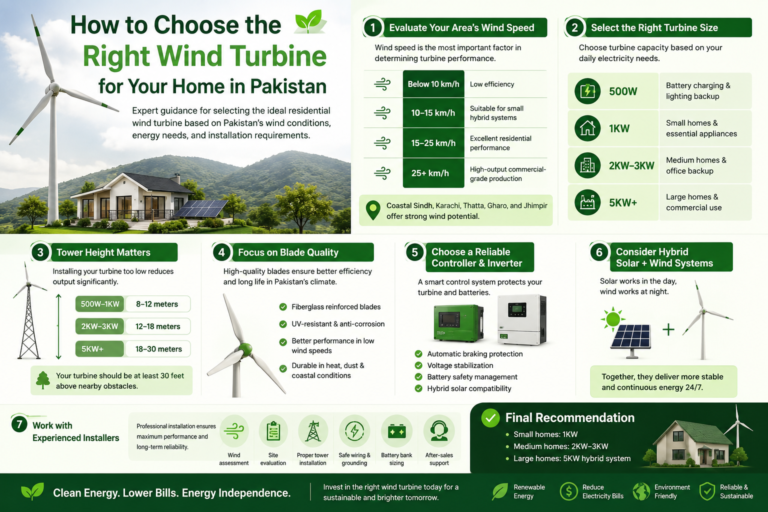
What Size Wind Turbine Is Suitable for a Home?
There is no universal answer.
But these categories give a simple idea:
| Turbine Size | Typical Role |
|---|---|
| 500W | Small batteries, lights, CCTV |
| 1kW | Small home / backup contribution |
| 2kW | Residential hybrid system |
| 3kW | Medium home / farmhouse |
| 5kW | Larger home or farm |
| 10kW | Large property / substantial load |
The correct size depends more on wind resource and annual electricity demand than on house size.
A 10kW turbine installed at a poor site can generate less useful energy than a properly installed 3kW turbine at a good site.
How Much Electricity Can a Wind Turbine Produce?
Suppose a 3kW turbine ran at full rated power for one hour:
That is 3 electricity units.
But it will not normally operate at rated power all day.
This is why annual energy production and capacity factor are important. Wind Turbine in Karachi
What Is Capacity Factor?
Capacity factor compares actual annual energy with the energy the turbine would produce if it ran at full power 24 hours a day.
A 5kW turbine’s theoretical maximum annual production is:
If it actually produces 8,760kWh:
Its capacity factor is approximately 20%.
Capacity factor depends strongly on the wind site and turbine power curve.
Annual kWh Is More Important Than Maximum Watts
For a homeowner, the most useful question is:
How many electricity units will this turbine produce at my location during a year?
Not:
What is the biggest watt number printed on the generator?
Annual energy depends on:
site wind distribution, turbine power curve, tower height, downtime, electrical losses and turbulence.
How Should Wind Speed Be Checked Before Buying?
For initial screening, long-term datasets such as NASA POWER or wind maps can be useful.
But these cannot see every:
house, wall, tree, water tank or local obstruction.
For a significant investment, on-site wind measurement is much better.
The important measurement is wind speed near the planned rotor height, not only at ground level.
If you intend to install the rotor at 20 metres, measurements taken near that height are far more useful than readings taken while standing in your garden.
Why Average Wind Speed Alone Is Not Enough
Imagine two locations.
Both have an average wind speed of 5 m/s.
Location A experiences almost continuous wind near 5 m/s.
Location B is calm for long periods but occasionally gets strong gusts.
Both may have similar averages, but turbine energy production may be different.
For accurate analysis we need a wind-speed distribution combined with the turbine’s power curve.
Wind Direction Also Matters
A horizontal-axis turbine normally turns toward the wind using a yaw or tail system.
But knowing the dominant wind direction helps with site selection.
Suppose the useful wind mostly comes from southwest.
If a large building sits southwest of your turbine, that building may block your most valuable wind.
So site planning should consider both:
wind speed + wind direction
What Is Tip Speed Ratio?
The blade tip travels much faster than the wind itself.
Tip speed ratio compares:
blade-tip speed ÷ wind speed
It is an important design parameter that affects turbine efficiency, noise and rotor behavior.
Homeowners do not normally need to calculate TSR, but it becomes useful when evaluating detailed turbine engineering data.
Why Wind Turbines Make Noise
Wind turbine noise can come from:
air moving over blades, generator, bearings, vibration, tower resonance and turbulence.
A well-balanced turbine in clean wind usually behaves better than a poorly balanced rotor mounted close to a building.
Small turbines should therefore not be selected only by watt rating.
Mechanical quality matters too.
Why Foundation Design Matters
A turbine foundation is not designed only for the weight of the machine.
The wind pushes against:
blades, rotor, nacelle and tower.
This creates an overturning force at the base.
A taller tower can create a much larger bending moment.
Foundation design therefore depends on:
tower height, rotor diameter, turbine thrust, soil strength, foundation type and whether guy wires are used.
A 5kW turbine should not simply be placed on a concrete block designed for a 500W turbine. Wind Turbine Cost
Guy-Wire Tower vs Free-Standing Tower
A guyed tower uses steel cables to support the mast.
A free-standing tower supports itself.
| Guyed Tower | Free-Standing Tower |
|---|---|
| Lower structural cost | Higher cost |
| Smaller central foundation possible | Large foundation usually needed |
| Requires more land | Smaller footprint |
| Guy anchors required | No guy wires |
| Easier tilt-up designs possible | Often needs lifting equipment |
For rural homes and farmhouses, guyed towers can be economical when sufficient space exists.
Earthing and Lightning Protection
A wind-turbine tower is a tall metal structure.
Proper earthing is therefore very important.
The electrical system should be designed with suitable:
earthing, surge protection, circuit protection and lightning protection.
Poor earthing can damage the:
controller, inverter, batteries and other connected equipment.
Coastal Areas Need Corrosion Protection
In Karachi, Gharo, Thatta, Badin and other coastal or near-coastal areas, moisture and salt can accelerate corrosion.
Important items include:
galvanized towers, protected fasteners, coated metal surfaces, weatherproof connectors and sealed bearings.
A turbine may have a claimed long design life, but poor corrosion protection can shorten its practical life significantly.
Maintenance Is Necessary
Wind turbines contain moving parts.
Solar panels have almost no moving parts, but turbines require periodic inspection.
Typical checks include blade condition, bolts, bearings, electrical connectors, tower joints, guy-wire tension, corrosion and braking systems.
Maintenance requirements should be discussed before buying the turbine.
How to Identify an Unrealistic Wind Turbine
Suppose you see this advertisement:
5kW Wind Turbine
Rotor diameter:
1.8 metres
Rated wind:
5 m/s
Before buying it, basic physics should be checked.
A very small rotor cannot capture unlimited energy.
The bigger the claimed output and the smaller the rotor, the more carefully the claim should be examined.
A professional supplier should be willing to provide the turbine’s:
rotor diameter, rated wind speed, complete power curve, rated RPM and test documentation.
What Should a Pakistani Homeowner Check Before Buying?
The most important technical information can be summarized like this:
| Specification | Why It Matters |
|---|---|
| Rated Power | Maximum design output at rated conditions |
| Rated Wind Speed | Tells when rated output occurs |
| Rotor Diameter | Determines swept area |
| Power Curve | Shows real output at different winds |
| Cut-in Wind | When electricity begins |
| Rated RPM | Generator/rotor matching |
| Voltage | Electrical-system compatibility |
| Controller | Manages turbine power |
| Dump Load | Handles excess energy |
| Braking System | Overspeed protection |
| Tower Height | Determines access to better wind |
| Survival Wind | Structural safety |
| Turbine Weight | Tower/installation requirement |
| Battery Voltage | System compatibility |
| Annual Energy | Most useful performance figure |
A Practical Example for Pakistan
Suppose a house uses around:
600 electricity units per month
That equals approximately:
Buying a 5kW turbine does not automatically mean it can provide those 20kWh every day.
First check the site’s wind. Check Nasa Power https://power.larc.nasa.gov/data-access-viewer/
If average wind is poor, solar may produce much more energy per rupee.
If the property has good wind, especially in an open coastal or rural site, solar and wind can complement each other.
A possible system may be: Home Wind Turbine Technical Guide
8–10kW Solar + 2–5kW Wind + Battery
rather than trying to supply the whole house from wind alone.
The exact design must be calculated from the load and the local wind resource.
Which Is More Important: Turbine Size or Location?
Location.
A good turbine installed at a bad site will perform badly.
A properly selected turbine at a strong wind site can perform well.
The order should therefore be:
Check wind → choose tower height → choose rotor/turbine → design electrical system
not:
Buy turbine → then try to find somewhere to install it.
Home Wind Turbine Technical Guide
Final Advice
A home wind turbine can work in Pakistan, but it should be treated as an engineering system rather than a simple electrical appliance.
Do not buy a turbine only because the advertisement says:
1kW, 3kW, 5kW or 10kW.
Understand the wind speed at your property, examine the rotor diameter, request the power curve, choose a suitable tower, and make sure the controller, dump load, inverter and battery are correctly matched. Vertical Wind Turbine
thttps://windturbine.pk/blog/wind-turbine-system-explained-how-a-wind-turbine-works-in-pakistan/
Home Wind Turbine Technical Guide
—