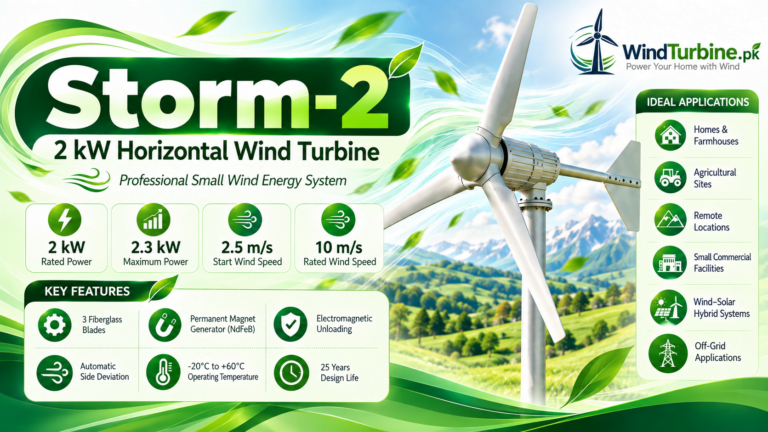
Wind Turbine in DHA Karachi: Cost, Wind Speed & Electricity Output
If you are considering a wind turbine in DHA Karachi, the first question is simple: Does DHA Karachi have enough wind to generate useful electricity? DHA Karachi is one of the most promising areas of Karachi for exploring small-scale wind energy. Just as the Jhimpir–Thatta region is widely recognized as Pakistan’s major wind corridor, DHA’s coastal location makes it an important area to consider for wind power within Karachi.
Does DHA Karachi Have Enough Wind for Electricity? The answer depends on your exact location, turbine height, and surrounding buildings.
DHA Karachi is located along Karachi’s coastal belt, where wind conditions can be attractive for small wind energy systems. However, a wind turbine installed on a rooftop surrounded by buildings may perform very differently from one installed at a higher, open location.
In this guide, we look at wind speed, wind turbine cost, electricity generation, and suitable turbine sizes for DHA Karachi, using authoritative climate and wind-resource information rather than simply assuming that Karachi’s coastal location guarantees strong wind.
Quick Answer: Wind Turbine in DHA Karachi
Here is a quick overview for homeowners and businesses considering a small wind turbine:
| Factor | DHA Karachi Wind Turbine Guide |
|---|---|
| Location | DHA Karachi, Sindh |
| Main data source | NASA POWER |
| Wind data | Regional/modelled wind resource |
| NASA wind heights | 10 m and 50 m |
| Higher turbine height | Wind speed can be adjusted using NASA POWER methodology |
| Best installation | Open, elevated location with minimal obstructions |
| Common small turbine sizes | 500W, 1kW, 2kW, 3kW, 5KW |
| Rooftop installation | Possible, but turbulence must be assessed |
| Battery required | Yes |
| Best approach | Site-specific wind feasibility assessment |
NASA POWER provides meteorological wind data derived from the MERRA-2 assimilation model. NASA also states that its wind-speed data is intended to describe the mean wind flow of a region, and local buildings and topography can change the actual wind experienced at a specific site. https://power.larc.nasa.gov/
What Is the Wind Speed in DHA Karachi?
There is no single wind-speed number that applies to every property in DHA Karachi.
This is important because a wind turbine installed at:
- DHA Phase 1, 2, 3 ,4 DHA Phase 5, DHA Phase 6, DHA Phase 7, DHA Phase 8 may experience different wind conditions depending on the building height, surrounding structures, proximity to the coast, and the height of the turbine.
For a wind turbine project, wind speed at the turbine’s hub height is more useful than a general weather-station reading.
NASA POWER provides wind-speed data at standard elevations including 10 m and 50 m. Its methodology also allows wind speed to be adjusted to a user-defined height between 10 m and 300 m using a wind-profile relationship.
NASA POWER Wind Data: What It Means
| NASA POWER Data | Meaning for Wind Turbine Planning |
|---|---|
| 10 m wind speed | Useful for understanding near-surface regional wind conditions |
| 50 m wind speed | More relevant to elevated wind-resource assessment |
| Custom height | NASA POWER can estimate wind speed at a selected height |
| Actual rooftop wind | Can be different because of buildings and turbulence |
| Exact turbine output | Requires turbine power curve + site wind distribution |
Therefore, NASA POWER data should be treated as a starting point for feasibility, not as a guarantee of the electricity your turbine will produce.
NASA’s own documentation specifically cautions that its wind parameters represent the mean wind flow of a region. Therefore, the data may not fully reflect the effects of buildings, trees, and local topography at a particular site. As a result, actual wind conditions at a specific property can be different from the regional data. For this reason, a site-specific wind assessment is recommended before installing a wind turbine.
Why Wind Speed Matters So Much
Wind turbines do not produce the same amount of electricity at every wind speed.
As wind speed increases, the available energy in the wind increases rapidly. This is why a small increase in average wind speed can have a significant impact on the energy produced by a turbine.
For this reason, you should never select a turbine based only on its advertised capacity.
For example:
A 3kW wind turbine does not produce 3kW all day.
The turbine may be rated at 3kW under specific rated wind conditions. At lower wind speeds, its actual power output can be much lower.
This is why a 1kW turbine installed at a good wind site can sometimes produce more useful energy than a 3kW turbine installed in a turbulent rooftop location.
Wind Turbine Cost in DHA Karachi
The cost of installing a wind turbine in DHA Karachi depends on the turbine capacity and the complete system configuration.
A basic turbine price and the final installed project cost are not necessarily the same.
Estimated Wind Turbine Equipment Prices in DHA
You may find prices of different wind turbines https://windturbine.pk/prices-of-wind-turbine-in-pakistan/
Important: These are indicative equipment price ranges and should not be considered a fixed installed quotation. Prices can change depending on the manufacturer, generator type, controller, exchange rate, tower, and accessories.
The complete project may also require:
| Component | Required? |
|---|---|
| Wind turbine | Yes |
| Wind charge controller | Usually |
| MPPT controller | Depending on system |
| Inverter | Required for AC loads |
| Battery bank | Depends on backup requirements |
| Tower/mounting structure | Can be installed |
| Foundation | Roof top is best but ground-mounted systems are available |
| Guy wires | Depends on tower design |
| Electrical protection | Recommended |
| Installation | Yes |
This means that the total cost of a wind turbine system in DHA Karachi can be considerably higher than the price of the turbine alone.
How Much Electricity Can a Wind Turbine Generate in DHA Karachi?
This is the most important question for anyone planning a wind turbine.
Unfortunately, it is not technically correct to say that a 1kW turbine will always produce a specific number of units per day.
Electricity production depends on:
- Wind speed
- Wind-speed distribution
- Turbine power curve
- Turbine height
- Rotor diameter
- Air density
- Turbine efficiency
- Turbulence
- System downtime
- Controller and inverter losses
Example of Potential Output
The table below provides planning scenarios, not guaranteed production:
| Wind Turbine | Rated Capacity | Example Daily Energy Range* | Example Monthly Range* |
|---|---|---|---|
| 500W | 0.5kW | 1–4 kWh | 30–120 kWh |
| 1kW | 1kW | 2–8 kWh | 60–240 kWh |
| 2kW | 2kW | 4–16 kWh | 120–480 kWh |
| 3kW | 3kW | 6–24 kWh | 180–720 kWh |
*These are illustrative planning ranges based on different capacity factors. They are not a NASA POWER production forecast for every DHA Karachi property.
Actual electricity production should be calculated from the site’s wind-speed distribution and the selected turbine’s power curve.
For this reason, I recommend avoiding claims such as “a 3kW turbine will produce 25 kWh every day in DHA Karachi” unless you have a specific site assessment and turbine power curve to support the calculation.
How much electricity 1KW vertical wind turbine generate? please read this https://windturbine.pk/blog/1kw-vertical-wind-turbine-in-pakistan-urdu/
How to Calculate Wind Turbine Electricity Output
A useful way to estimate annual electricity generation is:
Annual Energy = Rated Capacity × 8,760 hours × Capacity Factor
The actual capacity factor for a turbine in DHA Karachi cannot be accurately determined from the turbine’s rated capacity alone.
To calculate it properly, you need the site’s wind-speed distribution and the turbine’s power curve.
1kW vs 2kW vs 3kW Wind Turbine for DHA Karachi
The right turbine size depends on both your electricity consumption and your site’s wind resource.
| Turbine | Best For | Space Requirement | Wind Resource Requirement |
|---|---|---|---|
| 500W | Small backup loads | Low | Lower than larger systems, but still needs suitable wind |
| 1kW | Basic residential backup | Moderate | Good wind exposure recommended |
| 2kW | Larger home loads | Higher | Stronger and cleaner wind preferred |
| 3kW | Large homes/small business | Higher | Good wind resource strongly recommended |
A common mistake is to choose a 3kW turbine simply because it produces more power on paper.
If the turbine is installed in turbulent wind behind buildings, its real-world energy production may be much lower than expected.
Rooftop Wind Turbine in DHA Karachi
A rooftop wind turbine may look like an attractive option because it does not require a large plot of land.
However, rooftop installation has one major challenge:
Turbulence
When wind passes over and around buildings, it becomes disturbed and turbulent.
This can cause:
- Lower energy production
- Unstable turbine operation
- Increased vibration
- Additional mechanical stress
- More noise
- Reduced turbine lifespan
Therefore, a rooftop wind turbine should not simply be installed at the highest available point without evaluating the airflow.
Rooftop vs Ground Installation
| Factor | Rooftop Turbine | Ground-Mounted Turbine |
|---|---|---|
| Land required | Low | Higher |
| Installation | Easier in some cases | Requires foundation |
| Turbulence | Potentially high | Usually easier to control |
| Maintenance | Roof access required | Easier if accessible |
| Structural assessment | Very important | Foundation assessment required |
| Wind exposure | Depends on building | Depends on tower height |
| Noise | More noticeable | Can be easier to isolate |
For many DHA Karachi properties, a properly designed tower installation may provide cleaner airflow than a low rooftop installation.
However, the correct solution depends on the property.
Can a Wind Turbine Work With Solar Panels?
Yes.
For a DHA Karachi home, a solar-wind hybrid system may be worth considering if both resources are suitable.
A typical system could include:
Solar Panels → Hybrid Inverter → Battery
plus:
Wind Turbine → Wind Controller → Hybrid Inverter/Battery
The advantage is that solar and wind can complement each other.
| System | Main Energy Source | Best Use |
|---|---|---|
| Solar only | Sunlight | Daytime generation |
| Wind only | Wind | Suitable windy sites |
| Solar + Wind | Sun + Wind | More diversified renewable generation |
| Solar + Wind + Battery | Sun + Wind + Storage | Backup and energy independence |
However, adding a wind turbine does not automatically make a system more economical.
If the actual wind resource at your property is poor, solar alone may be the better investment.
Can You Install a Wind Turbine Without Batteries?
Yes, but the answer depends on the system architecture.
A wind turbine produces variable electricity because wind speed changes continuously.
A system without batteries may be possible when the turbine is connected to a suitable grid-tied or hybrid configuration, subject to the applicable electrical and grid-connection requirements.
For an off-grid backup system, batteries are generally needed to store electricity for periods when the wind turbine is not producing enough power.
Common Wind System Configurations
| System | Battery | Suitable For |
|---|---|---|
| Wind + Controller + Battery + Inverter | Yes | Off-grid/backup |
| Wind + Hybrid Inverter | Depends | Hybrid systems |
| Wind + Solar + Battery | Yes | Renewable hybrid backup |
| Grid-connected wind | Not necessarily | Requires compatible equipment and applicable approvals |
The inverter and controller must be compatible with the turbine’s voltage, output characteristics, and operating requirements.
How to Check Wind Turbine Feasibility in DHA Karachi
Before purchasing a turbine, the most important step is a wind feasibility assessment.
A good assessment should consider both regional data and the actual installation site.
https://windturbine.pk/blog/
Step 1: Check NASA POWER Data
NASA POWER provides wind data at different temporal scales, including hourly, daily, monthly, and climatological data. Its meteorological data is derived from the MERRA-2 assimilation model.
https://power.larc.nasa.gov/parameters/
Step 2: Check Wind Height
Compare the available wind resource at 10m and 50m, or estimate the wind speed at the proposed turbine height using an appropriate wind-profile model.
NASA POWER supports custom wind-height calculations between 10m and 300m.
Step 3: Inspect the Property
Check:
- Building height
- Nearby buildings
- Trees
- Water tanks
- Boundary walls
- Rooftop structures
- Distance from the coastline
- Proposed tower height
Step 4: Select the Turbine
Choose a turbine based on its:
- Power curve
- Cut-in wind speed
- Rated wind speed
- Rotor diameter
- Generator type
- Voltage
- Controller compatibility
Step 5: Estimate Electricity Production
Combine the site’s wind-speed distribution with the turbine’s power curve. This produces a much more realistic estimate than simply multiplying the turbine’s rated capacity by 24 hours.
https://windturbine.pk/prices-of-wind-turbine-in-pakistan/
NASA POWER vs Pakistan Meteorological Department Data
For a serious wind-energy assessment, both international modelled datasets and local observations can be valuable.
NASA POWER provides globally available analysis-ready meteorological data and allows users to obtain wind data for specific coordinates.
Pakistan’s Climate Data Processing Centre (CDPC) operates under the Pakistan Meteorological Department and is responsible for storing, processing, retrieving, and supplying climatological and meteorological data. The centre’s data is used for applications including energy, engineering, construction, and other sectors.https://weather.gov.pk/cdpc
For a commercial-scale project, local measured data from a nearby meteorological station or an on-site measurement campaign can provide valuable validation.
For a residential wind turbine in DHA Karachi, a practical approach is to use NASA POWER for initial feasibility and then evaluate the actual property conditions before finalizing the turbine.
Final Verdict: Is a Wind Turbine Worth It in DHA Karachi?
A wind turbine in DHA Karachi is feasible, but the answer depends on the individual property, you need site survey first. To book a site survey contact https://windturbine.pk/contact/
The coastal location is promising, but coastal location alone is not enough to guarantee good electricity production.
The most important factors are:
- Wind speed at turbine height
- Wind-speed distribution throughout the year
- Building-related turbulence
- Turbine power curve
- Rotor size
- Tower height
- Installation quality
For homeowners, a 1kW to 5kW turbine may be considered for small-scale applications, but the turbine should be selected only after assessing the site’s wind resource.
Our Recommendation
If you are planning a wind turbine in DHA Karachi, Check the wind resource first.
Use NASA POWER data to understand the regional wind conditions, then evaluate your specific rooftop or property. If the site has suitable wind exposure, select the turbine based on its power curve and calculate the expected annual electricity generation.
For the most accurate result, a site-specific wind feasibility assessment is recommended before investing in a wind turbine.
Frequently Asked Questions
What is the wind speed in DHA Karachi?
Wind speed varies across DHA Karachi and throughout the year. actual rooftop wind can differ because of buildings and local turbulence.
How much does a wind turbine cost in DHA Karachi?
Please see price pages.
How much electricity does a 1kW wind turbine produce?
There is no fixed output. A 1kW turbine’s production depends on the site’s wind-speed distribution and the turbine’s power curve. A 20% capacity-factor example would produce about 1,752 kWh per year, but the actual capacity factor must be calculated for the specific site.
Is rooftop wind turbine installation possible in DHA Karachi?
Yes, but rooftop turbulence and structural strength must be carefully evaluated. A rooftop turbine should not be selected solely based on the available roof space.
Is solar better than wind in DHA Karachi?
It depends on the property. Solar is generally easier to deploy, while wind may provide additional generation where wind exposure is genuinely strong. A solar-wind hybrid system can be considered after evaluating both resources.
Should I install a 1kW, 2kW, or 3kW turbine?
The correct size depends on your electricity consumption and the wind resource at your property. A site assessment and load analysis should be completed before choosing the turbine.
Data Sources
- NASA POWER: Global meteorological and renewable-energy resource data.
- NASA POWER Wind Methodology: Wind speed and height adjustment methodology.
- Pakistan Meteorological Department – Climate Data Processing Centre: Official Pakistani meteorological and climatological data services.
For wind-resource assessment, NASA POWER and Pakistan Meteorological Department’s