2 kW Wind Turbine in Pakistan: Price, Wind-Speed Analysis, Output and Complete Buying Guide
A 2 kW wind turbine can be a useful renewable-energy source for homes, farmhouses, agricultural sites, shops and remote facilities in Pakistan. However, its success depends much more on the actual wind available at the installation height than on the “2,000 W” rating printed on the turbine.
This distinction is especially important in Pakistan. A turbine installed at an open coastal site near Karachi may perform reasonably well, while the same machine placed on a low roof between buildings may generate very little electricity. Hyderabad also has promising wind conditions, particularly during the warmer and monsoon months, but local buildings, tower height and seasonal variation must still be considered.
This guide explains:
- Real wind conditions in Karachi and Hyderabad Wind Turbine in Hyderabad
- Realistic output at different wind speeds
- Expected monthly and annual electricity generation
- 2 kW wind turbine price in Pakistan
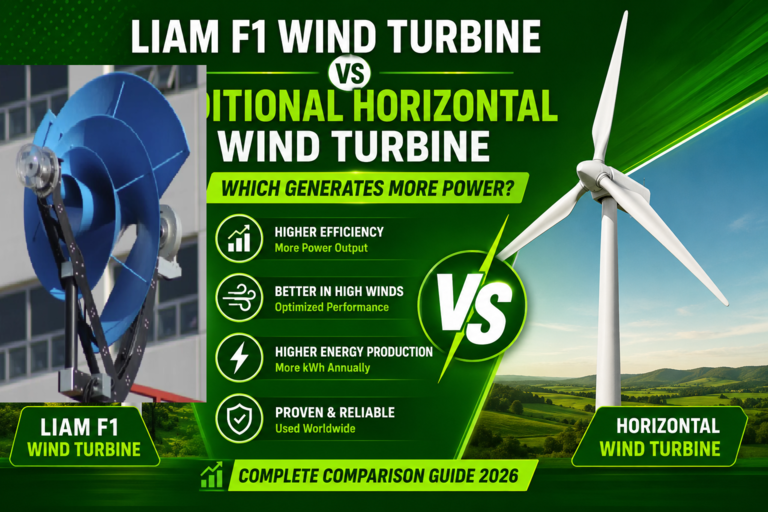
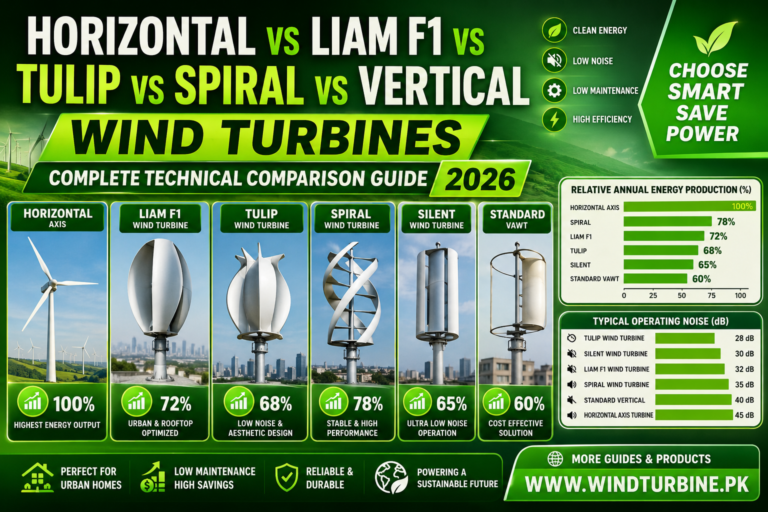
- Horizontal versus vertical turbines
- Tower and installation requirements
- Solar-system integration
- Lithium-battery charging
- Inverter and controller selection
- Maintenance, safety and return on investment
What Is a 2 kW Wind Turbine?
A 2 kW wind turbine is designed to deliver a maximum rated electrical output of approximately:
2 kW = 2,000 watts
But this output is normally achieved only at the manufacturer’s rated wind speed, commonly somewhere around 10–13 m/s.
A 2 kW turbine does not continuously produce 2,000 watts.
At lower wind speeds, the output may be only a small fraction of its rated capacity. For example, depending on the rotor size and power curve, a nominal 2 kW turbine may produce:
- Almost nothing below its cut-in speed Wind Turbine Price in Pakistan
- A few hundred watts at moderate wind
- Around 1 kW only at fairly strong wind
- Full 2 kW output close to its rated wind speed
For this reason, buyers should compare the turbine’s power curve and annual energy production, not only its rated wattage.
Is Pakistan Suitable for Small Wind Turbines?
Pakistan has a very uneven wind resource.
Some of the best wind areas are found in:
- Karachi’s exposed coastal belt
- Port Qasim and Bin Qasim
- Gharo
- Jhimpir
- Thatta
- Keti Bandar
- Badin
- Hyderabad and Jamshoro
- Coastal Balochistan
- Gwadar and surrounding coastal locations
- Open agricultural and elevated sites in other provinces
The Global Wind Atlas identifies southern Sindh and Pakistan’s coastal corridor as the country’s strongest wind region. However, wind maps are intended mainly for preliminary site screening. They cannot replace measurements taken at the actual tower location. (Global Wind Atlas)
A small home turbine is much more sensitive to local obstructions than a large commercial turbine. Trees, boundary walls, water tanks, neighbouring houses and high-rise buildings can all cause turbulence and reduce energy production.
Karachi Wind Speed: What the Available Data Shows
Karachi should not be treated as one single wind location. Conditions vary considerably between:
- Coastal and inland neighbourhoods
- Open and densely built-up areas
- Low roofs and tall towers
- Sea-facing and obstructed sites
Wind Turbine in Pakistan
Hawksbay, Karachi
A study using wind measurements from Hawksbay reported a yearly mean wind speed of approximately 5.9 m/s at 80 metres. It also reported lower average wind speeds closer to the ground, demonstrating the importance of tower height. The study recorded monthly 10-metre wind speeds above 6 m/s during some summer months, while winter values were closer to 3–4 m/s. (Academia)
Selected Hawksbay measurements
| Period | Wind speed at 10 m | Wind speed at 30 m | Wind speed at 60 m | Wind speed at 80 m |
|---|---|---|---|---|
| April | 5.04 m/s | 5.48 m/s | 6.00 m/s | 6.22 m/s |
| June | 5.88 m/s | 6.25 m/s | 6.68 m/s | 6.85 m/s |
| July | 6.33 m/s | 6.83 m/s | 7.39 m/s | 7.64 m/s |
| October | 3.57 m/s | 3.94 m/s | 4.35 m/s | 4.52 m/s |
| January | 3.21 m/s | 3.77 m/s | 4.27 m/s | 4.45 m/s |
| May | 6.58 m/s | 7.04 m/s | 7.66 m/s | 7.93 m/s |
These figures illustrate two important points:
- Karachi’s wind is generally stronger during late spring, summer and the monsoon season.
- Wind speed increases significantly with installation height.
Even a difference of 1 m/s can have a large effect because the power available in wind increases approximately with the cube of wind speed.
Paradise Point and exposed coastal Karachi
A separate coastal analysis near Paradise Point found average annual wind speeds above 7 m/s at 30 metres and around 9 m/s at 61 metres at the studied site. These values represent an exposed coastal location and should not be applied to central Karachi or a typical residential rooftop. (ResearchGate)
What this means for Karachi homeowners
A realistic preliminary classification is:
| Karachi site type | Likely small-wind suitability |
|---|---|
| Open coastal plot with tall tower | Good to very good |
| Farmhouse near coast or Port Qasim | Good |
| Open industrial site | Moderate to good |
| Sea-facing detached home with clear exposure | Potentially suitable |
| Low rooftop surrounded by similar-height homes | Marginal |
| Dense commercial or high-rise area | good need a proper tower |
| Roof behind water tanks and parapet walls | Poor |
Karachi may be windy at street level during the afternoon, but a useful wind-energy site requires clean, non-turbulent airflow for many hours over the year.
Hyderabad Wind Speed and Wind-Energy Potential
Hyderabad is inland compared with Karachi, but it lies close to the wider Sindh wind corridor. Its wind pattern is strongly seasonal.
A peer-reviewed wind-resource study for Hyderabad reported:
- Annual average wind speed of approximately 6.2 m/s
- Wind speeds above 6 m/s over much of the analysed period
- Stronger conditions during spring and summer
- Annual wind power density above approximately 255 W/m²
- Annual wind energy density above approximately 2,245 kWh/m²
The study used measured data and statistical wind-distribution analysis for the Hyderabad area. (ResearchGate)
Important warning about the Hyderabad data
These results demonstrate that Hyderabad has genuine wind potential, but they do not guarantee that every residential roof receives an annual average of 6.2 m/s.
The measured or analysed height, surrounding terrain and exact station location may differ from a customer’s property. A turbine mounted only a few metres above a turbulent rooftop may experience much lower effective wind than the regional study suggests.
Karachi versus Hyderabad
| Factor | Karachi | Hyderabad |
|---|---|---|
| Main wind influence | Arabian Sea breeze | Inland seasonal and regional wind flow |
| Strongest period | April to September | Spring, summer and monsoon period |
| Coastal advantage | Strong in exposed areas | No direct coastline |
| Urban turbulence risk | Very high in dense areas | High in built-up areas |
| Best installation | Open coastal site or tall tower | Open land, outskirts or tall unobstructed tower |
| Winter performance | Often lower | Often lower |
| 2 kW turbine potential | Good | Good |
| Site survey requirement | Essential | Essential |
Karachi has the advantage of regular sea-breeze circulation, particularly close to the coast. Hyderabad can also have good average wind, but its site performance may depend more strongly on season, openness and local terrain.
Why Wind Speed Matters More Than Turbine Rating
The theoretical power in wind is expressed as:
[
P = \frac{1}{2}\rho A V^3
]
Where:
- (P) = power available in the wind
- (\rho) = air density
- (A) = rotor swept area
- (V) = wind speed
The most important term is (V^3), meaning wind speed is cubed.
For example:
- Doubling the wind speed does not double available power.
- In theory, doubling wind speed increases available wind power by eight times.
A real turbine cannot capture all that energy. Losses occur through:
- Blade aerodynamics
- Generator efficiency
- Bearings
- Rectification
- Controller
- Inverter
- Cables
- Battery charging
Therefore, rotor size and power curve are critical.
Estimated Output of a Typical 2 kW Wind Turbine by Wind Speed
The following table is an illustrative engineering estimate, not a manufacturer-specific guarantee.
It assumes:
- Cut-in speed around 3 m/s
- Rated output of 2,000 W around 12 m/s
- Gradual cubic-style output increase between cut-in and rated speed
- No severe turbulence or controller limiting
- A reasonably designed horizontal-axis turbine
| Wind speed | Approximate instantaneous output | Energy in one hour at that speed |
|---|---|---|
| Below 3 m/s | 0 W or negligible | 0 kWh |
| 3 m/s | Near 0 W | Near 0 kWh |
| 4 m/s | About 40–100 W | 0.04–0.10 kWh |
| 5 m/s | About 100–250 W | 0.10–0.25 kWh |
| 6 m/s | About 220–450 W | 0.22–0.45 kWh |
| 7 m/s | About 370–700 W | 0.37–0.70 kWh |
| 8 m/s | About 570–1,000 W | 0.57–1.00 kWh |
| 9 m/s | About 825–1,300 W | 0.83–1.30 kWh |
| 10 m/s | About 1,140–1,600 W | 1.14–1.60 kWh |
| 11 m/s | About 1,530–1,900 W | 1.53–1.90 kWh |
| 12 m/s | Around 2,000 W | Around 2.0 kWh |
| Above rated speed | Usually limited near rated output | Controller-dependent |
Actual power can differ substantially because turbine power curves vary. A large-rotor, low-speed 2 kW turbine may produce more at 5–7 m/s than a small-rotor turbine that is marketed with the same 2 kW rating.
Why You Cannot Multiply Average Wind Speed by 24 Hours
Suppose the annual average wind speed is 6 m/s. It would be incorrect to assume:
Turbine output at 6 m/s × 24 hours × 365 days
Wind changes throughout the day. Some hours may be:
- Below cut-in speed
- Between 4 and 6 m/s
- Between 7 and 10 m/s
- At very high speeds for a short period
Because power depends on the cube of wind speed, two sites with the same average speed can produce different annual energy if their wind-speed distributions differ.
Professional energy estimates therefore require:
- Hourly or ten-minute wind data
- Weibull distribution
- Turbine-specific power curve
- Tower height
- Air density
- Turbulence losses
- Electrical losses
- System availability
Realistic Daily, Monthly and Annual Output
A useful way to estimate annual production is through the capacity factor.
[
Annual\ Energy = Rated\ Power \times 8760 \times Capacity\ Factor
]
For a 2 kW turbine:
[
2 \times 8760 = 17,520\ kWh
]
This 17,520 kWh figure represents the impossible practical scenario of the turbine producing full 2 kW output every hour of the year.
Real annual output is a fraction of this.
Estimated generation by capacity factor
| Capacity factor | Annual energy | Monthly average | Daily average |
|---|---|---|---|
| 5% | 876 kWh | 73 kWh | 2.4 kWh |
| 10% | 1,752 kWh | 146 kWh | 4.8 kWh |
| 15% | 2,628 kWh | 219 kWh | 7.2 kWh |
| 20% | 3,504 kWh | 292 kWh | 9.6 kWh |
| 25% | 4,380 kWh | 365 kWh | 12.0 kWh |
| 30% | 5,256 kWh | 438 kWh | 14.4 kWh |
Realistic interpretation for Pakistan
| Site quality | Possible capacity-factor range | Estimated annual output |
|---|---|---|
| Poor turbulent rooftop | 2–7% | 350–1,225 kWh |
| Average open residential site | 7–12% | 1,225–2,100 kWh |
| Good open site | 12–20% | 2,100–3,500 kWh |
| Strong exposed coastal site | 20–28% | 3,500–4,900 kWh |
| Exceptional professionally assessed site | Above 28% possible | More than 4,900 kWh |
These are planning ranges, not guarantees. A proper estimate should use the exact turbine’s power curve and at least several months of measured site data, ideally adjusted against a long-term reference.
NASA POWER also cautions that modelled wind data represents the mean wind flow of a broader region and does not capture detailed effects from buildings and local topography. (POWER)
Estimated Output in Karachi
Typical obstructed Karachi rooftop
Assumptions:
- Turbine mounted only slightly above the roof
- Nearby houses and water tanks
- Turbulent wind
- Effective capacity factor: Wind Turbine in Thatta
| Period | Estimated generation |
|---|---|
| Daily average | 2.4–4.8 kWh |
| Monthly average | 73–146 kWh |
| Annual estimate | 876–1,752 kWh |
At such a site, the cost of tower, turbine and electronics may not be justified.
Good Karachi residential or farmhouse site
Assumptions:
- Open exposure
- Tall tower
- Coastal or outskirts location
- Effective capacity factor: 12–20%
| Period | Estimated generation |
|---|---|
| Daily average | 7.2–9.6 kWh |
| Monthly average | 219–292 kWh |
| Annual estimate | 2,628–3,504 kWh |
Strong exposed coastal site
Assumptions:
- Consistent coastal wind
- Correct tower height
- Minimal obstruction
- Quality turbine with suitable rotor diameter
- Capacity factor: 20–28%
| Period | Estimated generation |
|---|---|
| Daily average | 9.6–13.4 kWh |
| Monthly average | 292–409 kWh |
| Annual estimate | 3,504–4,906 kWh |
Estimated Output in Hyderabad
For open Hyderabad sites, the measured regional wind potential is encouraging, but a home turbine should still be assessed locally.
Built-up Hyderabad rooftop
| Period | Estimated generation |
|---|---|
| Daily average | 2.4–5.8 kWh |
| Monthly average | 73–175 kWh |
| Annual estimate | 876–2,100 kWh |
Open site or city outskirts
| Period | Estimated generation |
|---|---|
| Daily average | 7.2–10.8 kWh |
| Monthly average | 219–329 kWh |
| Annual estimate | 2,628–3,942 kWh |
Strong open agricultural site
Where local measured wind is close to the Hyderabad study values and the turbine is installed high enough, production may reach the upper part of the range. But this should be confirmed through measurement rather than assumed from city-level data.
Seasonal Output in Karachi and Hyderabad
Both cities generally have stronger output during the warmer months. Small Wind Turbine
| Season | Karachi expectation | Hyderabad expectation |
|---|---|---|
| December–February | Low to moderate | Low to moderate |
| March–April | Improving | Improving rapidly |
| May–August | Strongest period | Strongest period |
| September | Moderate to strong | Moderate |
| October–November | Lower | Lower |
A wind turbine may therefore complement solar well during:
- Windy summer afternoons
- Monsoon weather
- Cloudy but windy days
- Evening sea-breeze periods in Karachi
- Night-time windy periods
However, it should not be assumed that a turbine will generate meaningful power every night.
2 kW Wind Turbine Price in Pakistan
Wind Turbine price in Pakistan visit Wind Turbine Price list
Indicative 2026 price ranges
A cheap turbine may appear attractive but may have:
- Small rotor diameter
- High rated wind speed
- Weak braking system
- Poor controller
- No proper dump load
- Short blade life
- Inaccurate power claims
- No local spare parts
What Should a Genuine 2 kW Turbine Look Like?
Rotor diameter is one of the most important specifications.
A turbine cannot produce meaningful energy without sweeping enough air.
Recommended questions before buying
Ask the supplier for:
- Rotor diameter
- Blade length
- Cut-in wind speed
- Rated wind speed
- Complete power curve
- Annual energy estimate at 4, 5, 6 and 7 m/s
- Generator voltage
- Maximum safe wind speed
- Braking system
- Controller and dump-load specifications
- Turbine weight
- Tower requirement
- Warranty
- Bearing and blade replacement availability
- Test certification
A 2 kW label alone is not enough.
Horizontal or Vertical 2 kW Turbine?
Horizontal-axis wind turbine
A horizontal-axis wind turbine usually has two, three or five blades rotating like a conventional windmill.
Advantages
- Generally higher aerodynamic efficiency
- Better energy production per square metre of swept area
- Mature and proven design
- More likely to have a documented power curve
- Usually better for open sites and towers
Disadvantages
- Must face the wind
- Requires a yaw or tail system
- Can experience vibration in turbulent wind
- Needs adequate clearance
Vertical-axis wind turbine
A vertical-axis turbine rotates around a vertical shaft.
Advantages
- Accepts wind from different directions
- No conventional tail-yaw mechanism required
- Can have a visually compact design
- Generator may be positioned closer to the base in some designs
Disadvantages
- Many small models have lower real efficiency
- Marketing claims are often optimistic
- Some have poor self-starting performance
- A rooftop location does not automatically make them suitable
- Rated output may require unusually high wind
Recommendation for Pakistan
For an open farmhouse, agricultural site, coastal plot or properly designed tower, a quality horizontal-axis turbine is generally the safer choice for maximum annual energy.
A vertical turbine should be selected only when the supplier provides:
- Verified power curve
- Rotor dimensions
- Tested annual energy output
- Structural calculations
- Proven controller and braking system
Can a 2 kW Wind Turbine Be Connected to Solar?
Yes. A 2 kW wind turbine can be combined with solar panels, but it normally cannot simply be connected to the solar-panel input of an ordinary inverter.
Solar and wind behave differently.
Solar panels produce relatively stable DC electricity. A wind generator produces variable voltage and frequency depending on rotor speed.
A proper hybrid system normally uses:
- Wind turbine
- Wind rectifier
- Wind MPPT or charge controller
- Dump load
- Battery bank or wind-compatible DC bus
- Solar MPPT
- Hybrid inverter
- AC and DC protection
- Earthing and lightning protection
Typical hybrid layout
Solar panels → Solar MPPT → Battery/DC bus
Wind turbine → Rectifier → Wind controller → Battery/DC bus
Battery/DC bus → Hybrid inverter → Household loads
The wind and solar controllers can charge the same battery bank if:
- Both are configured for the same nominal voltage
- Their charging limits are compatible
- The battery BMS permits the combined charge current
- The controllers do not exceed the battery’s maximum voltage
- A proper dump-load and braking strategy is installed
Can It Be Connected to an Existing Solar Inverter?
Sometimes, but not always.
There are three common arrangements. Wind Turbine with Solar System
1. Separate wind controller connected to the battery
This is often the most practical arrangement for off-grid or hybrid homes.
The solar inverter continues managing the solar panels and household loads. A separate wind controller charges the same battery bank.
Compatibility must be checked carefully.
2. Wind input on a purpose-built hybrid inverter
Some inverters are specifically designed for:
- Solar
- Wind
- Battery
- Grid
- Generator
These are less common than solar-only hybrid inverters.
3. AC-coupled wind inverter
The turbine feeds a dedicated wind inverter, which supplies AC to the building or grid.
This arrangement requires proper:
- Grid synchronisation
- Anti-islanding protection
- Utility approval
- Electrical design https://windturbine.pk/
Do not connect the turbine directly to a normal PV input unless the inverter manufacturer explicitly supports wind input.
Can a 2 kW Wind Turbine Charge a Lithium Battery?
Yes, provided the correct controller and battery settings are used.
The most suitable chemistry for modern home systems is normally:
LiFePO₄ — lithium iron phosphate
Common nominal voltages include:
- 24 V
- 48 V
- 51.2 V
For a 2 kW system, a 48 V or 51.2 V arrangement is generally preferable.
Current at different battery voltages
Ignoring losses:
| Battery-system voltage | Approximate current at 2 kW |
|---|---|
| 12 V | 167 A |
| 24 V | 83 A |
| 48 V | 42 A |
| 51.2 V | 39 A |
A 12 V 2 kW wind system would require extremely high current and very thick cables. A 48 V or 51.2 V system is more practical.
Charging a 51.2 V LiFePO₄ Battery
A 51.2 V battery normally contains 16 LiFePO₄ cells in series.
The wind controller must be configured according to the battery manufacturer’s charging limits.
A typical system may involve:
- Nominal voltage: 51.2 V
- Maximum charge voltage commonly around 56–58.4 V, depending on the battery
- BMS-controlled charge-current limit
- Wind-controller overvoltage protection
- Dump load or braking when the battery stops accepting charge
The exact voltage must come from the battery manufacturer. It should not be guessed.
Why a dump load is essential
A solar panel can be disconnected from a full battery without creating a mechanical overspeed problem.
A wind turbine is different.
If the battery becomes full and the electrical load disappears, the rotor may accelerate. The controller must direct surplus energy to a dump load or activate an appropriate braking system.
A suitable wind system should include:
- Diversion or dump-load controller
- Resistive dump-load bank
- Electrical brake
- Mechanical brake where applicable
- Overvoltage protection
- Emergency stop
Suggested Battery Size
The turbine size does not directly determine the battery size. Battery capacity depends on:
- Daily household demand
- Solar capacity
- Backup duration
- Maximum charging current
- Depth of discharge
- Battery BMS rating
Examples
| Battery | Nominal stored energy | Practical use |
|---|---|---|
| 51.2 V, 100 Ah | 5.12 kWh | Small backup system |
| 51.2 V, 200 Ah | 10.24 kWh | Medium home system |
| 51.2 V, 300 Ah | 15.36 kWh | Larger hybrid system |
| 51.2 V, 400 Ah | 20.48 kWh | High-consumption home or farmhouse |
A 2 kW turbine producing 8 kWh in a windy day could theoretically add approximately 8 kWh before charging losses and household consumption.
What Appliances Can a 2 kW Wind Turbine Support?
The turbine does not directly decide which appliances can run. The inverter and battery determine the instantaneous load capability.
A 2 kW wind turbine can contribute energy for:
- LED lighting
- Ceiling fans
- Refrigerator
- Deep freezer
- Television
- Wi-Fi equipment
- Computers
- CCTV
- Small water pump
- Washing machine
- Selected office loads
It may contribute energy toward an air conditioner, but the turbine alone cannot be expected to start and continuously run a large AC unless:
- Wind is strong enough
- The battery is adequately charged
- The inverter has sufficient surge rating
- Solar or grid support is available
Example household load
| Appliance | Power | Daily operating time | Daily energy |
|---|---|---|---|
| 5 fans | 350 W | 8 hours | 2.8 kWh |
| 10 LED lights | 100 W | 6 hours | 0.6 kWh |
| Refrigerator | Average 120 W | Equivalent 10 hours | 1.2 kWh |
| Television | 100 W | 4 hours | 0.4 kWh |
| Wi-Fi and CCTV | 60 W | 24 hours | 1.44 kWh |
| Laptop and charging | 100 W | 4 hours | 0.4 kWh |
| Total | 6.84 kWh/day |
A well-performing 2 kW turbine could cover a meaningful part of this energy, but a poor site may produce less than half of it.
Tower Height for a 2 kW Wind Turbine
A good turbine on a poor tower is still a poor system.
For most 2 kW installations, a practical tower may be:
- 9–12 m for an open rural site
- 12–18 m where nearby obstacles exist
- Higher where engineering and local conditions require it
A commonly used wind-siting principle is to keep the rotor well above nearby obstructions. The exact height must be decided through structural and wind assessment.
Why rooftops are problematic
Wind striking a building separates around:
- Roof edges
- Parapet walls
- Water tanks
- Stair rooms
- Solar-panel frames
This creates:
- Eddies
- Direction changes
- Rapid gusts
- Vibration
- Uneven blade loading
Turbulence reduces energy and increases fatigue.
A free-standing ground tower is usually preferable to a low rooftop pole.
Guyed Tower or Free-Standing Tower?
Guyed tower
Advantages:
- Lower steel cost
- Easier to raise and lower
- Suitable for open land
- Good for maintenance
Disadvantages:
- Requires space for guy anchors
- Guy wires create access restrictions
- Anchor design is critical
Free-standing tower
Advantages:
- Requires less surrounding space
- Cleaner appearance
- Suitable for commercial sites
Disadvantages:
- Higher cost
- Larger foundation
- More demanding structural design
For a 2 kW farmhouse system, a hinged guyed tower is often economical.
Foundation and Structural Safety
Tower design must account for:
- Turbine weight
- Rotor thrust
- Tower weight
- Wind gusts
- Vibration
- Soil bearing capacity
- Guy-wire tension
- Corrosion
- Fatigue
- Earthquake loads where applicable
For Karachi’s coastal environment, corrosion protection is particularly important.
Recommended measures include:
- Hot-dip galvanised steel
- Marine-grade coating where needed
- Stainless or protected fasteners
- Sealed electrical connectors
- Regular corrosion inspection
A turbine should not be attached to an ordinary water-tank frame or an unverified rooftop column.
Controller, Inverter and Dump Load
Wind controller
The controller normally performs some or all of the following:
- Rectifies three-phase AC into DC
- Regulates output
- Charges the battery
- Limits voltage
- Activates the dump load
- Applies electrical braking
- Displays turbine voltage, current and power
- Records energy generation
Inverter
The inverter converts battery DC into household AC.
For Pakistan, this will normally be:
- 230 V
- 50 Hz
- Pure sine wave
The inverter rating depends on the household load, not only on turbine size.
A 2 kW turbine can be connected to:
- 3 kW inverter
- 5 kW inverter
- 8 kW inverter
- Larger hybrid inverter
provided the DC-bus and battery configuration are compatible.
Dump load
The dump load absorbs excess turbine energy when:
- Battery is full
- Inverter is not accepting power
- Grid fails in certain grid-connected systems
- Controller voltage reaches its limit
Its continuous and peak rating must match the turbine and controller.
Cable Sizing and Voltage Drop
Long low-voltage cable runs can waste significant energy.
Approximate generator current at 2 kW:
| System voltage | Current before losses |
|---|---|
| 24 V | 83 A |
| 48 V | 42 A |
| 96 V | 21 A |
| 220 V | 9 A |
Higher transmission voltage reduces cable current and losses, but requires correctly rated equipment and stricter electrical safety.
Cable size must be calculated from:
- Maximum current
- Cable length
- Permissible voltage drop
- Installation method
- Ambient temperature
- Conductor material
- Protection-device rating
Earthing and Lightning Protection
A complete wind system should include:
- Tower earthing
- Equipment earthing
- Surge protective devices
- Lightning down-conductor where required
- Proper earth electrodes
- AC protection
- DC protection
- Isolators
- Emergency stop
Karachi’s salt and humidity can deteriorate poor connections quickly, while open towers are exposed to lightning and surge risk.
Maintenance Requirements
A 2 kW turbine requires more mechanical maintenance than solar panels.
Monthly visual inspection
Check:
- Unusual noise
- Blade condition
- Tower movement
- Loose cables
- Controller alarms
Every three to six months
Check:
- Tower bolts
- Guy-wire tension
- Blade bolts
- Earthing
- Corrosion
- Cable glands
- Braking system
- Dump-load operation
Annual inspection
Check:
- Bearings
- Blade balance
- Generator
- Slip rings, where used
- Tower welds
- Foundation cracks
- Electrical terminations
- Insulation resistance
- Controller data and fault history
Maintenance frequency may need to be higher near the Karachi coast because of salt corrosion.
Expected Lifespan
A quality small wind turbine may have a design life of around 15–20 years, but individual components may need earlier replacement.
| Component | Possible service interval |
|---|---|
| Blades | Inspection throughout life |
| Bearings | May require replacement during turbine life |
| Controller | Depends on heat, dust and electrical quality |
| Inverter | Commonly shorter life than the tower |
| Dump load | Long life if correctly sized |
| Battery | Depends heavily on chemistry and cycling |
| Tower coating | Periodic maintenance required |
A warranty should clearly state which components are covered.
Return on Investment
Suppose a complete installed 2 kW system costs:
PKR 750,000
Assume annual output:
2,800 kWh
Assume the displaced electricity value:
PKR 55 per kWh
Annual gross value:
[
2,800 \times 55 = PKR\ 154,000
]
Assume annual maintenance:
PKR 15,000
Net annual saving:
[
154,000 – 15,000 = PKR\ 139,000
]
Simple payback:
[
750,000 \div 139,000 = 5.4\ years
]
ROI scenarios
| Annual generation | Value at PKR 55/kWh | Net after PKR 15,000 maintenance | Simple payback on PKR 750,000 |
|---|---|---|---|
| 1,200 kWh | PKR 66,000 | PKR 51,000 | 14.7 years |
| 2,000 kWh | PKR 110,000 | PKR 95,000 | 7.9 years |
| 2,800 kWh | PKR 154,000 | PKR 139,000 | 5.4 years |
| 3,500 kWh | PKR 192,500 | PKR 177,500 | 4.2 years |
| 4,500 kWh | PKR 247,500 | PKR 232,500 | 3.2 years |
This table shows why site quality matters. The same equipment may have either an excellent or very poor payback.
Battery replacement, financing, taxes, inverter replacement and system downtime should also be included in a full financial analysis.
Common Buying Mistakes in Pakistan
Buying only by rated wattage
A 2 kW turbine with a small rotor and high rated wind speed may perform worse than a well-designed 1 kW turbine.
Trusting “start-up speed”
A turbine may start rotating at 2 m/s but produce almost no useful electricity.
Start-up speed is not the same as productive wind speed.
Installing too low
Low mounting height is one of the biggest causes of poor output.
Installing behind buildings
A windy feeling on the roof does not mean clean turbine-quality wind.
Ignoring the dump load
A battery-connected turbine requires safe surplus-energy management.
Connecting to a solar MPPT without approval
An ordinary solar input may not safely handle a variable wind generator.
Using average wind from another part of the city
Karachi airport, Hawksbay, DHA, Port Qasim and a dense inland neighbourhood can have very different conditions.
Not asking for a power curve
Without a verified power curve, energy estimates are mostly guesswork.
Best Cities for Wind Turbine in Sindh
| City / Area | Wind potential | Small 1–5 kW turbine ke liye recommendation |
|---|---|---|
| Jhimpir, Thatta | Excellent | Sindh ke best proven wind locations mein se ek |
| Gharo, Thatta | Excellent | Open land aur proper tower par highly suitable |
| Keti Bandar | Excellent | Coastal, strong and consistent wind; study mein around 7.16 m/s at 50 m report hui |
| Thatta outskirts | Very good | Open agricultural/coastal areas suitable |
| Dhabeji | Good to very good | Industrial/open locations mein achi possibility |
| Mirpur Sakro | Very good | Coastal exposure ki wajah se promising |
| Baghan / coastal Thatta | Very good | Site survey ke baad strong option |
| Badin | Good to very good | Particularly open and coastal side |
| Golarchi / Shaheed Fazil Rahu | Very good | Open farmland aur coastal influence |
| Tando Muhammad Khan | Good | Open areas mein useful wind mil sakti hai |
| Hyderabad outskirts | Good | City centre se zyada outskirts aur open land behtar |
| Jamshoro | Good | Elevated/open sites promising |
| Nooriabad | Moderate to good | Industrial plots aur obstruction-free sites mein potential |
| Port Qasim / Bin Qasim | Good to very good | Karachi ke best nearby industrial wind locations |
| Hawke’s Bay / Mubarak Village | Good to very good | Coastal sites; tower height bohat important |
| Gadap outskirts | Moderate to good | Har location suitable nahi; measurement zaroori |
Recommended Site-Survey Process
Before purchasing, follow this sequence.
Step 1: Preliminary screening
Use:
- Global Wind Atlas
- NASA POWER
- PMD or published studies
- Nearby wind-mast data
These sources identify promising regions but do not replace local measurements. (POWER)
Step 2: Inspect the site
Record:
- Building heights
- Trees
- Water tanks
- Tower location
- Distance from obstacles
- Cable route
- Soil or roof structure
Step 3: Measure wind
Install a calibrated anemometer at or close to the proposed hub height.
A useful assessment should capture:
- Average wind speed
- Wind direction
- Gusts
- Turbulence
- Seasonal pattern
- Time above cut-in speed
- Frequency distribution
Step 4: Match the turbine
Use the measured wind distribution with the turbine’s power curve.
Step 5: Add system losses
Typical planning losses may include:
- Turbulence
- Electrical conversion
- Cabling
- Availability
- Battery charging
- Inverter operation
- Soiling and maintenance downtime
Step 6: Calculate financial return
Include:
- Turbine
- Tower
- Controller
- Dump load
- Inverter
- Battery
- Foundation
- Installation
- Maintenance
- Replacement components
Expert Recommendation for Karachi
A 2 kW wind turbine is worth serious consideration when the property has:
- Open coastal exposure
- A farmhouse or industrial plot
- Space for a proper tower
- Few nearby obstructions
- Measured average wind near or above 5 m/s at hub height
- A need for night-time renewable charging
- An existing 48 V or 51.2 V battery system
It is usually not recommended for:
- A crowded low-rise residential roof
- A roof surrounded by higher buildings
- A short pole near a water tank
- A site where no tower can be installed
- A customer expecting continuous 2 kW production
For most Karachi homes, solar should remain the main renewable source. Wind should be added where a survey confirms that it improves seasonal and night-time generation.
Expert Recommendation for Hyderabad
Hyderabad has credible regional wind potential, with published research reporting an annual mean around 6.2 m/s for the analysed location. (MDPI)
A 2 kW system may perform well at:
- Open agricultural land
- Farmhouses
- Outskirts
- Industrial sites
- Tall and unobstructed towers
Performance is less certain on a normal urban rooftop.
A local wind survey is essential because the regional study cannot represent every neighbourhood, roof height or obstacle pattern.
Best 2 kW System Configuration
For a home or farmhouse, a practical configuration could be:
| Component | Recommended arrangement |
|---|---|
| Turbine | Quality 2 kW HAWT with documented power curve |
| Tower | 12–18 m, subject to site and structural design |
| Generator | Three-phase permanent magnet generator |
| Controller | Wind MPPT/diversion controller |
| Dump load | Rated for full turbine output |
| Battery | 51.2 V LiFePO₄ |
| Battery capacity | 100–300 Ah depending on demand |
| Inverter | 5 kW or larger hybrid inverter, based on home load |
| Solar | Existing or new PV array |
| Protection | DC/AC breakers, isolators, surge protection and earthing |
| Monitoring | Wind voltage, current, power and accumulated energy |
A 5 kW inverter may be used even though the turbine is 2 kW because the inverter must support the combined home load, battery and solar system.
Final Verdict
A 2 kW wind turbine can be a valuable investment in Pakistan, but only when the system is designed around the site’s actual wind resource.
For Karachi:
- Coastal and open locations can be promising.
- Hawksbay and other exposed areas show stronger wind at increased height.
- Dense urban rooftops may perform poorly because of turbulence.
For Hyderabad:
- Published research indicates good regional wind potential.
- Open land and elevated towers are much more suitable than obstructed roofs.
- Local measurement remains necessary.
A properly installed 2 kW turbine at a good site may generate approximately 2,500–4,500 kWh per year. At an average or obstructed site, it may generate less than 1,500–2,000 kWh annually.
The best residential solution is normally:
Solar panels + 2 kW wind turbine + 51.2 V LiFePO₄ battery + compatible controllers + hybrid inverter
This combination provides:
- Solar generation during sunny daytime hours
- Wind generation during suitable afternoon, evening, night and monsoon periods
- Battery storage during grid outages
- Better renewable-energy coverage across different weather conditions
The final purchase decision should be based on a measured wind survey, turbine power curve, rotor diameter and complete installed cost—not on the 2 kW label alone.
Check Feasibility online for free https://windturbine.pk/feasibility/