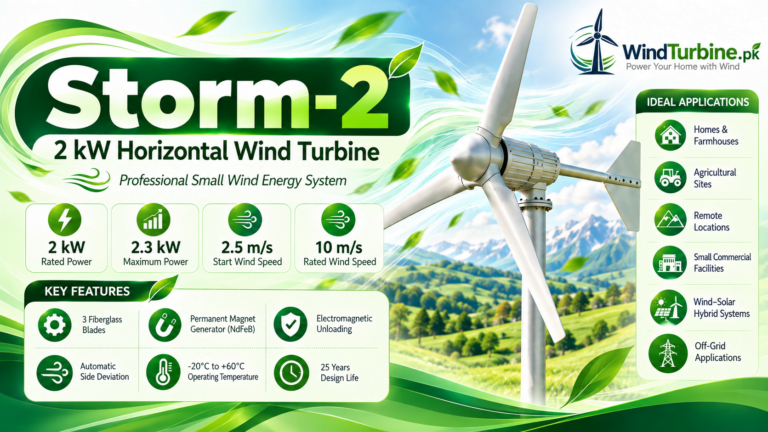
1 kW Wind Turbine Cost in Pakistan 2026: Costing, Output and Home Use
As electricity prices rise and power interruptions remain a concern, many homeowners, farmhouse owners and small businesses are exploring alternative energy options. This has increased interest in searches such as 1 kW wind turbine, wind turbine for home, small wind turbine, and wind turbine price in Pakistan or 1KW wind turbine cost in Pakistan
A 1 kW horizontal-axis wind turbine can generate useful renewable electricity, but its performance depends heavily on the installation site. Unlike solar panels, a wind turbine cannot be selected only by checking its rated capacity. Wind speed, tower height, nearby buildings, rotor diameter and the turbine power curve all affect the amount of electricity it can generate.
This guide explains the estimated 1KW wind turbine cost in Pakistan, expected electricity generation, complete installation expenses, battery requirements, home applications and the conditions needed for successful operation.
If you want to see latest price of wind turbine in pakistan visit this page https://windturbine.pk/prices-of-wind-turbine-in-pakistan/
1KW wind turbine cost in Pakistan: Quick Answer
In above link the estimated equipment price of a 1 kW horizontal wind turbine in Pakistan is approximat.
This price may include the turbine set, generator, blades. controller, dumpload. A complete wind-energy system may cost substantially more after adding:
Steel tower or pole
- Reinforced-concrete foundation
- Guy wires and ground anchors
- Battery bank
- Inverter
- Electrical cables
- Earthing and lightning protection
- Transportation
- Installation labour
- Testing and commissioning
A current Pakistan market guide lists 1 kW turbine equipment windturbine.pk
These are preliminary budgeting ranges, not fixed quotations. A short tower on firm soil may cost less, while a rooftop installation, tall tower, weak soil or remote location may cost more.
What Is a 1 kW Wind Turbine?
A 1 kW wind turbine is designed to produce a maximum rated output of approximately:
1,000 watts
However, it only reaches this output when the wind reaches the turbine’s specified rated wind speed.
Depending on the model, a small horizontal-axis turbine may have:
- Three or five blades
- Permanent-magnet generator
- Tail-vane yaw system
- Three-phase AC output
- Rectifier or wind controller
- Electrical or mechanical braking
- Dump-load protection
- 24 V, 48 V, 96 V or higher system voltage
A 1 kW rating does not mean that the turbine generates 1,000 watts continuously.
Wind changes every minute. During low wind, the turbine may produce only a small amount of power. During suitable wind, output rises. At the rated wind speed, it may approach its full 1 kW output.
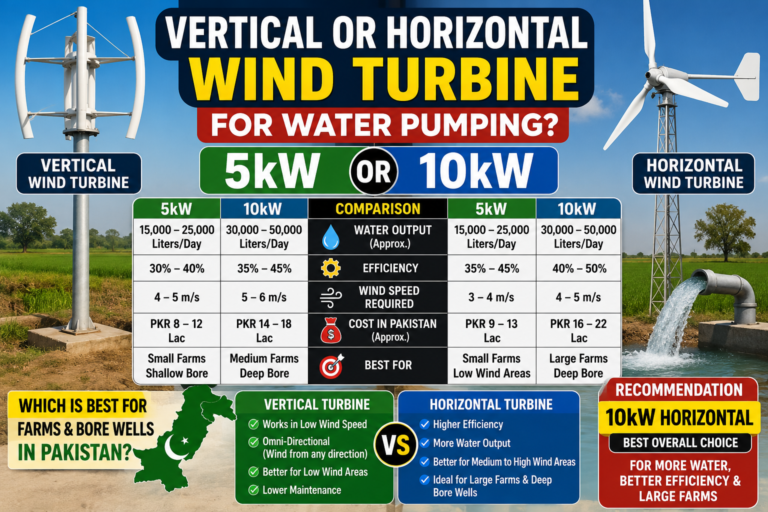
Horizontal Wind Turbine vs Vertical Wind Turbine
The two common designs are:
- Horizontal-axis wind turbine
- Vertical-axis wind turbine
1KW wind turbine cost in Pakistan
Horizontal-axis wind turbine
A horizontal wind turbine has a rotor that faces the wind, similar to the large turbines used in wind farms.
Its advantages may include:
- Better efficiency in clean airflow
- Larger swept area for a given cost
- Higher output on open sites
- Proven turbine design
- Better suitability for tall ground-mounted towers
- Strong commercial availability
Its limitations include:
- Requires correct wind direction alignment
- Needs a tower or pole
- Performs poorly in turbulent rooftop airflow
- Requires adequate blade-clearance area
Vertical-axis wind turbine
A vertical wind turbine can accept wind from different directions and may appear suitable for rooftops. However, many small vertical turbines produce less energy than buyers expect because of limited rotor swept area and turbulent urban wind.
For an open farmhouse, coastal property or rural site, a properly selected 1 kW horizontal wind turbine will generally offer better energy-production potential.
How Much Electricity Can a 1 kW Wind Turbine Generate?
The theoretical maximum daily production is:
1 kW × 24 hours = 24 kWh per day
This would require the turbine to operate continuously at its full rated output, which is not realistic.
Real output depends on the turbine’s capacity factor.
Capacity factor compares actual energy production with the energy the turbine would produce if it operated at full capacity continuously.
Estimated energy output
| Site Quality | Capacity Factor | Daily Generation | Monthly Generation |
|---|---|---|---|
| Poor or turbulent site | 5% | 1.2 kWh | 36 kWh |
| Weak-to-moderate site | 10% | 2.4 kWh | 72 kWh |
| Reasonable open site | 15% | 3.6 kWh | 108 kWh |
| Good windy site | 20% | 4.8 kWh | 144 kWh |
| Very good site | 25% | 6.0 kWh | 180 kWh |
| Excellent small-wind site | 30% to 50% | 7.2 kWh | 216 to 400kWh |
These figures are illustrative. Actual production should be estimated from:
- Measured wind data
- Turbine power curve
- Rotor diameter
- Tower height
- Turbulence level
- Seasonal wind pattern
- Electrical-system efficiency
The U.S. Department of Energy notes that wind power increases approximately with the cube of wind speed, making small differences in average wind speed extremely important to energy output. 1KW wind turbine cost in Pakistan The Department of Energy’s Energy.gov
Example Annual Energy Production
A 1 kW turbine has a theoretical annual maximum of:
1 kW × 8,760 hours = 8,760 kWh
At different capacity factors:
| Capacity Factor | Estimated Annual Energy |
|---|---|
| 5% | 438 kWh |
| 10% | 876 kWh |
| 15% | 1,314 kWh |
| 20% | 1,752 kWh |
| 25% | 2,190 kWh |
| 30% | 2,628 kWh |
A turbine at an unsuitable urban rooftop may generate less than the 5% example. A properly installed turbine on a tall tower at an open coastal or rural site may perform much better.
At What Wind Speed Does a 1 kW Wind Turbine Work?
Every turbine model has its own power curve, but common operating terms include:
Cut-in wind speed
The speed at which the turbine begins generating usable electricity.
For many small turbines, this may be approximately:
2.5 to 3.5 metres per second
Starting to rotate does not necessarily mean the turbine is producing meaningful power.
Rated wind speed
The wind speed at which the turbine reaches approximately 1 kW output.
Depending on the turbine, this may be around:
9 to 12 metres per second
This specification is extremely important. Some low-cost turbines advertise 1 kW output at a high wind speed that may occur only occasionally.
Cut-out or braking wind speed
At very high wind speeds, the turbine may brake, furl, turn away from the wind or divert electricity to a dump load for protection.
Before purchasing, always ask for:
- Cut-in wind speed
- Rated wind speed
- Maximum power
- Survival wind speed
- Complete power curve
Why the Power Curve Matters
Two turbines may both be advertised as 1 kW but generate very different amounts of electricity.
For example:
- Turbine A may produce 1 kW at 9 m/s.
- Turbine B may produce 1 kW at 12 m/s.
- Turbine A may have a larger rotor.
- Turbine B may start spinning easily but produce little power below rated speed.
A credible supplier should provide a chart showing turbine output at several wind speeds.
A typical power-curve table may look like this:
| Wind Speed | Possible Output |
|---|---|
| 3 m/s | 10–40 W |
| 4 m/s | 40–100 W |
| 5 m/s | 100–200 W |
| 6 m/s | 200–350 W |
| 7 m/s | 350–550 W |
| 8 m/s | 550–750 W |
| 9–12 m/s | Up to rated output |
These are examples only. The manufacturer’s tested power curve must be used for the actual turbine.
Can a 1 kW Wind Turbine Power a Home?
A 1 kW wind turbine can contribute electricity to a home, but it will not usually operate the entire house independently.
At a suitable site, it may help supply energy for:
- LED lights
- Ceiling fans
- Television
- Wi-Fi router
- Laptop computers
- Mobile charging
- Security cameras
- Small refrigerator
- Small water-pumping applications
- Battery charging
- Essential farmhouse loads
It may not reliably operate the following by itself: 1KW wind turbine cost in Pakistan
- Air conditioner
- Electric heater
- Electric iron
- Electric water heater
- Large water pump
- Electric oven
- Microwave
- Multiple high-power appliances
The main limitation is not only the turbine’s 1 kW rating. Wind output can fall at any time, so stable household operation normally requires a battery and inverter.
What Appliances Can a 1 kW Wind Turbine Support?
The following example shows a modest essential-load combination:
| Appliance | Approximate Power |
|---|---|
| Four LED lights | 48 W |
| Two ceiling fans | 160 W |
| Wi-Fi router | 15 W |
| Television | 100 W |
| Laptop | 65 W |
| Small refrigerator average | 100–200 W |
| Approximate running load | 488–588 W |
A 1 kW turbine could support this load during suitable wind, but direct operation is not recommended because turbine output varies continuously.
A battery bank should absorb changes in wind generation and supply the load when the wind drops.
Is a Battery Required?
A battery is normally required for an off-grid or backup wind system.
The battery:
- Stores excess wind energy
- Stabilises voltage
- Supplies power during calm periods
- Supports appliance startup
- Allows nighttime and scheduled use
- Prevents sudden load interruption
A wind turbine does not work like a normal petrol generator. The output changes according to wind speed, so a stable electrical system usually needs:
- Wind turbine
- Wind charge controller
- Dump load
- Battery bank
- Inverter
- Electrical protection
Recommended Battery Size for a 1 kW Wind Turbine
Battery size should be based on:
- Daily electricity requirement
- Required backup duration
- Turbine system voltage
- Maximum charging current
- Battery BMS limit
- Expected daily generation
- Inverter capacity
Small basic system
- Battery capacity: 2–3 kWh
- Suitable for lights, fans and electronics
- Limited overnight backup
Practical home system
- Battery capacity: 4–5 kWh
- Better for essential household loads
- Can absorb more turbine energy
Larger off-grid arrangement
- Battery capacity: 7–10 kWh
- Suitable for farmhouses and remote installations
- Better energy reserve during calm weather
A single 12 V, 100 Ah lithium battery stores only about 1.28 kWh nominally and may be too small for the full output of a 1 kW turbine. 1KW wind turbine cost in Pakistan
Recommended System Voltage
For a 1 kW turbine, commonly considered system voltages are:
- 24 V
- 48 V
- 96 V
- High-voltage controller-specific output
At 12 volts
Approximate current:
1,000 W ÷ 12 V = 83 amperes
This requires very thick cable and creates higher losses.
At 24 volts
Approximate current:
1,000 W ÷ 24 V = 42 amperes
This is more manageable but still requires appropriately sized cable.
At 48 volts
Approximate current:
1,000 W ÷ 48 V = 21 amperes
For many small wind systems, 48 V offers a practical balance between cable size, battery configuration and inverter availability.
The actual charging current will vary with turbine voltage, controller efficiency and battery-charging voltage.
Wind Controller and Dump Load
A solar charge controller should not automatically be used as a wind controller.
A wind turbine normally requires a dedicated wind controller that can:
- Rectify three-phase AC
- Regulate battery charging
- Monitor battery voltage
- Activate a dump load
- Provide electrical braking
- Protect against overvoltage
- Control overspeed conditions added in 1KW wind turbine cost in Pakistan
What is a dump load?
When the battery becomes full, the turbine may continue generating electricity.
The excess energy must be sent to a safe electrical resistance called a dump load or diversion load.
The dump load converts excess electricity into heat.
Without a suitable dump load, the turbine may:
- Overspeed
- Produce excessive voltage
- Damage the controller
- Stress the blades and bearings
- Trigger repeated BMS disconnection
Tower Height for a 1 kW Wind Turbine
Tower height has a major effect on wind turbine output.
A turbine mounted near ground level may be affected by:
- Houses
- Trees
- Boundary walls
- Water tanks
- Parapets
- Billboards
- Other towers
These obstructions create turbulent wind.
A typical small-turbine tower may be:
6 to 12 metres high
At difficult sites, a taller tower may be required.
The exact height depends on:
- Surrounding obstacles
- Local permissions
- Turbine weight
- Rotor diameter
- Tower design
- Guy-wire area
- Wind conditions
- Safety clearances
The best installation point is not simply the highest available roof. The turbine needs smooth, unobstructed wind.
Guyed Tower vs Self-Supporting Tower
Guyed tower
1KW wind turbine cost in Pakistan, A guyed tower uses steel wire ropes connected to separate ground anchors.
Advantages
- Lower steel cost
- Smaller central foundation
- Can be designed as a tilt-down tower
- Easier turbine maintenance
- Suitable for farmhouses and open land
Limitations
- Requires more ground area
- Guy wires can create access hazards
- Separate anchor foundations are needed
- Regular tension inspection is required
Self-supporting tower
A self-supporting tower does not require guy wires.
Advantages
- Smaller overall footprint
- Cleaner installation appearance
- Better for certain commercial locations
- No ground-level guy-wire obstruction
Limitations
- More expensive steel structure
- Larger foundation
- More difficult installation
- Crane may be required
- Greater engineering cost
For most small 1 kW farmhouse systems, a properly designed guyed tower is usually the more economical option.
Foundation Cost and Requirements
A 1 kW turbine foundation must support:
- Turbine weight
- Tower weight
- Rotor thrust
- Generator torque
- Wind gusts
- Braking loads
- Vibration
- Overturning forces
- Guy-wire forces
The electrical capacity alone cannot determine the foundation size.
A typical ground foundation may include:
- Excavation
- PCC blinding
- Reinforced-concrete block
- RCC pedestal
- Steel reinforcement cage
- Cast-in anchor bolts
- Cable conduit
- Earthing connection
- Drainage slope
Final dimensions should be approved by a qualified engineer based on:
- Turbine load data
- Tower height
- Rotor diameter
- Soil-bearing capacity
- Maximum wind conditions
- Guy-wire arrangement
IEC 61400-2 addresses the safety, installation, engineering integrity, maintenance and operation of small wind turbines under specified external conditions. IEC Webstore
Rooftop vs Ground-Mounted Wind Turbine
Ground-mounted installation
This is generally the preferred arrangement.
Benefits include:
- Better tower-height options
- Stronger load transfer to the soil
- Easier maintenance
- Reduced vibration in the building
- Space for guy wires
- Safer turbine lowering
- Easier foundation inspection
Rooftop installation
A rooftop installation may appear cheaper because the building provides height, but it can create additional technical challenges.
Possible issues include:
- Turbulent wind
- Vibration transfer
- Building resonance
- Weak slab or beam connections
- Waterproofing damage
- Difficult maintenance
- Blade-clearance risks
- Greater noise inside the building
A turbine should not be attached only to a roof slab or ordinary brick parapet. The loads should be transferred into verified beams, columns and foundations through an engineered structural frame.
Is a 1 kW Wind Turbine Suitable for Karachi?
Karachi has both strong solar potential and useful wind conditions in many coastal and open locations. However, wind performance varies significantly between neighbourhoods.
Detail about Wind Turbine in Karachi DHA https://windturbine.pk/blog/wind-turbine-in-dha-karachi/
Better potential locations may include:
- Coastal properties
- Open farmhouses
- Outskirts of Karachi
- Super Highway areas
- Port and industrial zones
- Open agricultural land
- Locations without nearby high-rise buildings
- Sites where wind remains available during evening and night
Poorer locations may include:
- Streets surrounded by high buildings
- Small enclosed rooftops
- Areas behind large trees
- Locations near water tanks and parapets
- Dense residential neighbourhoods
- Low tower installations
For Karachi, wind should ideally be measured at or close to the intended turbine hub height before making a major investment.
Is a 1 kW Wind Turbine Suitable for Lahore?
Solar will generally be easier to justify in Lahore because sunlight is widely available while urban wind may be intermittent and turbulent.
A 1 kW turbine may still be considered where:
- The property is outside the dense city
- The site is open and unobstructed
- A sufficiently tall tower can be installed
- Wind measurements confirm suitable conditions
Occasional strong storms or gusts do not represent a reliable annual wind resource. more detail wind turbine in Lahore https://windturbine.pk/blog/wind-turbine-in-lahore/
Is a 1 kW Wind Turbine Suitable for Islamabad and Rawalpindi?
The hilly terrain and local wind patterns can produce significant variation between nearby sites.
A turbine may work at:
- Open elevated locations
- Farmhouses
- Ridge areas
- Rural sites
- Locations with clear airflow
However, valleys, buildings and trees may create turbulence.
A site-specific assessment is more reliable than relying only on city-level wind information. more about 1KW wind turbine cost in Pakistan.
Is a 1 kW Wind Turbine Suitable for Multan?
Multan has strong solar potential, while the wind resource should be evaluated at the specific property.
A wind turbine may be useful at:
- Open agricultural sites
- Farmhouses
- Remote water-pumping locations
- Sites with measured seasonal wind
- Hybrid solar-wind systems
For most urban properties in Multan, solar may provide a simpler and more predictable investment unless wind measurements support the turbine.
Best Locations for Small Wind Turbines in Pakistan
Small wind turbines may offer stronger potential in:
- Karachi’s open coastal belt
- Thatta more detail wind turbine in Thatta. https://windturbine.pk/blog/wind-turbine-in-thatta-sindh/
- Badin
- Gharo
- Jhimpir
- Hyderabad outskirts
- Coastal Balochistan
- Gwadar
- Open parts of Sindh
- Agricultural farmhouses
- Remote telecom sites
- Elevated and unobstructed locations
Even within these areas, actual output depends on local obstructions and tower height.
A windy district does not guarantee that every house in that district is suitable.
1 kW Wind Turbine vs Solar Panels
A 1 kW wind turbine and 1 kW solar system are both electricity-generating technologies, but their operation is different.
| Factor | 1 kW Wind Turbine | 1 kW Solar |
|---|---|---|
| Generates during daylight | Yes, when windy | Yes |
| Generates at night | Possible | No |
| Tower required | Yes | No |
| Major foundation | Usually yes | Usually no |
| Moving parts | Yes | No |
| Maintenance | Moderate | Low |
| Urban suitability | Limited | High |
| Output predictability | Site-dependent | Generally higher |
| Cloudy-weather output | Possible | Reduced |
| Initial installed cost | Usually higher | Usually lower |
| Farmhouse suitability | Good at windy sites | Good |
| Coastal suitability | Potentially excellent | Excellent |
For most urban homes, solar generally offers lower installation cost and more predictable output.
For a verified windy farmhouse or coastal property, a wind turbine may complement solar by generating electricity at night and during cloudy weather.
Wind Turbine in Hyderabad https://windturbine.pk/blog/wind-turbine-in-hyderabad/
Solar-Wind Hybrid System for Home
A hybrid system combines:
- Solar panels
- Wind turbine
- Solar charge controller
- Wind controller
- Dump load
- Battery bank
- Hybrid inverter
A simplified arrangement is:
Solar Panels
     │
Solar Controller
     │
     ├──────── Lithium Battery Bank ───── Inverter ───── Home Loads
     │
Wind Controller
     │
1 kW Wind Turbine ───── Dump Load
This arrangement may provide:
- Solar power during sunny daytime hours
- Wind generation during suitable daytime or nighttime wind
- Battery storage during low-generation periods
- Reduced dependence on a petrol or diesel generator
- Improved off-grid reliability
1 kW Wind Turbine for Water Pumping
A 1 kW turbine may support small water-pumping applications, but direct connection to an ordinary AC pump is generally unsuitable.
A practical system may use:
- Turbine
- Wind controller
- Battery
- Inverter
- Small pump
- Water-storage tank
The battery stabilises the supply, while the elevated water tank acts as a form of energy storage.
Pumping performance depends on:
- Pump wattage
- Starting surge
- Required water flow
- Total pumping head
- Daily wind energy
- Battery capacity
- Inverter surge rating
For agricultural pumping, solar may remain more predictable during daylight, while wind can provide additional pumping energy at night at a good site.
Maintenance Requirements
A 1 kW horizontal wind turbine should be inspected regularly.
Recommended inspection items
- Blade condition
- Blade-root bolts
- Hub fasteners
- Generator bearings
- Tail-vane assembly
- Yaw movement
- Tower bolts
- Foundation cracks
- Anchor bolts
- Guy-wire tension
- Turnbuckles and shackles
- Corrosion
- Cable twisting
- Earthing connections
- Controller
- Brake switch
- Dump load
- Battery charging
- Unusual noise or vibration
Maintenance frequency depends on the manufacturer, turbine design and site conditions.
Coastal installations may require more frequent corrosion inspections.
Expected Lifespan
The useful life of a small wind turbine depends on:
- Manufacturing quality
- Bearing quality
- Blade balance
- Tower stability
- Wind turbulence
- Overspeed control
- Corrosion protection
- Controller quality
- Maintenance
- Extreme weather exposure
A well-designed and maintained system can operate for many years. A low-quality turbine on a weak tower or turbulent rooftop may develop problems much earlier.
The cheapest turbine is not always the least expensive option over its full service life.
Factors Affecting 1 kW Wind Turbine Cost
1. Rotor diameter
A larger rotor captures more wind energy but may also increase thrust and structural requirements.
2. Generator quality
Copper winding, magnet quality, bearings and heat management affect both performance and lifespan.
3. Rated wind speed
A turbine rated at 1 kW at a lower wind speed may have a larger rotor and higher cost.
4. Controller type
A proper MPPT or diversion controller may cost more than a basic rectifier but can provide better control and protection.
5. Tower height
A taller tower requires more steel, stronger guy wires and larger foundations.
6. Galvanising
Hot-dip galvanising adds cost but improves corrosion protection.
7. Battery type
Lithium batteries cost more initially than lead-acid batteries but typically offer higher usable capacity and longer cycle life.
8. Installation location
Remote and difficult-to-access locations increase transport and labour costs.
9. Foundation conditions
Weak soil, loose fill, groundwater or rooftop structural reinforcement can increase installation costs.
10. Imported components
Exchange-rate movement, customs duties and freight charges affect turbine prices in Pakistan.
What Should Be Included ?
A professional 1 kW wind turbine quotation should clearly state whether it includes:
- Wind turbine generator
- Blades and hub
- Tail vane
- Controller
- Rectifier
- Dump load
- Brake switch
- Tower
- Foundation
- Guy wires
- Guy-wire anchors
- Electrical cable
- Cable length
- Earthing
- Lightning protection
- Batteries
- Inverter
- Transportation
- Installation
- Crane or lifting
- Testing and commissioning
- Warranty
- Maintenance support
Equipment-only and installed-system prices should be shown separately to add in 1KW wind turbine cost in Pakistan.
Questions to Ask Before Buying
Before purchasing a 1 kW wind turbine for home, ask the supplier:
- What is the rotor diameter?
- At what wind speed does it produce 1 kW?
- What is the complete power curve?
- What is the cut-in wind speed?
- What is the survival wind speed?
- Is the turbine horizontal or vertical axis?
- Is the controller included?
- Is the dump load included?
- Is electrical braking included?
- What voltage does the turbine produce?
- What tower height is recommended?
- Is the tower included?
- Is the foundation included?
- Are guy wires and anchors included?
- What cable length is included?
- Is earthing included?
- What battery capacity is recommended?
- Is the inverter included?
- What maintenance is required?
- What warranty is provided?
Common Mistakes to Avoid
Buying without measuring the wind
A turbine purchased for a poor-wind site may never produce enough electricity to justify its cost.
Installing the turbine too low
Ground-level wind may be much weaker and more turbulent than wind above surrounding obstacles.
Comparing only rated power
A 1 kW label does not indicate annual energy production.
Ignoring the tower cost
The tower and foundation may cost more than the turbine itself.
Installing on a weak rooftop
Rooftop wind loads and vibration should be evaluated by a structural engineer.
Using a solar controller
Wind requires a suitable diversion controller and dump load.
Using an undersized battery
A small battery may reach full charge quickly, overload its BMS or cause frequent dumping of wind energy.
Using thin cable
Low-voltage wind systems can carry high current. Undersized cable causes voltage drop, heating and energy loss.
Ignoring maintenance access
The turbine must be safely reachable for blade, bearing and bolt inspection.
Frequently Asked Questions
What is the 1 kW wind turbine price in Pakistan?
The estimated equipment price , depending on the turbine design, rotor diameter, controller, voltage, manufacturer and included accessories. A complete installed system may cost PKR 500,000 or more after adding the tower, foundation, wiring and installation.
How much electricity does a 1 kW wind turbine generate per day?
At a reasonable site, it may generate approximately 2.4–4.8 kWh per day. A poor site may produce less, while a very good windy site may generate 6 kWh per day or more.
Can a 1 kW wind turbine run a house?
It can contribute to essential household loads but will not usually power an entire home continuously. A battery and inverter are required for stable backup operation.
Can a 1 kW turbine run an air conditioner?
A normal air conditioner generally requires more reliable continuous and surge power than a 1 kW wind turbine can provide directly. A larger hybrid system with sufficient battery and inverter capacity would be required.
Can a 1 kW wind turbine work at night?
Yes. A wind turbine can generate electricity at night whenever sufficient wind is available.
Is a wind turbine better than solar?
For most urban homes, solar provides better financial value and more predictable energy. Wind can be valuable at verified windy sites and is especially useful as part of a solar-wind hybrid system.
Does a 1 kW wind turbine need a battery?
A battery is normally required for off-grid and backup applications. Grid-connected systems may use different equipment and require technical and regulatory approval.
What tower height is required?
A small turbine may require a tower approximately 6–12 metres high, but the final height depends on surrounding obstacles, turbine specifications and site conditions.
Can it be installed on a rooftop?
It is technically possible at some properties, but the building structure, vibration, turbulence, blade clearance and waterproofing must be evaluated. Ground installation is generally preferable.
What is the best voltage for a 1 kW turbine?
A 48 V system is often more practical than 12 V because it reduces current and cable losses. The final voltage should match the controller, battery and inverter.
Final Verdict: Is a 1 kW Wind Turbine Worth It?
A 1 kW horizontal wind turbine can be a useful renewable-energy system for:
- Open farmhouses
- Coastal properties
- Remote sites
- Agricultural applications
- Small off-grid systems
- Telecom and monitoring equipment
- Solar-wind hybrid systems
It may not provide good value at:
- Turbulent urban rooftops
- Low tower heights
- Locations surrounded by buildings
- Sites without wind measurements
- Properties where only occasional gusts occur
For most homeowners, the best decision process is:
- Calculate daily electricity consumption.
- Assess the available solar resource.
- Measure wind at the proposed turbine height.
- Review the turbine’s verified power curve.
- Estimate annual energy production.
- Add tower, foundation and electrical costs.
- Compare the complete system with solar or hybrid alternatives.
A 1 kW wind turbine should be purchased on the basis of expected annual energy generation—not merely its advertised wattage.
At a genuinely windy site, it can generate renewable energy during the day and night. At an unsuitable site, even an inexpensive turbine may produce disappointing results. small wind turbine for home https://windturbine.pk/blog/small-wind-turbines-in-pakistan/
1 kW wind turbine cost in pakistan.
- 1kw wind turbine
- wind turbine price
- wind turbine in Pakistan
- wind turbine price in Pakistan
- wind turbine for home
- vertical wind turbine
- small wind turbine
- 1kw wind turbine price in Pakistan
- horizontal wind turbine
- home wind turbine Pakistan
- wind turbine installation cost
- wind turbine for farmhouse
- wind turbine output per day
- solar wind hybrid system Pakistan
1 kW Wind Turbine Price and Home Use in Pakistan 2026
Recommended internal links:
- Wind Turbine Price in Pakistan https://windturbine.pk/
- Wind Turbine parts explain. Pakistan https://windturbine.pk/blog/1-kw-wind-turbine-parts/
- How Much Energy Can a 1 kW Wind Turbine Generate in Karachi? https://windturbine.pk/blog/1kw-vertical-wind-turbine-in-pakistan-urdu/
- Vertical Wind Turbine Price in Pakistan
- Wind Turbine Foundation and Tower Guide
Need a 1 kW wind turbine for your home or farmhouse?
Contact WindTurbine.pk for turbine selection, site assessment, tower planning and a customised quotation and feasibility. https://windturbine.pk/feasibility/