15 Things to Check Before Buying a Wind Turbine in Pakistan
Planning to buy a wind turbine in Pakistan? Do not choose a turbine simply because a seller has written a large kW number on the advertisement. The right wind turbine depends on your wind speed, tower height, rotor size, power curve, installation location, electrical system and expected annual energy production. 15 Things to Check Before Buying a Wind Turbine.
A properly selected 1kW wind turbine at a good site can be more useful than a poorly selected 3kW turbine at a bad site.
At WindTurbine.pk, we recommend checking the site first and selecting the turbine afterwards. You can start with our Wind Turbine Feasibility Check before making an investment.
15 Things to Check Before Buying a Wind Turbine explains 15 important things to check before buying a wind turbine in Pakistan, including wind speed, tower height, rotor diameter, power curve, generator, controller, dump load, batteries, inverter compatibility, tower safety and expected annual kWh.
Quick Checklist: What to Check Before Buying a Small Wind Turbine
| # | What to Check | Why It Matters |
|---|---|---|
| 1 | Wind speed | Determines available wind energy |
| 2 | Wind data quality | One windy day is not enough |
| 3 | Tower height | Higher, cleaner wind can improve performance |
| 4 | Buildings and trees | Obstacles create turbulence |
| 5 | Turbine size | Must match your energy requirement |
| 6 | Rotor diameter | Determines swept area |
| 7 | Power curve | Shows output at different wind speeds |
| 8 | Rated and cut-in wind speed | Helps you understand real operating conditions |
| 9 | Generator, RPM and torque | Must match the rotor |
| 10 | Controller and dump load | Controls and protects the system |
| 11 | Solar, battery and inverter compatibility | Essential for hybrid/off-grid systems |
| 12 | Voltage and cable size | Reduces electrical losses |
| 13 | Tower and foundation | Critical for structural safety |
| 14 | Braking and overspeed protection | Protects the turbine in strong winds |
| 15 | Annual kWh and total project cost | Shows whether the project makes financial sense |
1. Check the Wind Speed at Your Property
Wind is the fuel of a wind turbine.
One of the biggest mistakes buyers make is purchasing a wind turbine before checking the wind resource at the actual installation site.
Someone may say:
“There is a lot of wind on my roof.”
That is not enough information.
You need to know the wind speed in metres per second (m/s) and, ideally, how that wind changes by hour, month and season.
Initial Wind-Speed Guide
| Average Wind Speed at Turbine Height | Initial Assessment |
| Below 3 m/s | Usually poor |
| 3–4 m/s | Low |
| 4–5 m/s | Needs careful analysis |
| 5–6 m/s | Promising |
| 6–7 m/s | Very good |
| Above 7 m/s | Excellent wind resource |
These ranges are for initial screening only. They do not guarantee a particular turbine’s electricity production.
The actual result depends on the turbine’s power curve, rotor size, tower height, turbulence and system efficiency.
Why Wind Speed Matters So Much
The power available in moving air increases approximately with the cube of wind speed:
Wind Power ∝ Wind Speed³
For example:
(6 ÷ 5)³ = 1.728
So air moving at 6 m/s contains about 73% more power than air moving at 5 m/s.
A turbine cannot convert all of that wind energy into electricity, but the relationship explains why a modest improvement in site wind speed can have a major effect on annual energy production.
If you do not know your site’s wind conditions, start with the Prices of wind turbine in pakistan
2. Do Not Trust a Few Minutes of Wind Measurement
Suppose you stand on your roof at 4 PM and measure 7 m/s for ten minutes.
Does that mean your annual average wind speed is 7 m/s?
No.
Wind changes by:
- hour
- day
- season
- weather conditions
- year
For an initial wind turbine assessment, historical wind data can be useful. For important projects, on-site measurement becomes increasingly valuable.
Useful Wind Data
| Data | What It Tells You |
| Hourly wind speed | Detailed wind behaviour |
| Daily average | Day-to-day variation |
| Monthly average | Seasonal pattern |
| Annual average | Overall wind resource |
| Maximum wind | Strong-wind conditions |
| Wind direction | Helps select turbine position |
| Multi-year data | Improves long-term confidence |
This is why a proper feasibility assessment is better than saying:
“It feels windy, so a wind turbine should work.”
3. Check the Correct Tower Height
Wind near the ground is often slower and more disturbed by buildings, trees and other obstacles.
As the turbine is installed higher, wind can become:
- faster
- smoother
- less affected by smaller obstacles
This is why tower height can sometimes be more important than simply buying a larger generator.
For example:
| Height | Example Average Wind Speed |
| 10 m | 4.2 m/s |
| 15 m | 4.6 m/s |
| 20 m | 5.0 m/s |
| 30 m | 5.5 m/s |
These are example figures only. Actual wind shear depends on terrain and surface conditions.
Do not ask only:
“How high is the tower?”
Also ask:
“How high will the rotor be compared with nearby buildings and trees?”
A 12-metre tower in open farmland may perform very differently from a 12-metre tower surrounded by taller buildings.
For residential installations, our Wind Turbine for Home in Pakistan guide explains the key factors to consider.
4. Check Buildings, Trees and Other Obstacles
This is particularly important for rooftop wind turbines.
Wind hitting a building does not simply pass over it smoothly. Air can slow down, separate, change direction and form swirling airflow.
This disturbed airflow is called turbulence.
Common Sources of Turbulence
| Obstacle | Possible Problem |
| Nearby house | Blocks and disturbs wind |
| Tall building | Creates a large turbulent zone |
| Water tank | Local turbulence |
| Trees | Reduce and disturb airflow |
| Boundary wall | Near-ground disturbance |
| Factory shed | Creates a wake |
| Billboard | Disturbed airflow |
Turbulence can reduce energy production and may also increase:
- vibration
- bearing wear
- blade fatigue
- mechanical loading
- tower loading
This is why rooftop installation requires a proper assessment.
For more information, read Small Wind Turbines for Homes and Rooftops in Pakistan.
5. Choose 1kW, 2kW or 3kW for the Right Reason
Do not start with:
“I have a large house, so I need a 3kW wind turbine.”
First determine:
- How much electricity do you use?
- What wind speed is available?
- How much of your load should wind supply?
- Do you already have solar?
- Do you have batteries?
- Are you grid-connected or off-grid?
- How much tower height is available?
General Starting Point
| Turbine Size | Typical Application |
| 1kW | Small loads, battery charging, home hybrid systems |
| 2kW | Homes, farmhouses, shops and hybrid systems |
| 3kW | Larger homes, farmhouses, offices and small businesses |
These are starting categories, not automatic recommendations.
You can also read the 2kW Wind Turbine Buying Guide for Pakistan.
6. Check the Rotor Diameter, Not Just the Generator kW
This is one of the most important technical checks when comparing wind turbines.
A turbine captures energy from the area swept by its blades. This is called the rotor swept area.
For a horizontal-axis wind turbine:
A = πR²
where R is the rotor radius.
Example: 2-Metre Rotor
Diameter = 2 m
Radius = 1 m
Swept area:
≈ 3.14 m²
Imagine two sellers offer:
3kW Wind Turbine A
and
3kW Wind Turbine B
Both generators are labelled 3kW.
However, if one has a significantly different rotor size and power curve, their output at normal wind speeds can be very different.
Always ask:
What is the rotor diameter and swept area?
Do not ask only:
“How many watts is the generator?”
7. Ask for the Complete Power Curve
A wind turbine power curve is one of the most useful technical documents a manufacturer can provide.
It shows approximately how much electrical power the turbine produces at different wind speeds under the stated test or measurement conditions.
For example, an educational power curve might look like this:
| Wind Speed | Example Output |
| 3 m/s | Very low |
| 4 m/s | 150 W |
| 5 m/s | 350 W |
| 6 m/s | 650 W |
| 7 m/s | 1,050 W |
| 8 m/s | 1,600 W |
| 9 m/s | 2,200 W |
| 10 m/s | 2,700 W |
| 11 m/s | 3,000 W |
Important: These are educational example figures, not the power curve of a specific WindTurbine.pk product.
If your site spends much of the year between 4 and 7 m/s, you should pay close attention to turbine output in that range.
A large “3,000 W” label is not enough.
8. Check Cut-In Speed and Rated Wind Speed
Two specifications that are often misunderstood are cut-in wind speed and rated wind speed.
What Is Cut-In Wind Speed?
Cut-in speed is approximately the wind speed at which the turbine begins producing electrical power according to its specification.
You may see an advertisement saying:
“Starts at 2 m/s!”
Be careful.
A turbine rotating at 2 m/s does not necessarily mean it is producing useful electrical power.
The better question is:
How many watts does it actually produce at 3, 4, 5, 6 and 7 m/s?
What Is Rated Wind Speed?
Rated wind speed is the wind speed at which the turbine reaches its rated power under the manufacturer’s specified conditions.
For example:
- Turbine A = 3kW at 10 m/s
- Turbine B = 3kW at 12 m/s
Both are called 3kW turbines, but their behaviour at a moderate-wind site can be different.
Specifications to Compare
| Specification | Why Check It? |
| Cut-in speed | When generation starts |
| 4 m/s output | Low-wind performance |
| 5 m/s output | Important comparison |
| 6 m/s output | Important comparison |
| 7 m/s output | Important comparison |
| Rated wind speed | When rated output is reached |
| Cut-out/protection behaviour | High-wind safety |
9. Check Generator RPM, Torque and Rotor Matching
Many small wind turbines use a Permanent Magnet Generator (PMG), but the generator alone does not make a good wind turbine.
The complete system must be matched:
Blades → Rotor RPM → Torque → Generator → Controller → Electrical Load
A 3kW generator may be capable of producing 3kW at a particular RPM, but the rotor may not be able to drive the generator to that operating point at the wind speeds available at your site.
Ask the Supplier
- What is the rated generator RPM?
- At what rotor RPM is rated output achieved?
- Is the turbine direct drive?
- What is the rotor diameter?
- What is the rated wind speed?
- What does the complete turbine power curve show?
This helps distinguish a properly designed 3kW wind turbine from a 3kW generator simply attached to blades.
10. Check the Controller and Dump Load
The wind turbine controller is an important part of the complete system.
Unlike solar panels, a wind turbine has a rotating mechanical rotor. When batteries become full or electrical demand falls, the rotor can still be driven by the wind.
Depending on the system design, excess energy may need to be sent to a dump load.
A dump load converts excess electrical energy into heat.
A Small Wind System May Include
| Component | Purpose |
| Rectifier | Converts generator AC where applicable |
| Wind controller | Manages turbine output |
| Battery charging control | Controls battery charging |
| Dump load | Absorbs excess energy |
| Electrical brake | Helps slow/control the turbine |
| Protection devices | Electrical safety |
Do not treat the controller and protection system as optional accessories. They are part of the wind turbine system design.
11. Check Compatibility With Solar, Batteries and Inverter
Many customers in Pakistan already have solar panels, batteries and an inverter.
A common question is:
Can I add a wind turbine to my existing solar system?
Often, yes—but the system must be designed correctly.
A typical hybrid arrangement may look like:
Solar Panels → Solar Controller
Wind Turbine → Wind Controller + Dump Load
Then:
Battery/DC System → Inverter → Home
The exact architecture depends on the equipment.
Before Buying, Check
| Existing Equipment | Information Needed |
| Solar inverter | Model and specifications |
| Battery | Voltage, chemistry and capacity |
| Solar panels | Existing kW |
| Wind turbine | Voltage and controller |
| Grid | Connection type |
| Backup generator | If installed |
Do not assume that every solar inverter can directly accept wind turbine input.
For a practical example, see our 2kW Wind Turbine Pakistan guide.
12. Check System Voltage and Cable Distance
Small wind turbine systems can use different system voltages, including:
- 24V
- 48V
- 96V
The correct voltage depends on the system design.
Current is also important.
Using the simplified relationship:
Power = Voltage × Current
For a 3kW system at 48V:
3,000 ÷ 48 ≈ 62.5 A
For a 1kW system at 48V:
1,000 ÷ 48 ≈ 20.8 A
Actual operating current changes with voltage, turbine output and equipment efficiency, but the calculation demonstrates why cable selection matters.
Long Cable Runs Can Waste Energy
Suppose your turbine is 80 metres from the controller.
A poorly sized cable can create significant voltage drop and energy losses.
Check:
- cable length
- cable cross-section
- turbine voltage
- operating current
- voltage drop
- electrical protection
The cheapest cable is not necessarily the cheapest system over its lifetime.
13. Check the Tower and Foundation Properly
A wind turbine tower is not simply a pole carrying the weight of the turbine.
Wind creates forces on:
- blades
- rotor
- generator
- nacelle
- tower
- foundation
During strong winds, these forces can become much greater than the turbine’s static weight.
Tower Design Should Consider
- turbine weight
- rotor diameter
- wind thrust
- maximum wind speed
- vibration
- tower height
- guy wires, where used
- soil and foundation
- corrosion
Foundation Design Should Consider
| Check | Why It Matters |
| Soil | Supports the foundation |
| Foundation dimensions | Helps resist overturning |
| Concrete | Structural strength |
| Reinforcement | Handles structural loads |
| Anchor bolts | Connect the tower |
| Drainage | Protects the foundation |
| Groundwater | Can affect foundation design |
Do not choose a foundation size only from turbine weight.
A 100kg turbine exposed to strong wind can experience forces far greater than its static 100kg weight.
14. Check Braking, Overspeed and High-Wind Protection
A wind turbine must be designed to survive conditions beyond normal electricity production.
Suppose a turbine reaches rated output at 11 m/s.
What happens at:
- 15 m/s?
- 20 m/s?
- 25 m/s?
- a sudden strong gust?
The turbine needs a way to control rotor speed and mechanical loads.
Depending on the design, protection can include:
- electrical braking
- mechanical braking
- furling
- pitch control
- aerodynamic control
- controller-based protection
Questions to Ask the Supplier
| Question | Why It Matters |
| What is the rated RPM? | Normal operation |
| What is the maximum RPM? | Overspeed protection |
| What braking system is used? | Safety |
| What happens when batteries are full? | Control |
| What happens if the inverter/grid fails? | Fail-safe behaviour |
| What is the survival wind speed? | Structural safety |
| Is a dump load included? | Energy management |
For a serious installation, these questions are as important as the turbine’s kW rating.
15. Calculate Expected Annual kWh Before Looking at Payback
This may be the most important final check.
Do not buy a wind turbine because:
“It is 3kW.”
Buy it because your assessment indicates that:
This turbine, at this site and this height, is expected to produce useful energy each year.
kW and kWh Are Different
kW = power
kWh = energy
A 3kW turbine operating at its full 3kW output for one hour would produce:
3 kWh
But a 3kW wind turbine does not normally produce 3kW during every hour of the year.
Theoretical Maximum
A 3kW turbine operating at full rated output for all 8,760 hours would produce:
3 × 8,760 = 26,280 kWh/year
That is a theoretical maximum—not a realistic prediction for most sites.
Capacity-Factor Examples
| Turbine | 10% Capacity Factor | 20% | 30% |
| 1kW | 876 kWh/year | 1,752 | 2,628 |
| 2kW | 1,752 | 3,504 | 5,256 |
| 3kW | 2,628 | 5,256 | 7,884 |
These are mathematical examples only, not guaranteed production figures.
Real annual energy should be estimated using the site’s wind distribution and the actual turbine power curve.
For current market information, see our Wind Turbine Price in Pakistan guide.
Compare the Complete Project Cost, Not Just the Turbine Price
Do not compare two wind turbine quotations only by the headline price.
The turbine itself may be only one part of the project.
Complete Wind Turbine System Cost Can Include
| Item | Check Before Buying |
| Turbine | Included? |
| Blades/hub | Included? |
| Controller | Included? |
| Dump load | Included? |
| Tower | Included? |
| Foundation | Included? |
| Installation | Included? |
| Cable | Included? |
| Protection | Included? |
| Inverter | Included? |
| Batteries | Included? |
| Transport | Included? |
| Earthing | Included? |
| Lightning protection | Included? |
| Warranty | Duration? |
This is why two quotations for a “3kW wind turbine” can have very different prices.
Check the latest listed ranges on the Wind Turbine Prices in Pakistan page.
A Cheap 3kW Wind Turbine Can Cost More Than a Good 2kW Turbine
Imagine two products.
Model of Turbine A
- 3kW rating printed on the generator
- small rotor
- poor or unavailable power curve
- short tower
- inadequate control system
- low-quality bearings
- limited after-sales support
Another one
- 2kW rated output
- properly matched rotor
- documented power curve
- suitable tower
- appropriate controller
- proper protection
- spare parts availability
Turbine A has the bigger number.
But Turbine B may be the better investment if it produces more useful energy reliably at the actual site.
The better comparison is:
Useful annual kWh + reliability + complete installed cost
rather than:
PKR per rated kW
Should You Buy a Horizontal or Vertical Wind Turbine?
This is another common question in Pakistan.
Horizontal-Axis Wind Turbine (HAWT)
This is the familiar propeller-style turbine.
It can be highly effective where there is:
- open land
- clean wind
- sufficient tower height
- good wind exposure
Vertical-Axis Wind Turbine (VAWT)
The rotor turns around a vertical axis.
Some VAWT designs can accept wind from changing directions, but that does not mean every vertical wind turbine automatically performs better in turbulent rooftop conditions.
Compare the Actual Machine
| Check | HAWT | VAWT |
| Rated kW | Check | Check |
| Rotor swept area | Check | Check |
| Power curve | Check | Check |
| Rated wind speed | Check | Check |
| Annual energy | Calculate | Calculate |
| Structural loads | Check | Check |
| Turbulence suitability | Site-specific | Site-specific |
| Maintenance | Model-specific | Model-specific |
Do not select the technology from appearance alone.
Read our detailed Horizontal Axis vs Vertical Axis Wind Turbine guide.
Is Rooftop Wind Turbine Installation a Good Idea?
Sometimes—but not always.
A roof gives a turbine additional height, which can sound attractive. However, the building itself can disturb the airflow.
Rooftop Installation May Be Worth Investigating When:
- the roof is structurally suitable
- the turbine can be placed high enough
- the surrounding area is relatively open
- vibration can be controlled
- maintenance access is safe
Rooftop Installation May Be Poor When:
- taller buildings surround the property
- water tanks block airflow
- the turbine must remain very close to roof level
- strong turbulence is present
- the structure is not designed for turbine loads
Where sufficient land is available, a properly designed ground-mounted tower can often provide cleaner wind.
Should You Buy Wind or Add More Solar?
This question should be answered using data rather than preference.
Solar is generally easier to predict. Wind is more site-sensitive.
Wind can become particularly useful where:
- evening or night wind is available
- the site has consistent wind
- solar already exists
- additional daytime solar has limited value
- the property needs renewable generation outside solar hours
At a poor wind site, adding more solar may be the better investment.
At a strong wind site, solar + wind can provide a useful hybrid renewable-energy system. https://weather.gov.pk/
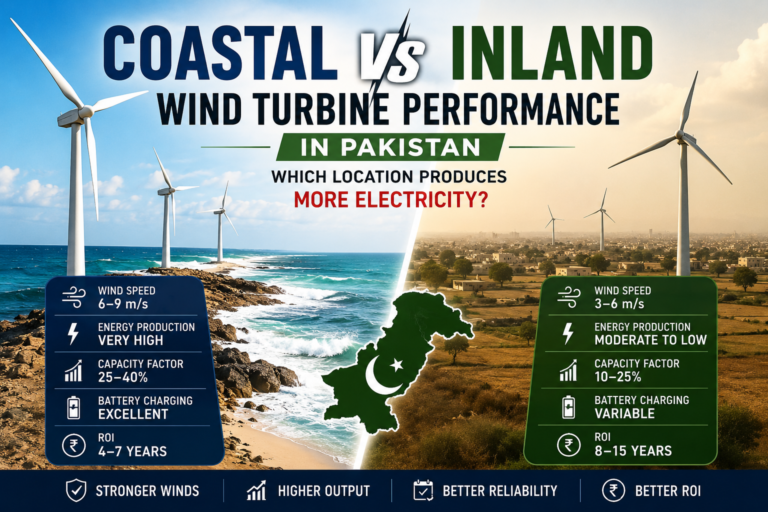
Pakistan Location Matters
A small wind turbine should not be recommended simply because it is being installed somewhere in Pakistan.
Wind conditions vary significantly between regions and even between nearby properties.
For example, an open coastal site in Sindh can experience very different conditions from the same turbine installed between buildings in Lahore.
Even within Karachi, two properties can have different wind conditions because of:
- building height
- trees
- nearby structures
- roof design
- local terrain
- distance from the coastline
Read our Best Wind Turbine for Home in Karachi guide for a location-specific example.
You can also explore our guide to the Best Cities for Wind Turbines in Sindh and Balochistan.
What Documents Should You Ask the Wind Turbine Supplier For?
Before buying a 1kW, 2kW or 3kW wind turbine, ask for technical documentation.
Ideally, you should be able to review:
| Document / Specification | Why It Is Needed |
| Datasheet | Basic specifications |
| Power curve | Expected output by wind speed |
| Rotor diameter | Swept-area calculation |
| Rated wind speed | Understand the rating |
| Cut-in wind speed | Starting behaviour |
| Rated RPM | Generator/rotor matching |
| Maximum RPM | Safety |
| Generator type | Electrical design |
| Output voltage | System compatibility |
| Controller specification | Correct control |
| Dump-load rating | Protection |
| Tower requirements | Structural design |
| Survival wind speed | Safety |
| Warranty | Commercial protection |
| Installation manual | Correct installation |
A professional supplier should be comfortable discussing these details.
15-Point Final Wind Turbine Buying Checklist
Before making payment, check every item below:
| # | Question |
| 1 | Do I know the site’s average wind speed? |
| 2 | Have I checked long-term or hourly wind data? |
| 3 | Is the proposed tower high enough? |
| 4 | Have buildings and trees been assessed? |
| 5 | Is 1kW, 2kW or 3kW properly sized for my requirement? |
| 6 | Do I know the rotor diameter and swept area? |
| 7 | Have I seen the turbine power curve? |
| 8 | Do I know the rated and cut-in wind speeds? |
| 9 | Are generator RPM, torque and rotor properly matched? |
| 10 | Are the controller and dump load included? |
| 11 | Is the turbine compatible with my inverter, battery and solar system? |
| 12 | Are voltage, cable size and cable distance correct? |
| 13 | Are the tower and foundation properly engineered? |
| 14 | Does the turbine have proper braking and high-wind protection? |
| 15 | Do I know the estimated annual kWh and total installed cost? |
If several answers are still unknown, you are probably not ready to buy the turbine yet.
What Information Should You Send for a Wind Turbine Assessment?
Before recommending a system, useful information includes the following.
Property Information
- Google Maps location
- building or house height
- photographs of the proposed turbine area
- nearby buildings and trees
- available open space
- proposed tower height
Electricity Information
- monthly electricity consumption in kWh
- electricity bill
- peak load, if known
- existing solar capacity
- battery capacity
- inverter model
Your Goal
Tell the supplier whether you want wind energy for:
- electricity bill reduction
- battery charging
- backup power
- off-grid electricity
- solar-wind hybrid
- farmhouse
- shop
- office
- small business
With this information, turbine selection becomes much more meaningful.
For a first screening, use the Wind Turbine Feasibility Check.
The Most Important Rule Before Buying a Wind Turbine
There is one idea worth remembering from this entire guide:
Do not buy a wind turbine first and then try to make it work at your property. Study the property first, then choose the turbine that fits it.
A successful small-wind project requires:
Good wind + correct rotor + correct turbine + correct tower + correct electrical system + professional installation
A 1kW wind turbine at the right location can be useful.
A 3kW wind turbine at the wrong location can be disappointing.
That is why WindTurbine.pk recommends starting with wind feasibility and site conditions, followed by turbine selection and system design.
For current business, visit WindTurbine.pk for Business.
pricing, see Wind Turbine Prices in Pakistan.
Frequently Asked Questions About 1kW–3kW Wind Turbines
Is a 1kW wind turbine enough for a house?
It can provide useful energy for a small home, essential loads, battery charging or a solar-wind hybrid system. Whether it is enough depends on the home’s electricity consumption and the site’s wind resource.
Is a 3kW wind turbine three times better than a 1kW wind turbine?
Not automatically. Actual annual production depends on rotor size, power curve, wind conditions, tower height and installation quality. Compare annual kWh, not only rated kW. https://windturbine.pk/blog/3kw-wind-turbine-power-generation-per-month/
What is the minimum wind speed needed for a small wind turbine?
There is no single minimum wind speed that applies to every turbine. Many small turbines begin operating at relatively low wind speeds, but useful energy production generally requires stronger and consistent wind. The manufacturer’s actual power curve is more useful than an advertised starting speed.
Can I install a wind turbine with my existing solar system?
Often yes. Wind and solar can complement each other, but the wind controller, dump load, battery voltage and inverter architecture must be compatible.
Should I install a wind turbine on my roof?
Only after checking wind flow and structural conditions. Rooftops can experience significant turbulence from the building and nearby obstacles.
Which is better: 1kW, 2kW or 3kW?
The best turbine is the one that matches your wind resource, annual electricity requirement, available tower height, electrical system and budget. Bigger is not automatically better.
Where should I check before buying a wind turbine in Pakistan?
Start by checking the wind resource at the proposed installation site. You can use the https://windturbine.pk/blog/2kw-wind-turbine-pakistan/ for an initial assessment.
Secondary Keywords:
- 1kW wind turbine Pakistan
- 2kW wind turbine Pakistan
- 3kW wind turbine Pakistan
- wind turbine for home Pakistan
- small wind turbine Pakistan
- home wind turbine buying guide
- wind turbine power curve
- wind turbine tower height
- wind turbine rotor size
- solar wind hybrid system Pakistan
- wind turbine feasibility Pakistan
- wind turbine price in Pakistan
Recommended Internal Links
- Wind Turbine Feasibility Check
- Wind Turbine Prices in Pakistan
- WindTurbine.pk Products
- Wind Turbine blog
- How to Choose the Right Wind Turbine for Your Home in Pakistan
- 2kW Wind Turbine Pakistan Buying Guide
- Horizontal Axis vs Vertical Axis Wind Turbine
- Best Wind Turbine for Home in Karachi
- Best Cities for Wind Turbines in Sindh and Balochistan
- Small Wind Turbines for Homes in Pakistan