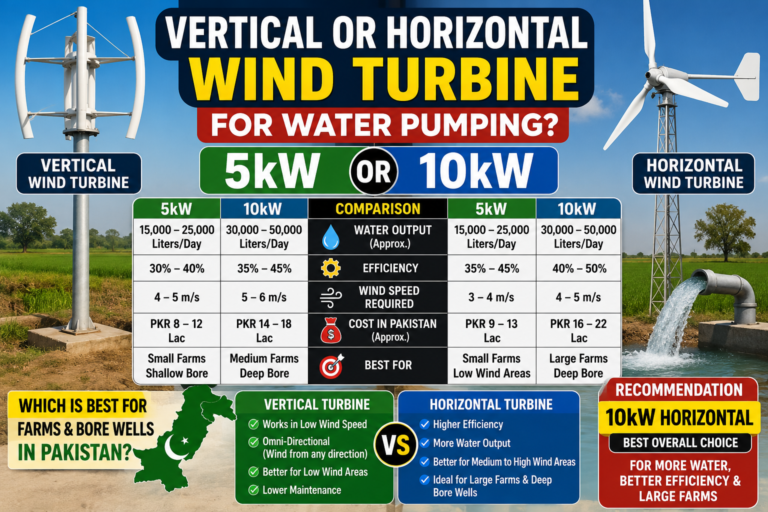
10kW Wind Turbine in Pakistan: Price, Real Output, NASA Wind Data and Installation Guide
10kW wind turbine in Pakistan can supply meaningful electricity to your home, small business, farmhouse, commercial building, school, remote facility or wind-solar hybrid system. However, the term “10kW” describes the turbine’s rated or nominal capacity—not the electricity it will produce continuously.
The actual performance of a 10kW wind turbine in Pakistan depends on:
- average wind speed at hub height;
- wind-speed distribution throughout the year;
- turbine rotor diameter and swept area;
- tower height;
- surrounding buildings and trees;
- turbine power curve;
- generator and controller efficiency;
- equipment downtime;
- local air density and turbulence.
A 10kW turbine installed at a poor site can produce less electricity than a properly selected 3kW turbine installed at a strong, unobstructed wind site. https://windturbine.pk/
The most important purchasing metric is therefore not simply the rated power. It is the turbine’s expected annual energy production in kilowatt-hours at the proposed installation site. The US Department of Energy similarly recommends comparing turbines through their annual energy output, power curve, tower height and site wind distribution rather than nameplate capacity alone.
10kW Wind Turbine Price in Pakistan
The current listed price for the referenced 10kW vertical wind turbine in Pakistan available here
https://windturbine.pk/prices-of-wind-turbine-in-pakistan/ or contact by Whats app 0330-856-2626
Estimated project scope
| Component | Status |
|---|---|
| Vertical wind turbine and generator | Expected |
| Blades and rotor assembly | Expected |
| Wind charge controller | Must be confirmed |
| Dump load | Must be confirmed |
| Grid-tie or hybrid inverter | Must be confirmed |
| Steel tower | Usually quoted separately |
| RCC foundation | Usually quoted separately |
| Transport and crane | Site dependent |
| Installation labour | Ask before ordering |
| Earthing system | Must be confirmed |
| Lightning protection | Yes |
| AC/DC protection devices | Must be confirmed |
| Monitoring system | Optional |
| Batteries | Not normally included |
The final installed price can therefore be substantially higher than the turbine price alone.
What Does “10kW Wind Turbine” Actually Mean?
A 10kW turbine does not produce 10 kilowatts throughout the day.
It may produce:
- almost zero power in very low wind;
- a few hundred watts in moderate wind;
- several kilowatts in strong wind;
- approximately 10kW only near its rated wind speed;
- no power if the turbine shuts down during extreme wind or maintenance.
Wind power follows this relationship:
[
P=\frac{1}{2}\rho A V^3 C_p \eta
]
Where:
- (P) = electrical power;
- (\rho) = air density;
- (A) = rotor swept area;
- (V) = wind speed;
- (C_p) = aerodynamic power coefficient;
- (\eta) = generator and electrical efficiency.
The most important feature of this formula is (V^3): available wind power increases with the cube of wind speed. The Pakistan Meteorological Department’s Gharo study uses the same wind-power relationship and emphasizes that power density rises sharply with wind velocity. (pmd.gov.pk)
For example:
- doubling wind speed from 5 m/s to 10 m/s increases available wind power approximately eight times;
- a turbine producing less than 1kW at 5 m/s may approach its rated output near 11–12 m/s.
What Does a Genuine 10kW Turbine Look Like?
To understand what realistic 10kW performance requires, it is helpful to examine independently tested and professionally documented turbines.
International 10kW turbine benchmark comparison
| Specification | Bergey Excel 10 | TUGE10 |
|---|---|---|
| Turbine type | Three-blade horizontal axis | Three-blade horizontal axis |
| Rotor swept area | 38.5 m² | 82 m² |
| Rotor diameter | Not stated in certification summary | 10.2 m |
| Reference/nominal wind speed | 11 m/s | 11 m/s |
| Output at 11 m/s | 8.86kW | 9.43kW |
| Peak or maximum power | 12.6kW at 16.5 m/s | 9.9kW |
| Annual energy at 5 m/s average wind | 13,842 kWh | 25,867 kWh |
| Tower | Tested on 30m tower | 18m or 22m tower |
| Rated sound level | 42.9 dB(A) | 43.7 dB(A) |
| Testing/certification | ICC-SWCC/AWEA | IEC 61400-2/AWEA type tested by Intertek |
The ICC-SWCC certification report states that the Bergey Excel 10 has a 38.5m² swept area, produced 8.9kW at 11 m/s and reached a measured peak of 12.6kW. Its certified annual energy production at an average wind speed of 5 m/s is approximately 13,842 kWh. (Small Wind Certification)
Why is TUGE10’s annual output much higher?
Both machines are marketed in approximately the same capacity class, but TUGE10 has more than twice the rotor swept area.
That larger rotor intercepts more wind and produces substantially more electricity during moderate wind conditions. This illustrates an essential buying rule:
Two turbines carrying the same “10kW” label may produce very different amounts of electricity per year.
Certified 10kW-Class Power Curve
The following table uses measured data from the ICC-SWCC certification report for the Bergey Excel 10. It shows how output changes with wind speed.
| Wind speed | Approximate certified output |
|---|---|
| 2 m/s | 0 W |
| 3 m/s | 102 W |
| 4 m/s | 399 W |
| 5 m/s | 848 W |
| 6 m/s | 1,510 W |
| 7 m/s | 2,403 W |
| 8 m/s | 3,602 W |
| 9 m/s | 5,071 W |
| 10 m/s | 6,856 W |
| 11 m/s | 8,863 W |
| 12 m/s | 10,885 W |
| 14 m/s | 12,395 W |
| 16.5 m/s | 12,555 W |
These are measured outputs corrected to a sea-level air density of 1.225 kg/m³.
The table clearly shows that:
- a 10kW turbine does not deliver 10kW at 5–7 m/s;
- at 5 m/s it may produce less than 1kW at that moment;
- it requires approximately 11–12 m/s wind to approach 10kW;
- rotor design and generator control determine the shape of the power curve.
https://windturbine.pk/blog/how-to-check-wind-turbine-power-claims/
Wind POWER Wind Data for Coastal Pakistan by NASA
NASA POWER provides satellite- and model-based meteorological datasets for renewable-energy screening that explains that its wind products represent the mean wind flow of a region, rather than the exact wind flow around individual buildings, trees or local terrain. It also allows wind speed to be corrected to heights between 10m and 300m using surface roughness information.
A 2025 peer-reviewed Scientific Reports study analysed hourly NASA POWER wind data for six coastal locations in Pakistan during 2023. The data were evaluated at both 10m and 50m heights. (Nature)
NASA POWER coastal wind-speed table
| Location | Mean wind at 10m | Mean wind at 50m | Increase from 10m to 50m |
|---|---|---|---|
| Gwadar | 4.40 m/s | 4.93 m/s | 12% |
| Jiwani | 4.22 m/s | 4.81 m/s | 14% |
| Karachi | 4.57 m/s | 5.59 m/s | 22% |
| Keti Bandar | 5.02 m/s | 6.30 m/s | 26% |
| Ormara | 4.48 m/s | 5.46 m/s | 22% |
| Pasni | 3.94 m/s | 4.94 m/s | 25% |
The numerical values above are taken from the study’s wind-characteristic graphs for 10m and 50m heights.
Main observations
- Keti Bandar had the strongest mean wind among the six locations.
- Karachi and Ormara showed relatively promising elevated wind speeds.
- Gwadar had moderate average wind during the studied year.
- Jiwani and Pasni showed lower mean values, although local exposed sites may perform differently.
- Wind speed increased considerably with tower height, particularly around Karachi, Keti Bandar, Ormara and Pasni.
However, the NASA dataset used in this particular study covered only 2023. It should therefore be used as a preliminary screening reference, not as a guaranteed long-term production forecast. A commercial investment should use several years of reanalysis data and preferably on-site measurements.
Estimated 10kW Output in Coastal Pakistan
The following output estimates combine:
- NASA POWER mean wind speeds at 10m and 50m;
- an estimated wind speed at 30m hub height;
- the certified annual-energy curve of the Bergey Excel 10.
The 30m values were estimated from the two NASA heights using a site-specific power-law wind-shear calculation. Annual generation was then interpolated from the certified SWCC annual-energy table.
https://windturbine.pk/blog/wind-turbine-in-dha-karachi/
Illustrative energy-production table for 10kW wind turbine in Pakistan
| Location | Estimated wind at 30m | Estimated annual generation | Average monthly units | Capacity factor |
|---|---|---|---|---|
| Gwadar | 4.76 m/s | 12,200 kWh | 1,017 units | 13.9% |
| Jiwani | 4.61 m/s | 11,300 kWh | 938 units | 12.8% |
| Karachi | 5.24 m/s | 15,900 kWh | 1,325 units | 18.2% |
| Keti Bandar | 5.86 m/s | 21,100 kWh | 1,761 units | 24.1% |
| Ormara | 5.13 m/s | 14,900 kWh | 1,244 units | 17.0% |
| Pasni | 4.60 m/s | 11,100 kWh | 929 units | 12.7% |
These figures are analytical illustrations—not guaranteed production figures. They assume a certified turbine comparable to the Bergey Excel 10, open exposure, suitable tower height, reference air density and no major local turbulence. The calculation inputs come from NASA POWER-derived coastal data and the ICC-SWCC certified energy curve.
What does this mean practically?
At an annual generation of:
- 11,000 kWh, the turbine’s average continuous output is about 1.26kW;
- 16,000 kWh, average continuous output is about 1.83kW;
- 21,000 kWh, average continuous output is about 2.40kW.
Therefore, even though the turbine is rated at 10kW, its year-round average output may be between approximately 1.3kW and 2.4kW at the example locations.
This is normal for wind power. Rated output occurs only during stronger wind periods.
Gharo Wind Data: A Stronger Pakistan Example
A historical Pakistan Meteorological Department study used three years of measured data from a dedicated wind mast at Gharo, Sindh.
The study reported:
| Parameter | Gharo result |
|---|---|
| Annual mean wind at 30m | 6.18 m/s |
| Annual mean wind at 50m | 6.6 m/s |
| Wind power density at 50m | Approximately 360 W/m² |
| Hours with wind at or above 5 m/s at 30m | 5,989 hours/year |
| Hours with wind at or above 5 m/s at 50m | 6,656 hours/year |
| Strongest season | April to September |
| Dominant wind direction | West-southwest |
The study found considerably stronger summer winds, with monthly 50m averages exceeding 9 m/s during May, June and July. (pmd.gov.pk)
Using the certified Bergey annual-energy curve, a comparable 10kW-class turbine at Gharo’s measured 30m average of 6.18 m/s could theoretically produce around:
- 23,900 kWh per year
- approximately 1,990 units per month
- about 27% annual capacity factor
This estimate closely illustrates why Gharo, Jhimpir and nearby exposed areas are generally more attractive for wind energy than dense urban rooftops.
How Many Units Can a 10kW Wind Turbine Generate?
A 10kW turbine has a theoretical maximum monthly generation of:
[
10 \times 24 \times 30 = 7,200\text{ kWh}
]
However, this would require the turbine to produce its full 10kW output continuously for every hour of the month, which does not happen under normal wind conditions.
More realistic monthly production
| Wind-resource quality | Approximate annual output | Approximate monthly output |
|---|---|---|
| Weak to marginal site | 7,000–11,000 kWh | 580–920 units |
| Moderate site | 11,000–16,000 kWh | 920–1,330 units |
| Good coastal site | 16,000–22,000 kWh | 1,330–1,830 units |
| Strong exposed site | 22,000–28,000 kWh | 1,830–2,330 units |
| Exceptional site or very large rotor | Above 28,000 kWh | Above 2,330 units |
The exact result must be calculated using the turbine’s certified power curve and the site’s complete wind-speed frequency distribution.
Rotor Size Matters More Than the Printed Watt Rating
A turbine can only extract energy from the air passing through its rotor swept area.
For a horizontal turbine:
[
A=\pi r^2
]
For a vertical turbine, swept area is generally approximated as:
[
A=H \times D
]
Where:
- (H) = rotor height;
- (D) = rotor diameter. The Department of Energy’s Energy.gov)
Example of a questionable 10kW claim for 10kW wind turbine in Pakistan
Some vertical turbines advertised as 10kW list approximately:
- rotor height: 3.5m;
- rotor diameter: 1.2m;
- swept area: 4.2m²;
- rated wind speed: 12 m/s.
At 12 m/s, the total kinetic power passing through a 4.2m² rotor is only approximately:
[
4.45\text{ kW}
]
That is the total power in the wind before aerodynamic, generator, bearing, controller and cable losses.
It is therefore physically impossible for such a rotor to deliver 10kW of electrical output at 12 m/s under ordinary open-wind conditions.
By comparison:
| Turbine example | Swept area |
|---|---|
| Compact 3.5m × 1.2m vertical rotor | 4.2m² |
| Certified Bergey Excel 10 | 38.5m² |
| Type-tested TUGE10 | 82m² |
This does not mean that every compact vertical turbine is useless. It means that its advertised watt rating must be independently verified.
Horizontal or Vertical 10kW Wind Turbine?
Horizontal-axis wind turbine
A horizontal-axis wind turbine normally has:
- two or three aerodynamic blades;
- a rotor facing the wind;
- a tail or active yaw system;
- a relatively large swept area;
- higher tip speed;
- well-established power curves and certification methods.
The Department of Energy notes that horizontal-axis turbines are the most common small-wind configuration and that rotor diameter determines the intercepted wind area. https://windturbine.pk/blog/vertical-vs-horizontal-wind-turbine-pakistan/
Advantages of 10kW wind turbine in Pakistan
- generally higher aerodynamic efficiency;
- larger rotor area for the same rated capacity;
- more independently tested models;
- stronger output in smooth, open wind;
- easier comparison using certified power curves.
Limitations
- must face the wind;
- requires adequate blade clearance;
- may need a taller and stronger tower;
- more visually prominent.
Vertical-axis wind turbine
A vertical turbine rotates around a vertical shaft and can accept wind from multiple directions.
https://windturbine.pk/blog/vertical-wind-turbine-pakistan/
Advantages
- compact appearance;
- no conventional tail;
- suitable for demonstration and architectural projects;
- generator may be positioned lower in some designs;
- potentially easier access to certain components. 10kW wind turbine in Pakistan
Limitations
- small compact models often have limited swept area;
- many products lack independently certified power curves;
- turbulent rooftop wind can reduce production;
- some drag-based designs have lower efficiency;
- marketing ratings may refer to generator capacity rather than actual rotor output.
Practical conclusion
For pure electricity generation at a good open site, a properly certified horizontal-axis turbine with a large rotor will usually be the safer technical choice.
A vertical turbine may still be selected where appearance, wind-direction variation, installation shape or demonstration value is important—but its power curve must be verified. 10kW wind turbine in Pakistan.
Is a 10kW Wind Turbine Suitable for a Home?
A 10kW turbine can contribute significant electricity to a large home, farmhouse or estate, but it should not be selected only by adding the wattage of household appliances.
The buyer should examine annual consumption.
Example load comparison
| Electricity consumption | Annual energy required |
|---|---|
| 500 units/month | 6,000 kWh/year |
| 1,000 units/month | 12,000 kWh/year |
| 1,500 units/month | 18,000 kWh/year |
| 2,000 units/month | 24,000 kWh/year |
| 3,000 units/month | 36,000 kWh/year |
A genuine 10kW turbine producing 15,000 kWh annually could offset the annual consumption of a property using approximately 1,250 units per month.
However, generation and demand will not occur at the same time. A grid connection or battery system is needed to balance the difference.
Suitable Applications in Pakistan
A 10kW wind turbine may be appropriate for:
- large houses and coastal properties;
- farms and farmhouses;
- poultry and livestock farms;
- schools and educational institutions;
- workshops;
- small factories;
- telecom installations;
- security-camera systems;
- remote research stations;
- desalination or water-pumping projects;
- wind-solar hybrid systems;
- commercial renewable-energy demonstrations.
For a normal urban house with limited space and disturbed rooftop wind, a 10kW turbine may be impractical even if the electrical demand is high.
Tower Height and Site Selection
Tower height can make the difference between a successful turbine and an expensive rotating structure that generates very little electricity.
Wind speed generally increases with height because the turbine moves away from:
- buildings;
- boundary walls;
- trees;
- water tanks;
- uneven ground;
- surface friction.
The Department of Energy recommends locating the bottom of the rotor at least approximately 9m above nearby obstacles within about 90m of the tower. It also notes that increased tower height can produce a high return through improved wind exposure. (The Department of Energy’s Energy.gov)
Recommended tower range
For a genuine 10kW system:
| Site condition | Indicative tower approach |
|---|---|
| Open coastal land | 18–30m tower |
| Open farmhouse | 18–24m tower |
| Area with nearby trees | Tower above full tree height |
| Near low buildings | Rotor well above rooftop turbulence |
| Dense urban location | Usually not recommended without detailed study |
| Rooftop | Structural and turbulence assessment mandatory |
International 10kW benchmark turbines use towers between approximately 18m and 30m.
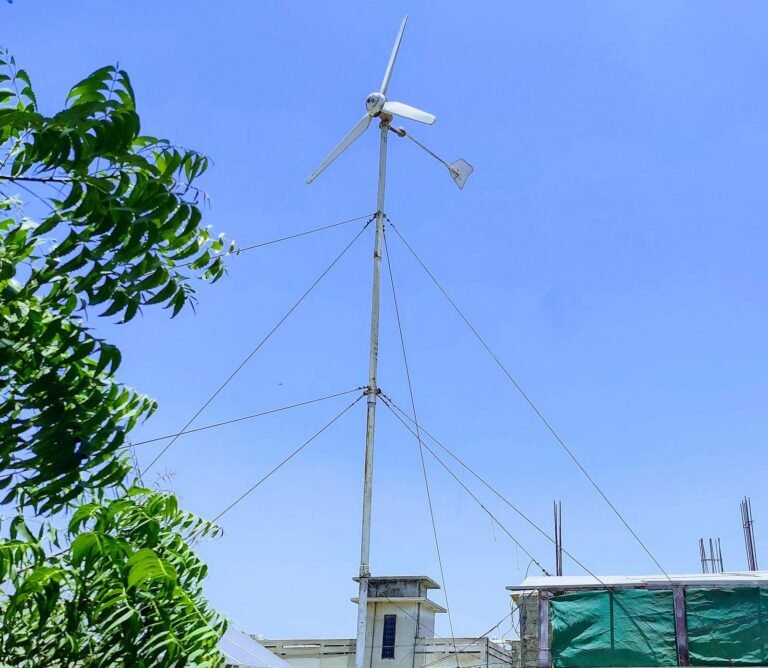
Should a 10kW Turbine Be Installed on a Rooftop?
Rooftop installation should not be the default choice.
The Department of Energy warns that rooftop turbines can:
- transfer vibration to the building;
- create internal noise;
- operate in turbulent wind;
- experience reduced energy production;
- experience shorter equipment life;
- require additional structural reinforcement. (The Department of Energy’s Energy.gov)
A ground-supported tower usually provides:
- smoother wind;
- better rotor clearance;
- easier maintenance;
- lower building vibration;
- safer structural load transfer;
- higher annual generation.
A 10kW turbine may also weigh several hundred kilograms and develop high dynamic and overturning forces during strong wind. Roof slab strength alone is not enough; forces must transfer safely to beams, columns and foundations.
Foundation and Structural Requirements
A professional 10kW installation should include engineering calculations for:
- turbine dead weight;
- tower dead weight;
- rotor thrust;
- cyclic vibration;
- fatigue;
- extreme gusts;
- tower resonance;
- overturning moment;
- guy-wire loads;
- bolt tension;
- foundation pull-out;
- corrosion;
- emergency braking forces.
IEC 61400-2 covers the design, installation, maintenance, operation, electrical systems, support structures and foundations of small wind turbines.
IEC 61400-24 provides requirements and guidance for lightning protection of turbine blades, structures, electrical equipment, controls and earthing systems.
For coastal Pakistan, the tower should normally use:
- hot-dip galvanised steel;
- marine-grade protective coating where required;
- stainless or protected fasteners;
- sealed electrical connections;
- proper drainage;
- scheduled corrosion inspections. https://windturbine.pk/blog/wind-turbine-in-thatta-sindh/
10kw wind turbine.