Wind Turbine Price in Pakistan: 1 kW to 100 kW Complete Guide
Pakistan has some excellent locations for wind energy, but a wind turbine is not suitable for every home, factory or city.
Wind turbine price from 1 KW to 100 KW in Pakistan
A customer may first search for:
“1 kW wind turbine price in Pakistan”
or:
“100 kW wind turbine price in Pakistan.”
But price should not be the first technical decision.
Before choosing a wind turbine, we need to know:
How much wind is available at the exact property, at what height, and how much electricity the selected turbine can realistically generate during a complete year?
This guide explains wind turbine prices from 1 kW to 100 kW, suitable applications, Pakistan’s proven wind regions, wind-data sources, tower requirements, expected performance, and the checks a homeowner or business should complete before investing.
For an initial site assessment, you can also use the WindTurbine.pk Wind Feasibility Check.
Wind Turbine Price in Pakistan 2026-2027
Small wind turbine prices vary according to turbine size, rotor diameter, generator, controller, tower, inverter, batteries, installation and other equipment.
The currently published WindTurbine.pk price guide shows the following indicative equipment prices. (windturbine.pk)
| Turbine Size | Published Indicative Price | Common Application |
|---|---|---|
| 500 W | Wind Turbine Price Page | Small loads, battery charging |
| 1 kW | Call or Whats App 0330-856-2626 | Home, farmhouse, hybrid system |
| 2 kW | Call or Whats App 0300-2500-169 | Home, farm |
| 3 kW | Larger home, shop, small business | |
| 5 kW | Call for latest price | Farm, large home, business |
| 10 kW | Project quotation | Farm, school, commercial |
| 20 kW | Project quotation | Commercial/agriculture |
| 30 kW | Project quotation | Business/industry |
| 50 kW | Project quotation | Industrial/commercial |
| 100 kW | Project quotation | Factory/institutional project |
Check the latest figures on our Wind Turbine Price in Pakistan page.
Important: turbine price and complete installed project price are not necessarily the same.
Why We Do Not Publish a Fixed 20 kW, 50 kW or 100 kW Price
A small turbine can sometimes be sold as a standard package. A commercial turbine project cannot be priced responsibly without knowing the site.
For example, a 100 kW project may require:
| Item | Why It Matters |
|---|---|
| Wind turbine | Main generating equipment |
| Controller/converter | Controls electrical output |
| Tower | Determines hub height |
| Foundation | Supports tower and turbine loads |
| Crane | Required for erection on larger systems |
| Transport | Depends on turbine and location |
| Switchgear | Electrical control/protection |
| Earthing | Safety |
| Lightning protection | Important for exposed towers |
| Cabling | Depends on tower and electrical distance |
| Monitoring | Important for commercial projects |
| Civil works | Site dependent |
| Grid integration | Required where applicable |
| Engineering | Structural + electrical design |
This is why “100 kW turbine price” and “100 kW installed wind project cost” can be very different numbers.
For commercial projects, the correct order should be:
Site → Wind Data → Load → Turbine → Tower → Annual Energy → Engineering → Final Price
Is Wind Energy Actually Proven in Pakistan?
Yes.
And we do not need to rely on a turbine seller’s claim to prove it.
The Government of Pakistan’s Private Power & Infrastructure Board (PPIB) commissioned-project database records numerous operational wind projects in Pakistan.
Examples include projects at Jhimpir and Gharo in Sindh, ranging from roughly 50 MW to around 100 MW.
This is important for a potential buyer.
Pakistan is not experimenting with wind energy for the first time. Large commercial wind turbines have already been operating here for years.
Real Wind Projects in Pakistan: Official Evidence
Some examples from official PPIB records are particularly useful.
| Project | Location | Capacity | Turbine Configuration |
|---|---|---|---|
| Artistic Wind Power | Jhimpir | 50 MW | 20 × 2.5 MW Goldwind GW-121 |
| Metro Wind Power | Jhimpir | 60 MW | 30 × 2 MW Gamesa G-114 |
| UEP Wind Power | Jhimpir, Thatta | 99 MW | 66 × 1.5 MW Goldwind GW77 |
| Foundation Wind I | Gharo | 50 MW | 20 × 2.5 MW Nordex N100 |
| Foundation Wind II | Gharo | 50 MW | 20 × 2.5 MW Nordex N100 |
These specifications come from individual PPIB project records.
This gives us something more valuable than a generic statement that “Sindh is windy.”
It gives us real operating-project evidence.
What Do Real Pakistani Wind Projects Tell Us About Performance?
Rated MW alone does not tell the whole story.
PPIB’s official project information for Artistic Wind Power at Jhimpir lists:
50 MW gross capacity
20 × 2.5 MW Goldwind GW-121 turbines
37.5% net capacity factor.
Metro Wind Power’s 60 MW Jhimpir project lists:
30 × 2 MW Gamesa G-114 turbines
38% net capacity factor.
UEP Wind Power’s 99 MW project lists:
66 × 1.5 MW Goldwind GW77 turbines
31% net capacity factor.
Real Pakistan wind-project examples
| Project | Location | Capacity | PPIB-listed Net Capacity Factor |
|---|---|---|---|
| A- Wind | Jhimpir | 50 MW | 37.5% |
| Metro Wind | Jhimpir | 60 MW | 38% |
| UEP Wind | Jhimpir/Thatta | 99 MW | 31% |
| A- Energy | Jhimpir | 49.3 MW | 37.5% |
These are strong numbers for commercial wind.
But there is a critical warning:
Do not apply a 31–38% utility-scale wind-farm capacity factor directly to a 1 kW turbine on a Karachi rooftop.
Large wind farms use tall towers, large rotors, professionally selected sites and open terrain.
A small urban turbine operates in a completely different environment.
How We Check Wind Before Recommending a Turbine
At WindTurbine.pk, the first stage should be wind-resource screening.
One useful independent source is NASA POWER.
NASA POWER meteorological data are based primarily on NASA’s MERRA-2 atmospheric reanalysis, and wind-speed data are available at standard heights including 10 m and 50 m. (Power Resources)
This allows us to study historical hourly wind patterns for a location.
However, NASA itself gives an important warning.
NASA says its wind parameters should be used for understanding the mean wind flow of a region, rather than local effects caused by buildings and local topography.
That means NASA data are useful for:
Initial site screening
Long-term historical analysis
Seasonal comparison
10 m vs 50 m comparison
Hourly wind analysis
But they cannot tell us exactly what is happening:
behind your neighbour’s house, beside a warehouse, or one metre above your rooftop.
That requires local assessment.
Why We Analyse Hourly Wind Data
Suppose a location has an annual average wind speed of:
5 m/s
A turbine buyer might think that is enough information.
It isn’t.
We want to know how the year is distributed.
For example:
| Wind Speed | Hours per Year |
|---|---|
| 0–1 m/s | ? |
| 1–2 m/s | ? |
| 2–3 m/s | ? |
| 3–4 m/s | ? |
| 4–5 m/s | ? |
| 5–6 m/s | ? |
| 6–7 m/s | ? |
| 7–8 m/s | ? |
| 8–9 m/s | ? |
| 9–10 m/s | ? |
| 10+ m/s | ? |
A year normally contains 8,760 hours.
If most of those hours occur below useful operating speeds, a large turbine rating will not solve the problem.
We then compare the hourly wind distribution against the manufacturer’s turbine power curve.
This allows us to estimate:
Annual Energy Production — kWh/year
That number is much more useful to a buyer than simply saying:
“This is a 5 kW turbine.”
How Accurate Is NASA Wind Data?
NASA also publishes validation information instead of asking users to blindly trust the model.
NASA’s daily validation summary for 10 m wind speed reports an overall mean bias error of 0.33 m/s and RMSE of 1.45 m/s for its comparison dataset.
These are not Jamshoro- or Karachi-specific errors. They describe NASA’s validation dataset.
This is exactly why we should use NASA POWER as a screening and historical-analysis tool, not claim that it replaces an anemometer installed at the proposed turbine position.
For larger commercial projects, actual site measurement can become necessary.
1 kW Wind Turbine Price and Application
A 1 kW wind turbine is one of the most common sizes considered by homeowners.
WindTurbine.pk currently lists an indicative 1 kW turbine price (windturbine.pk)
Typical applications can include:
small homes, farmhouses, battery charging, remote loads and solar-wind hybrid systems.
But 1 kW does not mean:
1 kW × 24 hours = 24 kWh every day.
The 1 kW figure is the turbine’s rated output under specified operating conditions.
Read our Pakistan-specific explanation: How Much Energy Can a 1 kW Wind Turbine Generate in Karachi?
3 kW Wind Turbine Price and Application
WindTurbine.pk’s current published guide lists . (windturbine.pk)
A 3 kW system may be considered for:
- larger homes;
- farms;
- shops;
- workshops;
- small businesses;
- hybrid renewable systems.
But a house consuming 3 kW at a particular moment does not automatically need a 3 kW wind turbine.
Electricity consumption should be analysed in kWh, while turbine capacity is stated in kW.
For a more detailed sizing explanation, see What Size Wind Turbine Do I Need for My Home?.
5 kW Wind Turbine Price and Application
The current WindTurbine.pk price guide lists (windturbine.pk)
Possible applications include:
- large homes;
- farmhouses;
- farms;
- workshops;
- schools;
- resorts;
- small businesses;
- remote facilities.
At this capacity, we would pay much more attention to the tower and foundation.
The turbine should not be selected independently and then placed on whatever tower happens to be available.
10 kW Wind Turbine
A 10 kW wind turbine moves from simple residential small wind toward a more serious commercial installation.
Potential applications include:
farms, schools, poultry operations, resorts, workshops, telecom installations, commercial properties and hybrid renewable-energy systems.
For 10 kW, we recommend at least:
Exact coordinates → wind analysis → site survey → load analysis → turbine power curve → tower selection → annual energy estimate → quotation.
Our Home Wind Turbine Technical Guide for 1–10 kW Systems explains the underlying technical concepts in simpler language.
20 kW and 30 kW Wind Turbines
At this level, the project is usually commercial rather than a normal urban home installation.
Potential users include:
- farms;
- factories;
- workshops;
- agricultural operations;
- schools and institutions;
- commercial buildings;
- remote facilities.
A 20–30 kW customer should provide more than a WhatsApp message asking:
“30 kW price?”
We need the site’s Google coordinates, electricity consumption, installation area, existing solar/inverter system, proposed tower location and surrounding obstacles.
50 kW Wind Turbine
A 50 kW turbine should be treated as an engineering project.
Before purchase, the buyer should investigate:
wind resource, turbine power curve, tower, soil, foundation, extreme wind, transport, crane access, electrical integration, protection, monitoring, service and spare parts.
The difference between a successful 50 kW project and an unsuccessful one is usually not just turbine price.
It is site + turbine + engineering.
https://windturbine.pk/blog/wind-turbine-for-factory-karachi/
100 kW Wind Turbine for Business
At 100 kW, asking only for a turbine price is the wrong starting point.
A business should ask:
How many kWh per year can this turbine realistically generate at our exact location and proposed hub height?
A proper 100 kW project should normally move through:
Wind Resource Assessment → Micro-siting → Turbine Selection → Annual Energy Production → Structural Design → Electrical Design → CAPEX → OPEX → Savings → Payback.
This is why WindTurbine.pk should provide project quotations for larger turbines instead of publishing one universal price. Wind Turbine for Business in Pakistan
Quick Guide: 1 kW to 100 kW
| Capacity | Typical User | Recommended Assessment |
|---|---|---|
| 1 kW | Small home/farmhouse | Wind screening |
| 2 kW | Home/farm | Wind + load check |
| 3 kW | Home/shop | Site assessment |
| 5 kW | Farm/business | Site survey |
| 10 kW | Commercial | Detailed assessment |
| 20 kW | Farm/business | Engineering assessment |
| 30 kW | Commercial | Detailed engineering |
| 50 kW | Industry | Full feasibility |
| 100 kW | Factory/institution | Full feasibility + engineering |
Best Areas for Wind Turbines in Pakistan
This needs careful wording.
We should separate:
areas with proven utility-scale wind development
from:
cities where an individual small-wind site may be suitable.
A wind farm 20 km away does not automatically prove that your roof has good wind.
Jhimpir — Pakistan’s Most Proven Wind Area
Jhimpir has perhaps the strongest real-world evidence for wind-energy development in Pakistan.
Official records also show net capacity factors between 31% and 38% for these particular projects.
For businesses with property near Jhimpir, wind energy deserves serious investigation.
Gharo
Gharo is another proven wind-development area.
PPIB records both Foundation Wind Energy I and II at Gharo, each with 50 MW gross capacity and 20 × 2.5 MW Nordex N100 turbines.
This is real project evidence rather than a theoretical wind-map prediction.
Thatta
Thatta is closely associated with Pakistan’s major operating wind projects.
For example, PPIB identifies UEP Wind Power’s 99 MW project at Jhimpir, Thatta, Sindh.
Open agricultural and commercial properties in this region deserve serious wind screening.
Jamshoro
Jamshoro is especially interesting for industrial wind applications because of its geography and proximity to Sindh’s established wind-development region.
For a Jamshoro factory, however, we should not simply copy Jhimpir’s performance.
We would analyse:
exact coordinates → historical hourly wind → 10 m/50 m data → estimated hub-height wind → wind-speed bins → turbine power curve → annual kWh.
That produces a project-specific answer.
Hyderabad
Hyderabad can be interesting, particularly for open properties, farms and industrial sites outside dense urban development. Wind Turbine For Business- Hyderabad
But central Hyderabad and open land outside Hyderabad can have very different wind conditions.
Buildings increase surface roughness and create turbulence.
So we should never advertise:
“Hyderabad = suitable for every wind turbine.”
Instead:
“Hyderabad contains locations worth assessing for wind energy.”
That is technically much safer.
Karachi
Karachi is one of the most important markets for small wind, but it is also one of the easiest places to install a turbine incorrectly.
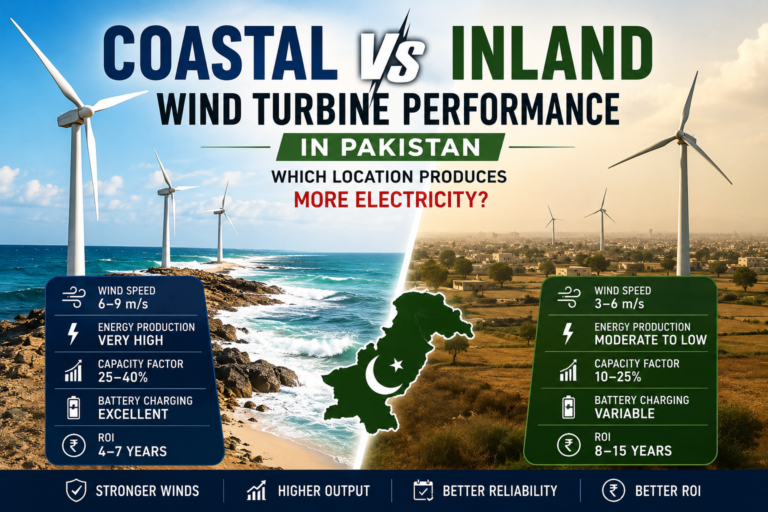
Some coastal and open Karachi locations can be promising.
Dense urban rooftops can be problematic.
NASA specifically warns that regional wind data do not represent local effects caused by buildings and local topography.
Therefore a Karachi assessment should consider:
distance from coast, surrounding building heights, rooftop height, available tower height, prevailing wind direction and turbulence.
A house near open coastal exposure and a house surrounded by multi-storey buildings should not receive the same recommendation.
For residential applications, see our Small Wind Turbines for Homes and Rooftops in Pakistan guide.
Badin and Coastal Sindh
Open land in southern Sindh can be worth investigating for:
farms, agricultural operations, water pumping, remote systems and commercial wind projects.
But wind is not the only consideration.
Site surveys should also examine:
soil, drainage/flood risk, access, foundation conditions and corrosion.
Keti Bandar and Coastal Locations
Coastal wind can be attractive, but coastal installation introduces an engineering problem that inland buyers may not face as strongly:
salt corrosion.
For coastal turbines we should check:
- tower galvanizing/coating;
- blade material;
- fasteners;
- generator enclosure;
- electrical enclosures;
- cable glands;
- connectors;
- maintenance intervals.
A good wind resource is of little value if the equipment deteriorates quickly in the environment.
Gwadar and Coastal Balochistan
Gwadar, Pasni and other exposed coastal Balochistan locations deserve wind-resource screening.
However, we should not say:
“It is near the sea, so install a wind turbine.”
Instead, analyse long-term wind, seasonal changes, corrosion, tower location and logistics.
For remote CCTV, telecom and security loads, a wind + solar + battery combination can sometimes be particularly interesting because the load continues through the night.
Lahore, Faisalabad and Punjab
A professional wind company should also be willing to tell a customer:
A wind turbine may not be the best investment at your site.
Urban Punjab should not automatically be treated as suitable for small wind.
Some open rural or exposed locations can work, but site conditions must be assessed individually.
WindTurbine.pk has a separate detailed guide: Are Wind Turbines Worth It in Punjab?.
Pakistan Wind Location Screening Table
| Location | Initial Assessment | Main Point |
|---|---|---|
| Jhimpir |  | Proven utility-scale wind |
| Gharo | | Proven utility-scale wind |
| Thatta | | Major wind-development region |
| Jamshoro | | Strong candidate for investigation |
| Hyderabad outskirts | | Open sites worth screening |
| Badin | | Open/coastal areas |
| Keti Bandar | | Wind resource + corrosion considerations |
| Karachi coast/open land | | Potentially useful |
| Dense Karachi rooftop | | Highly site dependent |
| Gwadar/Pasni | | Coastal sites worth screening |
| Punjab cities | | Site dependent |
| Open rural Punjab | | Assess individually |
| Northern/hilly areas | — | Terrain-specific assessment required |
These stars are screening categories, not measured wind-resource classes. A turbine should not be purchased from this table alone.
Why Tower Height Matters So Much
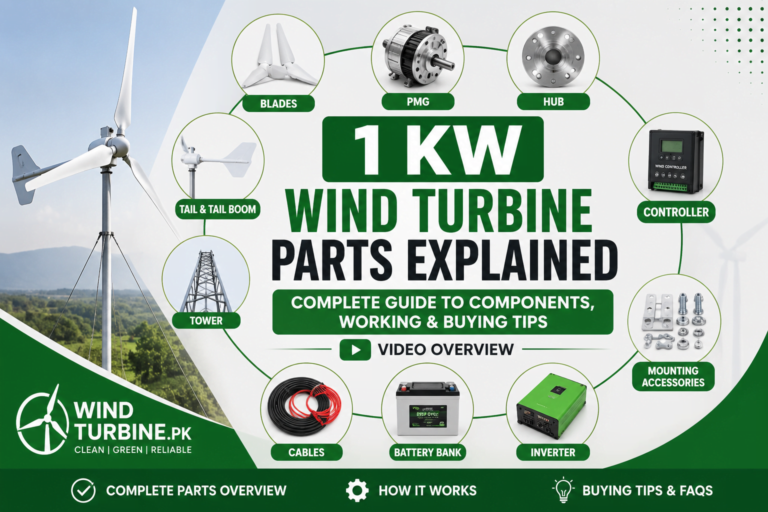
The generator is only one part of a wind turbine.
The tower determines where the rotor meets the wind.
Near the ground, buildings, trees, walls and other obstacles slow and disturb airflow.
A poorly positioned turbine can experience:
- low wind speed;
- turbulent wind;
- rapid direction changes;
- vibration;
- reduced energy;
- additional mechanical fatigue.
Therefore:
A good turbine on a bad tower can become a bad wind project.
This is one reason our Wind Feasibility Check considers installation conditions rather than only turbine size.
Rooftop Wind Turbine: Be Careful
Rooftop installation looks attractive because the building already provides height.
But buildings themselves disturb airflow.
A rooftop turbine can therefore experience significant turbulence.
Before recommending one, check:
building height, neighbouring buildings, roof structure, prevailing wind direction, vibration, turbine clearance and safe maintenance access.
Where land is available, a properly positioned dedicated tower can often provide cleaner airflow.
International Wind Turbine Standard: IEC 61400
Wind turbine engineering should not be based only on catalogue claims.
For small wind turbines, an important international reference is IEC 61400-2: Small Wind Turbines.
IEC states that the standard covers the safety, quality assurance and engineering integrity of small wind turbines and addresses design, installation, maintenance and operation. It also covers subsystems such as protection mechanisms, electrical systems, mechanical systems, support structures, foundations and electrical interconnection. (IEC Webstore)
This is an important lesson for buyers:
A wind turbine is not only blades and a generator. Wind turbine price from 1 KW to 100 KW in Pakistan
It is an engineered system.
What Should You Ask a Wind Turbine Supplier about Wind turbine price from 1 KW to 100 KW in Pakistan?
Before buying, ask for:
- Turbine datasheet
- Rotor diameter
- Swept area
- Rated power
- Rated wind speed
- Cut-in wind speed
- Power curve
- Rated RPM
- Generator type
- Voltage
- Controller specification
- Braking system
- Overspeed protection
- Survival/design wind speed
- Turbine weight
- Tower loads
- Tower drawing
- Foundation requirements
- Electrical diagram
- Warranty
- Spare-parts availability
- Test/certification documents
A specification saying only:
“5 kW — starts at 2 m/s — 20-year life”
is not enough to make a professional purchasing decision.
Grid-Connected Wind Systems in Pakistan
For a business considering a grid-connected wind turbine, current regulations also matter.
Pakistan introduced the NEPRA Prosumer Regulations 2026, so customers planning grid-connected distributed generation should check the current regulatory and distribution-company requirements before finalizing the system. (NEPRA)
For current regulations, use the official NEPRA website rather than relying on old net-metering blog posts.
This becomes especially important for commercial 10–100 kW projects.
How a Homeowner Should Select a Wind Turbine
For a home, use this sequence:
Step 1: Check electricity consumption
Look at monthly electricity use in kWh/units.
Step 2: Check the exact location
Do not use only the city name.
Step 3: Check historical wind
Use reliable resource data for initial screening.
Step 4: Inspect the property
Check buildings, trees, roof and available tower location.
Step 5: Select turbine
Compare rotor diameter and power curve—not just kW.
Step 6: Estimate annual kWh
Compare expected annual production with annual consumption.
A more detailed sizing method is available in What Size Wind Turbine Do I Need for My Home in Pakistan?.
Wind turbine price from 1 KW to 100 KW in Pakistan
How a Business Should Select a 10–100 kW Turbine
For business, the process should be more rigorous.
| Stage | Work Required |
|---|---|
| 1. Location | Exact GPS coordinates |
| 2. Desktop study | Historical wind-resource screening |
| 3. Site survey | Terrain, obstacles, access |
| 4. Wind analysis | Hourly speeds + direction + seasonality |
| 5. Hub height | Determine appropriate tower height |
| 6. Turbine selection | Power curve + rotor + design |
| 7. AEP | Calculate annual kWh |
| 8. Civil engineering | Tower/foundation/soil |
| 9. Electrical engineering | Controller, switchgear, protection |
| 10. CAPEX | Complete installed cost |
| 11. OPEX | Maintenance and operating cost |
| 12. Economics | Energy savings and payback |
Only after these steps does the price of the turbine become meaningful.
How Businesses Should Calculate Payback
Suppose an energy model estimates:
Annual wind generation = 30,000 kWh
and the business values displaced electricity at:
PKR 50/kWh
Then:
30,000 × 50 = PKR 1,500,000/year gross energy value
But that is not automatically annual profit.
The financial model should also consider:
maintenance + downtime + electrical losses + replacement components + financing + project life.
This gives a much more realistic business case. wind-turbine-for-factory-karachi
Wind vs Solar in Pakistan
For many homes, solar remains easier to install.
Wind becomes attractive where a genuine wind resource exists.
| Factor | Wind Turbine | Solar |
|---|---|---|
| Produces during day | Yes, if windy | Yes |
| Can produce at night | Yes | No |
| Moving parts | Yes | No |
| Maintenance | Lower | Lower |
| Site sensitivity | Very high | Lower |
| Tower | Usually required | No |
| Urban turbulence | Important | Not applicable in same way |
| Hybrid use | Excellent | Excellent |
This is why WindTurbine.pk should not try to sell a turbine at every property.
Sometimes the professional recommendation should be:
Use solar. Your wind resource is not good enough.
At another site, wind and solar together may be an excellent combination.
Our Recommended Wind Turbine Assessment Process
Whether the requirement is 1 kW or 100 kW, the basic principle remains the same:
1. Exact location
Get GPS/Google Maps coordinates.
2. Historical wind-resource screening
Use credible datasets such as Nasa and other established wind-resource tools.
3. Analyse hourly wind
Do not rely only on annual average.
4. Check hub height
Analyse wind at the proposed rotor height.
5. Conduct site survey
Identify buildings, trees, terrain, access and electrical route.
6. Select turbine
Compare power curve, rotor diameter, rated conditions and certification.
7. Calculate annual energy
Estimate kWh/year, not just kW.
8. Engineer tower and foundation
Follow the turbine loads and applicable engineering standards.
9. Calculate complete project cost
Include equipment, civil works, electrical system and installation.
10. Calculate economics
Compare expected annual energy and savings against project cost.
Final Advice for Homeowners
If you want a 1 kW, 2 kW, 3 kW or 5 kW wind turbine, do not buy one simply because the price looks attractive.
First check:
Does my property actually have enough wind?
Then determine:
How much electricity will this exact turbine produce at my site?
Start with the WindTurbine.pk Wind Feasibility Check.
You can also read our Home Wind Turbine Price in Pakistan guide and Small Wind Turbines for Homes and Rooftops guide.
Final Advice for Businesses
If you are considering 10 kW, 20 kW, 30 kW, 50 kW or 100 kW, do not begin by comparing quotation totals.
Compare:
Site wind resource
Rotor diameter
Power curve
Tower height
Expected annual kWh
Complete installed CAPEX
Maintenance/OPEX
Project life
Payback
Pakistan already has strong evidence that wind energy can work at the right locations. Official PPIB records show commercial wind projects at Jhimpir and Gharo operating at substantial scale, including individual projects around 50–99 MW.
But a successful wind farm does not prove that every Pakistani property is suitable for a turbine.
The professional approach is:
Measure or model the wind first. Select the turbine second. Calculate annual energy third. Discuss the final price after that.
For current small-turbine prices, visit Wind Turbine Prices in Pakistan.
For technical information about residential turbines, read WindTurbine.pk Home Wind Turbine Technical Guide.
Wind Turbine Price in Pakistan 2026: 1 kW to 100 kW Complete Guide
SEO Title:
Wind Turbine Price in Pakistan 2026 | 1kW–100kW Guide
URL slug:/wind-turbine-price-pakistan-1kw-100kw/
Meta description:
Wind turbine price in Pakistan 2026 for 1 kW to 100 kW systems. Compare home and commercial turbines, real Pakistan wind projects, locations, wind data, installation costs and buying requirements.
Primary keyword: wind turbine price in Pakistan
Important secondary keywords: 1 kW wind turbine price in Pakistan, 3 kW wind turbine price, 5 kW wind turbine price in Pakistan, 10 kW wind turbine Pakistan, 20 kW wind turbine Pakistan, 50 kW wind turbine Pakistan, 100 kW wind turbine Pakistan, commercial wind turbine Pakistan, wind turbine for business Pakistan.