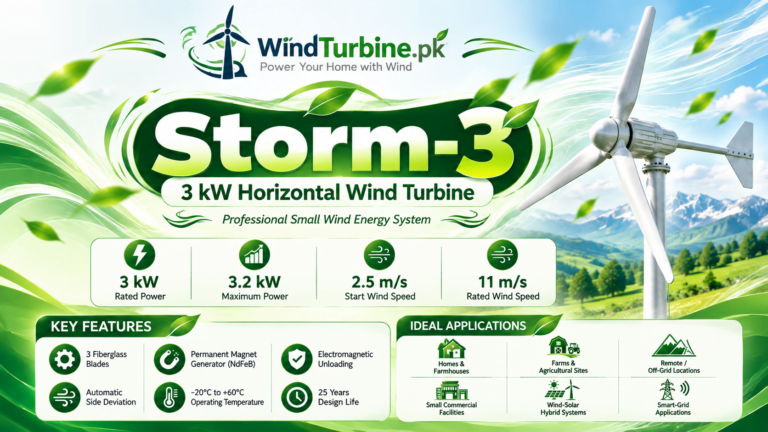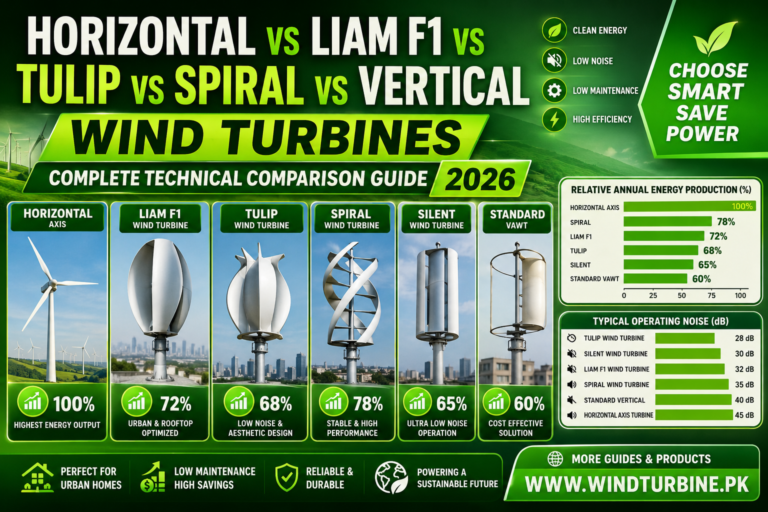
Best Locations for Wind Turbines in Pakistan: A Detailed Guide to Wind Potential, Cities, Corridors and Site Selection
Pakistan has significantly more wind-energy potential than is apparent from the number of small wind turbines currently installed across the country. However, wind energy is highly location-dependent. A turbine that performs well in one part of Pakistan may produce disappointing results only a few hundred kilometres away.
This is particularly important for 1kW, 2kW, 3kW, 5kW and 10kW small wind turbines, because these machines are much more sensitive to local wind conditions, tower height, turbulence and rotor size than simply looking at the turbine’s advertised rated power.
A national-scale wind-resource study using GIS and NREL wind-resource datasets identified substantial wind potential in western Balochistan, southern Sindh, mountainous areas of Khyber Pakhtunkhwa, the northern Indus Valley and parts of northern Punjab. The study estimated that about 8.89% of Pakistan’s area falls within fair-to-superb wind-energy classes, with Balochistan containing a particularly large share of the identified high-resource area.
At the same time, the Global Wind Atlas shows that wind conditions vary considerably by location and height, and emphasizes that mean wind-power density can be more informative than mean wind speed alone when evaluating a wind resource. (Global Wind Atlas)

The purpose of this guide is therefore not simply to say “Pakistan is windy”. Instead, it explains:
- where Pakistan’s major wind corridors are;
- which cities and districts deserve further investigation;
- why Sindh and Balochistan are particularly important;
- where small wind turbines may make sense;
- why some apparently windy cities may still be unsuitable;
- how tower height changes wind speed;
- why wind power density matters;
- why average wind speed alone is insufficient;
- how to assess a property before purchasing a turbine;
- and how to match a wind turbine to the actual site.
1. Why Location Is the Most Important Factor in Wind Energy
A wind turbine does not produce electricity simply because it is installed outdoors.
It needs sufficient moving air passing through its rotor.
The amount of power available in the wind can be expressed approximately as:
Where:
| Symbol | Meaning |
|---|---|
| P | Electrical power output |
| ρ | Air density |
| A | Rotor swept area |
| V | Wind speed |
| Cp | Turbine power coefficient |
The most important part for understanding location is:
Wind power increases approximately with the cube of wind speed.
That means a relatively small increase in wind speed can result in a large increase in available wind power.
For example:
| Wind Speed | Relative Wind Power |
|---|---|
| 3 m/s | 1.00× |
| 4 m/s | 2.37× |
| 5 m/s | 4.63× |
| 6 m/s | 8.00× |
| 7 m/s | 12.70× |
| 8 m/s | 18.96× |
| 9 m/s | 27.00× |
| 10 m/s | 37.04× |
This is why a 3 kW turbine installed at a strong-wind site can potentially produce considerably more annual energy than a larger turbine installed at a poor-wind site.
The U.S. Department of Energy similarly notes that wind power depends on air density, swept area and the cube of wind speed, and recommends using the turbine’s power curve, site wind distribution, tower height and micro-siting characteristics to estimate annual energy production. (The Department of Energy’s Energy.gov)
2. Pakistan’s Wind Resource Is Highly Uneven
Pakistan should not be treated as having one uniform wind resource.
There are several distinct wind-resource zones.
Broadly, the country’s more promising areas include:
- Southern Sindh
- Gharo–Jhimpir–Keti Bandar corridor
- Karachi coastal belt
- Thatta and surrounding coastal areas
- Badin and parts of lower Sindh
- Jamshoro and nearby corridors
- Matiari and parts of central Sindh
- Tando Muhammad Khan / Tando Allahyar region
- Parts of Balochistan’s western corridor
- Balochistan’s Makran/coastal belt
- Selected mountainous areas of Khyber Pakhtunkhwa
- Selected northern Punjab ridges and corridors
The important point is that these are screening areas, not automatic guarantees that every property inside them is suitable.
A scientific assessment of Pakistan’s wind resources found that coastal Sindh and northwestern valleys can have wind speeds reaching approximately 5–7 m/s at 50 m elevation, while some Balochistan areas show substantially higher wind-power-density potential.
3. The Gharo–Jhimpir Wind Corridor
If Pakistan’s wind-energy development is discussed, the Gharo–Jhimpir region of Sindh is one of the most important areas to understand.

The corridor has already attracted numerous utility-scale wind projects, which provides an important real-world indication that the region has commercially significant wind resources.
An IFC project description identifies the Gharo–Jhimpir wind corridor as containing the Gharo coastal cluster and inland Jhimpir Wind Farm Region. It also describes the region as a major concentration of operational wind projects. (IFC)
A Pakistan wind-resource study reports 6.86 m/s annual average wind speed at 50 m at Gharo, together with approximately 408.6 W/m² annual wind-power density in the referenced assessment.
Another detailed study of Gharo found site-specific mean wind speeds of approximately:
| Height | Mean Wind Speed |
|---|---|
| 10 m | 3.85 m/s |
| 30 m | 5.85 m/s |
| 50 m | 6.89 m/s |
The same study calculated increasing wind-power density with height. (Wiley Online Library)
Why does height matter so much?
Because wind generally becomes stronger and less turbulent as you move above ground-level obstacles.
That is one reason utility-scale turbines in the Jhimpir region have hub heights of around 80–90 metres or more. For example, one documented project in the corridor uses 20 turbines with 90 m hub height, while another wind project uses 80 m hub height.
4. Gharo
Gharo is one of the most studied wind locations in Pakistan.
The area is important because of:
- proximity to the Arabian Sea;
- open terrain;
- established wind-energy infrastructure;
- historical meteorological measurements;
- existing transmission infrastructure;
- extensive wind-farm development;
- and documented wind-resource studies.
A long-term wind study describes the Gharo measurement mast and nearby wind-project areas, including the coastal Khuttikun and Bhambore areas. (ScienceDirect)
The 2023 Pakistan wind-resource study classified Gharo as a good wind-resource location in the referenced 50 m assessment.
Potential applications
Gharo is relevant for:
- utility-scale wind farms;
- medium commercial turbines;
- agricultural applications;
- industrial energy projects;
- wind-solar hybrid systems;
- selected small wind applications.
However, a 1kW–10kW turbine should not automatically be installed simply because the property is near Gharo. A small turbine may be mounted at only 10–30 metres, while large wind-farm data may have been measured or modelled at much greater heights.
That distinction is critical.
5. Jhimpir
Jhimpir is arguably the most recognizable wind-energy location in Pakistan because of the concentration of operating wind farms.

The region has hosted projects using turbines from major international manufacturers.
For example, IFC documentation for Artistic Wind Power describes a 50 MW project in Jhimpir using 20 Goldwind 2.5 MW turbines with 90 m hub height and 121 m rotor diameter. (IFC)
This matters for small wind because it provides something that a theoretical wind map cannot provide:
Real-world evidence of commercial wind development.
But again, utility-scale wind farms should not be used as a substitute for a small-turbine site assessment.
6. Keti Bandar
Keti Bandar is particularly important because it lies in the coastal Sindh wind-resource zone.
The wind-resource research in the supplied document identifies the main Sindh wind corridor as beginning around Keti Bandar and Mirpur Sakro in Thatta district, extending northward and connecting with areas around Hyderabad, Jamshoro and Tando Muhammad Khan.
A separate study cited in the document reported approximately:
7.16 m/s annual average wind speed at 50 m at Kati Bandar, with approximately 414 W/m² average wind-power density.
That makes Keti Bandar an important location for further wind-energy investigation. https://windturbine.pk/
Potential applications
The region may be relevant for:
- agricultural pumping;
- remote power;
- hybrid wind-solar systems;
- microgrids;
- telecom installations;
- coastal businesses;
- medium-scale commercial wind projects;
- larger wind farms.
The biggest challenge is not necessarily wind itself.
Infrastructure, roads, grid connection, logistics, foundations, maintenance access and project economics must also be considered.
7. Thatta District
Thatta is one of the most important districts for wind-energy development in Sindh.
The district contains or connects several important wind-resource areas, including:
- Gharo;
- Jhimpir;
- Keti Bandar;
- Mirpur Sakro;
- surrounding coastal and inland wind corridors.
The supplied research specifically identifies Thatta as one of the Sindh districts with wind-energy potential requiring further investigation. Wind Turbine for Business in Pakistan
Why Thatta matters
Thatta combines several advantages:
- coastal influence;
- large open areas;
- established wind projects;
- proximity to Karachi;
- proximity to major transmission infrastructure in parts of the corridor;
- relatively open terrain;
- agricultural and rural energy requirements.
For commercial wind development, however, each individual site still needs detailed assessment. Wind Turbine in Thatta
8. Karachi: Is Karachi Good for Wind Turbines?
Yes—but Karachi should not be treated as one uniform wind site.
This is one of the most important conclusions for homeowners and businesses.
Karachi includes:
- dense urban areas;
- high-rise buildings;
- industrial zones;
- coastal areas;
- open land;
- elevated terrain;
- residential neighbourhoods;
- ports and industrial corridors.
Wind conditions can therefore vary significantly from one property to another.
The national wind-resource research specifically identifies Karachi district as having wind-energy potential requiring further investigation. Wind Turbine in Karachi

Coastal Karachi
Areas closer to the Arabian Sea may benefit from:
- sea breezes;
- greater exposure;
- fewer large obstacles;
- open coastal terrain.
Potential locations requiring investigation include parts of:
- Hawksbay;
- Paradise Point;
- coastal industrial areas;
- areas around Kemari;
- other exposed coastal properties.
The research document also identifies a wind corridor beginning around Kemari in Karachi and extending northwest toward Balochistan, including areas such as Hub and Sonmiani.
Urban Karachi
Urban rooftops are a different story.
A roof can be physically high but still have poor-quality wind because of:
- surrounding buildings;
- parapet walls;
- water tanks;
- trees;
- antennas;
- neighbouring structures;
- rooftop turbulence.
A wind turbine requires clean, useful airflow, not simply wind that can be felt by a person standing on the roof.
9. Kemari and the Karachi–Balochistan Wind Corridor
One of the particularly interesting findings in the supplied research is the identification of a corridor extending from Kemari in Karachi toward Balochistan.
The study identifies areas including:
- Hub;
- Sonmiani;
- Durji;
- Hanrab;
- Saroona.
as lying within this broader corridor.
This is important because it connects Karachi’s coastal wind resource with the much larger Balochistan wind-resource system.
For future wind-energy development, the Karachi–Hub–Sonmiani region deserves particular attention. Wind Turbine in Sindh and Balochistan.
10. Hub and Sonmiani
The Hub–Sonmiani area is strategically interesting because it combines:
- proximity to Karachi;
- coastal influence;
- industrial activity;
- open land in some locations;
- Balochistan’s broader wind-resource potential.
For businesses located around Karachi’s western industrial belt, a wind assessment can therefore be worthwhile.
The critical question is not simply:
“Is Hub windy?”
The correct question is:
“What is the long-term wind-speed distribution at my proposed turbine hub height, at this exact location?”
That distinction can save a substantial amount of money.
11. Badin
Badin is another Sindh district identified in the supplied research as having wind-energy potential requiring further investigation.
Badin’s location in lower Sindh gives it relevance for wind-energy development, particularly where:
- open land is available;
- the site is exposed;
- electricity demand exists;
- agricultural pumping is required;
- grid reliability is limited;
- hybrid wind-solar systems are being considered.
Badin should therefore be treated as a site-screening region rather than an automatic recommendation for every property.
12. Tando Muhammad Khan
Tando Muhammad Khan is specifically identified in the research as one of the Sindh districts with wind-energy potential.
The research describes the broader Sindh corridor as extending toward Tando Muhammad Khan.
This makes the district relevant for:
- agriculture;
- irrigation;
- rural energy;
- commercial applications;
- hybrid renewable systems;
- further wind-resource investigation.
13. Tando Allahyar
Tando Allahyar is also identified among the Sindh districts where wind-energy potential deserves further investigation.
The key point is that district-level wind potential does not mean every urban or rural property will have the same wind conditions.
For example:
A turbine in an open agricultural area may experience significantly cleaner airflow than the same turbine installed among buildings.
14. Matiari City
Matiari is another district identified in the research as having wind-energy potential.
For a commercial wind project, however, transmission availability is only one part of the equation.
A complete assessment should consider:
- wind resource;
- land;
- turbine technology;
- road access;
- transmission capacity;
- environmental constraints;
- foundation conditions;
- project financing;
- operation and maintenance access.
15. Jamshoro
Jamshoro is particularly interesting because the research identifies Thano Bula Khan tehsil and parts of Jamshoro district as having significant wind-power potential.
The study reports wind-power potential of up to approximately 700 W/m² at 50 m in parts of Thano Bula Khan and Thatta.
This makes Jamshoro an important region for further investigation.
It also has a strategic advantage: Wind Turbine in Jamshoro
proximity to Karachi, Hyderabad and established electricity infrastructure.
For industrial applications, this combination can potentially be more important than wind speed alone.
16. Mirpur Khas
Mirpur Khas is included in the research list of Sindh districts requiring further investigation for wind-energy generation.
The district is not equivalent to the core Gharo–Jhimpir wind corridor, however.
Therefore, a project in Mirpur Khas should be based on location-specific wind data, rather than assuming that conditions are equivalent to Jhimpir.
17. Balochistan: Pakistan’s Major Untapped Wind Resource
Balochistan deserves special attention.
The national wind-resource study found substantial wind-resource potential across the province, including:
- western Balochistan;
- southern Balochistan;
- coastal areas;
- Chagai region;
- Panjgur;
- Kech;
- Awaran;
- Khuzdar;
- parts of the Quetta-region corridors.

The research classifies Balochistan into seven wind-resource classes and reports that approximately 15% of the province’s area falls within fair-to-superb classes, based on the study’s methodology.
The same research identifies Balochistan as particularly resource-rich and highlights several major wind corridors.
18. Western Balochistan
One of the strongest findings in the document concerns the western Balochistan wind corridor.
The study reports wind-power potential reaching approximately:
900 W/m² at 50 m
in parts of the western corridor.
Areas identified include parts of:
- Chagai;
- Taftan;
- Dalbandin;
- Naukundi.
This is especially interesting for off-grid renewable energy because many remote areas have limited access to conventional electricity infrastructure.
19. Chagai
Chagai is an important example of how wind potential and energy-access challenges can overlap.
The supplied study identifies parts of Chagai district as having strong wind-power potential, including values up to approximately 900 W/m² at 50 m in selected areas.
The research also highlights the distance from the national grid and limited electricity access in parts of the district.
This creates a potentially important application:
Wind energy for remote electrification.
Instead of transporting diesel fuel over long distances, a properly designed renewable-energy system can potentially provide local electricity.
20. Taftan, Dalbandin and Naukundi
The research specifically identifies these areas in the western Balochistan wind corridor.
They are particularly interesting for:
- remote communities;
- telecom infrastructure;
- border-area facilities;
- agricultural applications where applicable;
- water pumping;
- hybrid wind-solar systems;
- off-grid microgrids.
However, remote projects face additional challenges:
- transportation;
- security;
- maintenance;
- spare parts;
- skilled technicians;
- battery replacement;
- communication;
- grid absence.
Therefore, high wind speed alone does not automatically make a project commercially viable. Wind Turbine Price in Pakistan
21. Panjgur and Kech
The southern Balochistan corridor extends through areas including parts of:
- Panjgur;
- Kech;
- Zamuran;
- Hoshab.
The research identifies these areas as having wind-resource potential and notes that some communities in these areas have limited electricity access.
This combination makes them interesting for decentralized renewable-energy systems.
22. Awaran and Khuzdar
The research also identifies wind corridors extending through parts of:
- Awaran;
- Khuzdar;
- surrounding areas.
These regions require careful site assessment because topography can strongly influence local wind flow.
Mountains can:
- accelerate wind;
- channel wind;
- create turbulence;
- block wind;
- create strong directional flows.
Therefore, a regional wind map is only the beginning.
23. Gwadar and the Makran Coast
Gwadar is naturally interesting for wind-energy development because of its coastal location.
However, coastal location does not automatically equal commercially excellent wind conditions at every site.
A proper assessment should examine:
- wind speed;
- wind direction;
- seasonal variation;
- turbulence;
- salt exposure;
- extreme wind;
- tower height;
- corrosion;
- grid availability.
For coastal turbines, corrosion protection becomes particularly important. Wind Turbine in Gawadar
24. Ormara
Ormara is another coastal Balochistan location that appears in the broader wind-resource assessment.
The research identifies Ormara among areas within Balochistan’s broader high-wind corridors.
Its coastal exposure makes it worth investigating for:
- remote energy;
- telecom;
- coastal facilities;
- hybrid systems;
- medium-sized wind projects.
But the project economics must include transportation and maintenance logistics.
25. Khyber Pakhtunkhwa: Wind Potential Exists, But It Is More Site-Specific
Khyber Pakhtunkhwa is not uniformly suitable for wind turbines.
The research shows a combination of:
- poor areas;
- marginal areas;
- fair areas;
- good areas;
- excellent areas;
- outstanding areas;
- and even small superb-resource zones.
The study reports that approximately 5.99% of Khyber Pakhtunkhwa’s area falls within fair-to-superb classes in its assessment.
This means that saying “KP is good for wind” or “KP is bad for wind” would both be oversimplifications.
26. Chitral
Mountainous areas such as Chitral can have interesting wind conditions because of:
- mountain passes;
- valley effects;
- elevation;
- channelled airflow.
But these same geographical features can create turbulence and complex wind patterns.
Therefore, a wind turbine in a mountain valley should be evaluated much more carefully than one on a flat coastal plain.
27. Upper Dir and Northern KP
Parts of northern KP have been identified as having useful wind resources.
However, the key challenge is complex terrain.
IEC site-assessment guidance emphasizes that terrain, obstacles and flow distortion can materially affect wind measurements and turbine suitability. (iTeh Standards)
This means:
A wind speed measured at one point cannot necessarily be assumed to represent a nearby turbine location in complex terrain.
28. Punjab: Why Most of the Plains Are Less Attractive for Wind
Punjab contains some wind-resource areas, but the province is dominated by relatively lower wind-resource territory.
The supplied study’s NREL-based classification reports that approximately 93.54% of Punjab’s area falls into the poor wind-power class in the referenced analysis, with only a small fraction reaching fair-to-superb classes.
This does not mean:
“Wind turbines cannot work in Punjab.”
It means:
Wind turbines require much more careful site selection in Punjab.
29. Kallar Kahar and Chakwal
Kallar Kahar–Chakwal is an example of a Punjab area with some wind potential.
The document reports a SODAR-based assessment of approximately:
293 W/m² at 50 m
and describes the resource as marginal in that assessment.
This type of location may be worth considering for:
- hybrid wind-solar systems;
- specialized applications;
- sites with unusually strong local wind;
- agricultural pumping where actual site measurements justify it.
But it should not be treated like Jhimpir.
30. What About Lahore?
Lahore is a major city with large electricity demand, but electricity demand does not mean that wind is automatically a good energy resource.
Urban Lahore presents challenges such as:
- buildings;
- trees;
- turbulence;
- low average wind speeds;
- rooftop obstructions;
- limited tower height.
For most Lahore properties, a wind turbine should therefore be considered only after specific wind-resource analysis.
Solar energy is often easier to deploy in low-wind urban environments, while wind can become interesting when a particular site demonstrates sufficient wind.
31. What About Islamabad and Rawalpindi?
The same principle applies.
The presence of wind on a particular day does not establish that a turbine will produce enough annual energy.
For Islamabad and Rawalpindi, terrain, buildings and local wind patterns must be considered.
A property-specific feasibility assessment should precede turbine selection.
32. Pakistan Wind-Resource Summary by Region
The following table is useful as an initial screening guide, not a guarantee of performance.
| Region | Wind Potential | Main Opportunity | Key Concern |
|---|---|---|---|
| Gharo | High | Commercial & utility wind | Site-specific conditions |
| Jhimpir | High | Commercial, utility, industrial | Correct turbine/tower |
| Keti Bandar | High | Coastal & remote energy | Infrastructure |
| Thatta | High in selected areas | Commercial/agriculture | Local variation |
| Karachi Coast | Moderate–High in selected exposed areas | Small/medium wind | Urban turbulence |
| Kemari/Western Karachi | Site-dependent | Industrial/coastal | Buildings & obstacles |
| Hub | Promising in selected areas | Industrial/coastal | Site assessment |
| Sonmiani | Promising | Coastal/remote | Infrastructure |
| Badin | Promising in selected areas | Agriculture/remote | Local wind variation |
| Jamshoro | Promising in selected areas | Industrial/agriculture | Exact site |
| Matiari | Promising in selected areas | Commercial/agriculture | Exact site |
| Tando Muhammad Khan | Promising in selected areas | Agriculture | Site-specific data |
| Tando Allahyar | Promising in selected areas | Agriculture | Site-specific data |
| Mirpur Khas | Potential | Agriculture/hybrid | Lower certainty |
| Balochistan West | High in selected corridors | Utility/off-grid | Infrastructure/security |
| Chagai | High in selected areas | Off-grid/industrial | Remoteness |
| Panjgur | Promising | Remote/hybrid | Infrastructure |
| Kech | Promising | Off-grid | Terrain/logistics |
| Ormara | Coastal potential | Remote/coastal | Logistics |
| Gwadar | Coastal potential | Commercial/remote | Site-specific resource |
| KP Mountains | Selected promising areas | Hybrid/off-grid | Complex terrain |
| Punjab Plains | Mostly low | Solar/hybrid | Low wind resource |
The underlying research explicitly identifies multiple Sindh districts—including Karachi, Thatta, Tando Muhammad Khan, Tando Allahyar, Badin, Mirpur Khas, Matiari and Jamshoro—for further wind-energy investigation.
33. Top Wind-Energy Areas to Investigate in Pakistan
Rather than claiming that every city has an identical wind resource, it is more scientifically useful to identify priority areas for investigation.
Group1- Established High-Wind Corridors
- Gharo
- Jhimpir
- Keti Bandar
- Mirpur Sakro
- Thatta wind corridor
- Selected areas of Thano Bula Khan
- Western Balochistan wind corridor
This is on number 2 — Coastal and Near-Coastal Areas
- Karachi coastal belt
- Kemari
- Hub
- Sonmiani
- Badin coastal areas
- Gwadar
- Ormara
- Makran coastal areas
Priority Group C — Inland Sindh Areas Requiring Site Investigation
- Jamshoro
- Matiari
- Tando Muhammad Khan
- Tando Allahyar
- Mirpur Khas
Priority Group D — Selected Mountain/Interior Areas
- Chagai
- Dalbandin
- Taftan
- Naukundi
- Panjgur
- Kech
- Awaran
- Khuzdar
- selected northern KP valleys/ridges
- selected northern Punjab ridges
This is a resource-screening list, not a definitive ranking. Actual suitability depends on the turbine hub height, power curve, terrain, turbulence, land, grid and economics.
34. Wind Speed Alone Is Not Enough
One of the biggest mistakes in wind-energy planning is to ask:
“What is the average wind speed?”
and stop there.
A proper wind assessment should investigate:
- average wind speed;
- hourly distribution;
- monthly distribution;
- seasonal variation;
- wind direction;
- wind-power density;
- turbulence;
- extreme wind;
- wind shear;
- terrain;
- obstacles;
- hub height;
- turbine power curve.
IEC site-suitability guidance emphasizes that wind-speed distribution is important because it determines how frequently different operating and loading conditions occur. It also recommends considering long-term representative data and vertical and horizontal extrapolation to the proposed turbine location and hub height. (iTeh Standards)
35. Why Wind Distribution Matters
Imagine two locations:
Location A
Average wind speed:
5.5 m/s
Location B
Average wind speed:
5.5 m/s
They sound identical.
But suppose Location A has:
- mostly 5–6 m/s wind throughout the year.
while Location B has:
- very little wind for several months;
- extremely strong wind for a few months.
Their annual energy production may be very different.
This is why a professional assessment should examine the wind-speed frequency distribution, not just one annual average.
36. Wind Power Density
Wind-power density is another valuable parameter.
It measures the available wind power passing through a unit area.
The supplied Pakistan research uses wind-power-density classes such as:
| Class | Wind Power Density |
|---|---|
| Poor | 0–200 W/m² |
| Marginal | 200–300 W/m² |
| Fair | 300–400 W/m² |
| Good | 400–500 W/m² |
| Excellent | 500–600 W/m² |
| Outstanding | 600–800 W/m² |
| Superb | >800 W/m² |
This classification is particularly useful when comparing locations.
37. Why Tower Height Changes Everything
Wind speed generally increases with height.
A simplified wind-shear equation is:
where:
- = wind speed at the new height;
- = measured/reference wind speed;
- = new height;
- = reference height;
- = wind-shear exponent.
IEC material describes wind shear as the change in wind speed with height and uses the power-law relationship for wind-profile modelling. (iTeh Standards)
Example
Suppose wind speed at 10 m is:
4 m/s
If the same location has:
6 m/s at 50 m
that is a huge difference in available wind energy.
This is why installing a turbine only a few metres above a roof can produce very different results from installing it on a properly designed tower.
38. Small Wind Turbine Tower Height
For small wind turbines, tower height should be determined from:
- rotor diameter;
- nearby obstacles;
- wind shear;
- turbulence;
- structural requirements;
- property constraints;
- local regulations;
- foundation requirements.
A small turbine should not be mounted at an arbitrary height simply because the tower is cheaper.
The tower is part of the energy system.
A better turbine at the wrong height can produce less annual energy than a smaller turbine installed correctly.
39. Rooftop Wind Turbines: A Special Warning
Rooftop wind turbines look attractive because the roof provides height.
But the roof also creates turbulence.

Air flowing around a building can:
- separate;
- swirl;
- accelerate;
- reverse;
- become turbulent.
A turbine requires relatively clean airflow.
Therefore, a roof-mounted turbine should be considered only after checking:
- building height;
- surrounding buildings;
- roof structure;
- turbine position;
- vibration;
- noise;
- maintenance access;
- structural loads;
- wind direction;
- turbulence.
40. Why Horizontal-Axis Wind Turbines Are Commonly Used
Most commercial wind turbines use a horizontal-axis configuration.
A horizontal-axis wind turbine typically has:
- rotor blades;
- hub;
- generator;
- nacelle;
- yaw system;
- tower;
- controller;
- electrical system.
The rotor faces the wind and captures energy across its swept area.
For a rotor diameter :
Therefore, rotor size is extremely important.
41. Rated Power Does Not Mean Constant Power
A turbine advertised as:
“3 kW wind turbine”
does not mean it continuously produces 3 kW.
The turbine may produce:
- almost nothing at very low wind speeds;
- a few hundred watts at moderate wind speeds;
- 1–2 kW at higher speeds;
- rated power only around its rated wind speed;
- zero production above its cut-out speed.
This is why the power curve is more useful than the headline “3 kW” number.
IEC power-performance standards define a measured power curve as the relationship between measured wind speed and turbine output under a specified measurement procedure. Small Windmill or Wind Turbine in Pakistan
42. What Is a Power Curve?
A simplified example:
| Wind Speed | Example Turbine Output |
|---|---|
| 2 m/s | 0 W |
| 3 m/s | 50 W |
| 4 m/s | 150 W |
| 5 m/s | 350 W |
| 6 m/s | 700 W |
| 7 m/s | 1,200 W |
| 8 m/s | 1,800 W |
| 9 m/s | 2,500 W |
| 10 m/s | 3,000 W |
| 11 m/s | 3,000 W |
This is only an illustrative example—not the power curve of a specific turbine.
When buying a turbine, always ask the manufacturer for the actual power curve.
43. The Difference Between kW and kWh
This distinction is essential.
kW = Power
It tells you the instantaneous rate of electricity production.
kWh = Energy
It tells you how much electricity was produced over time.
For example:
A turbine producing an average of 1 kW for 10 hours produces:
10 kWh
The U.S. Department of Energy identifies annual energy output in kWh/year as one of the most useful measures for determining whether a particular wind turbine and tower will actually meet an energy requirement. (The Department of Energy’s Energy.gov)
44. Annual Energy Production Is the Real Number to Compare
Suppose:
Turbine A
Rated power: 3 kW
Annual production: 5,000 kWh
Turbine B
Rated power: 5 kW
Annual production: 4,000 kWh
The 5 kW turbine is larger by nameplate rating, but the 3 kW turbine produces more annual energy at the particular site.
This illustrates a fundamental rule:
Do not select a wind turbine based on rated kW alone.
45. Small Wind Turbine Site-Assessment Checklist
Before purchasing a turbine, collect:
| Parameter | Why It Matters |
|---|---|
| GPS coordinates | Exact location |
| Elevation | Air density and terrain |
| Average wind speed | Initial resource estimate |
| Hourly wind data | Energy modelling |
| Monthly wind data | Seasonal behaviour |
| Wind direction | Turbine placement |
| Wind-power density | Resource quality |
| Wind shear | Tower-height calculation |
| Turbulence | Energy and turbine loading |
| Extreme wind | Structural safety |
| Terrain | Flow modelling |
| Obstacles | Turbulence and blockage |
| Hub height | Actual turbine wind resource |
| Rotor diameter | Energy capture |
| Power curve | Expected output |
| Cut-in speed | Low-wind behaviour |
| Rated wind speed | Rating interpretation |
| Cut-out speed | Safety |
| Survival wind speed | Structural design |
| Grid connection | Electrical integration |
| Battery requirement | Off-grid design |
| Foundation | Structural safety |
46. What Data Should Be Used?
For preliminary feasibility, sources such as:
- Global Wind Atlas;
- NASA POWER;
- NREL datasets;
- Pakistan Meteorological Department data;
- published research;
- historical weather data;
can be useful.
The Global Wind Atlas provides wind-speed and wind-power-density layers at multiple heights and allows users to investigate specific areas.
But preliminary resource mapping should not be confused with a bankable wind-resource assessment.
For larger projects, on-site measurement and long-term correlation become increasingly important.
47. Why GPS-Based Feasibility Is Better Than City-Based Recommendations
Consider a customer who says:
“I live in Karachi. Which wind turbine should I buy?”
The answer should not immediately be:
“Buy a 3 kW turbine.”
Instead, the first questions should be:
- Where exactly is the property?
- What is the GPS location?
- How tall can the tower be?
- Is it coastal or inland?
- What is around the property?
- What is the customer’s electricity consumption?
- Is the system on-grid or off-grid?
- Is battery storage required?
- What is the desired annual energy production?
Two Karachi properties may have very different wind conditions.
48. Wind + Solar Hybrid Systems in Pakistan
Pakistan is particularly interesting for hybrid renewable systems.
Solar energy is available during daylight.
Wind may produce:
- during the evening;
- at night;
- during cloudy periods;
- during seasonal wind events.
Therefore:
Solar + Wind + Battery
can potentially provide a more balanced renewable-energy system than either technology alone.
However, the system must be electrically compatible.
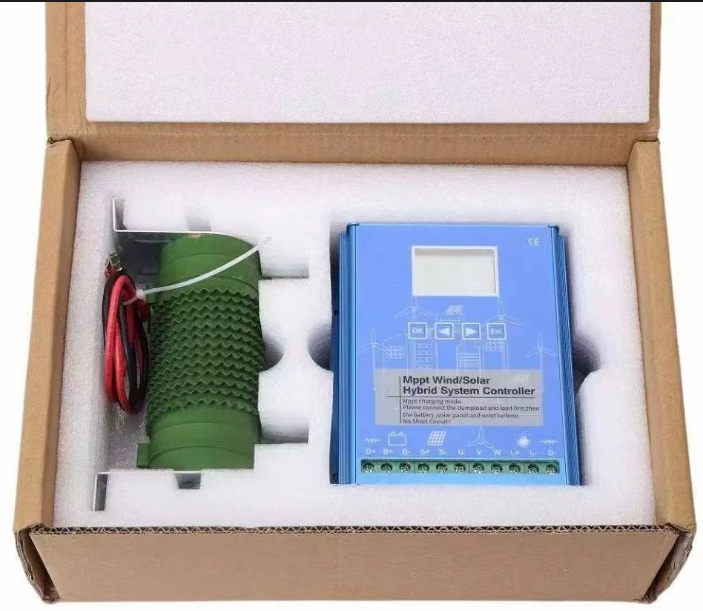
A hybrid system may include:
- solar PV;
- wind turbine;
- wind controller;
- dump load;
- MPPT controller;
- battery bank;
- hybrid inverter;
- protection equipment;
- grid connection where applicable.
49. Best Locations for Wind + Solar Hybrid Systems
Hybrid systems can be particularly interesting in:
- coastal Sindh;
- rural Sindh;
- Balochistan;
- remote KP;
- agricultural areas;
- areas with weak grid infrastructure;
- telecom installations;
- remote pumping applications.
The concept is simple:
Daytime:
Solar contributes strongly.
Evening/night:
Wind may continue producing electricity if sufficient wind is available.
Low solar days:
Wind can provide additional energy.
High-wind periods:
Excess wind can charge batteries or support other loads.
But this only works if the wind resource is actually strong enough.
50. Wind Energy for Agriculture in Pakistan
Agriculture is one of the most interesting applications for small and medium wind turbines.
Potential applications include:
- water pumping;
- livestock facilities;
- farm lighting;
- cold storage;
- irrigation support;
- remote farmhouses;
- agricultural processing.
Sindh and Balochistan are especially interesting because of the combination of:
- open land;
- wind corridors;
- agricultural activity;
- remote communities;
- unreliable electricity in some locations.
A wind turbine for pumping can sometimes be designed differently from a household electricity system.
51. Wind Turbines for Remote Areas
Remote Pakistan has an important wind-energy opportunity.
A conventional grid extension may require:
- poles;
- cables;
- transformers;
- substations;
- roads;
- maintenance.
In remote areas, distributed generation can potentially be more practical.
A system could consist of:
Wind Turbine → Controller → Battery → Inverter → Local Loads
or:
Wind + Solar → Hybrid Controller → Battery → Inverter → Local Microgrid
This is particularly relevant to parts of Balochistan identified in the research as having both wind potential and limited electricity access.
52. Why Balochistan Could Be Important for Off-Grid Wind
Balochistan’s wind potential is interesting not only because of resource quality.
It is also interesting because of the geographical distribution of population and infrastructure.
Some communities are far from major electricity networks.
A decentralized energy model could therefore potentially combine:
- wind;
- solar;
- batteries;
- local microgrids;
- water pumping;
- telecommunications.
This is an area where wind energy can be considered not merely as an alternative electricity source but as part of a broader rural-energy strategy.
53. Infrastructure Matters as Much as Wind
A location with excellent wind but no practical access can be less attractive than a location with slightly lower wind but excellent infrastructure.
For commercial projects, consider:
| Factor | Importance |
|---|---|
| Wind resource | Very high |
| Land availability | Very high |
| Grid connection | Very high |
| Road access | High |
| Distance to port | High |
| Security | High |
| Foundation conditions | High |
| Environmental constraints | High |
| O&M access | High |
| Local workforce | Medium–High |
| Transmission capacity | Very high |
| Project financing | Very high |
The supplied research itself notes that site selection should consider wind speed, electrification, grid connectivity, policy incentives and security conditions rather than relying on wind speed alone.
54. Wind Turbine Site Selection: A Practical 10-Step Process
Step 1 — Get GPS coordinates
Do not begin with the turbine.
Begin with the site.
Step 2 — Screen the wind resource
Use available wind maps and historical data.
Step 3 — Determine proposed tower height
A 10 m turbine and a 30 m turbine are not seeing exactly the same wind resource.
Step 4 — Study obstacles
Identify:
- buildings;
- trees;
- hills;
- towers;
- walls;
- other turbines.
Step 5 — Study wind direction
Determine prevailing wind directions.
Step 6 — Obtain the turbine power curve
Never rely only on rated power.
Step 7 — Calculate annual energy
Estimate kWh/year.
Step 8 — Design electrical system
Determine:
- voltage;
- controller;
- inverter;
- battery;
- dump load;
- grid connection.
Step 9 — Design tower and foundation
Consider:
- turbine weight;
- rotor diameter;
- thrust;
- extreme wind;
- guy wires;
- foundation;
- soil.
Step 10 — Calculate project economics
Compare:
- capital cost;
- installation;
- maintenance;
- replacement;
- annual kWh;
- electricity value. Wind Mill cost in Pakistan
55. A Wind Turbine Should Be Selected After the Site
This is perhaps the most important principle in this entire article.
Wrong approach:
Buy turbine → find location → try to make it work
Better approach:
Study location → understand wind → determine energy requirement → select turbine → design tower → design electrical system
The second approach reduces the risk of purchasing a turbine that is technically impressive but poorly matched to the site.
56. How to Choose Between 1kW, 2kW, 3kW, 5kW and 10kW
| Turbine | Typical Application |
|---|---|
| 300–500W | Lighting, battery charging, small loads |
| 1kW | Small loads, remote systems, hybrid systems |
| 2kW | Larger residential/remote applications |
| 3kW | Residential/small commercial |
| 5kW | Larger homes, farms, small businesses |
| 10kW | Commercial, agricultural, institutional |
| 20kW+ | Larger commercial/microgrid |
| 50–100kW | Industrial/commercial |
| 500kW+ | Utility-scale projects |
These are application categories, not guarantees of what each turbine can power.
Actual output depends on:
wind + rotor + power curve + tower + electrical system + availability.
57. The Importance of Rotor Diameter
Two turbines can both be advertised as 3 kW while having very different rotor diameters.
This matters because:
If rotor diameter increases, swept area increases with the square of diameter.
For example:
| Rotor Diameter | Swept Area |
|---|---|
| 2 m | 3.14 m² |
| 3 m | 7.07 m² |
| 4 m | 12.57 m² |
| 5 m | 19.63 m² |
| 6 m | 28.27 m² |
A larger rotor can capture more energy at the same wind speed, although the generator, structural design and turbine control must all be matched to the rotor.
58. Why “Low Cut-In Speed” Can Be Misleading
A manufacturer may advertise:
“Cut-in wind speed: 2 m/s”
This does not mean:
“The turbine produces useful electricity at 2 m/s.”
Cut-in simply means that the turbine begins producing measurable power.
Useful output may require substantially higher wind speed.
Therefore, ask for the actual power curve from 2 m/s onward.
59. Important Documents to Request from a Wind Turbine Supplier
Before purchasing a commercial turbine, ask for:
| Document | Purpose |
|---|---|
| Technical datasheet | Basic specifications |
| Power curve | Energy estimation |
| Rotor drawing | Mechanical assessment |
| Generator specification | Electrical design |
| Controller datasheet | Compatibility |
| Inverter specification | Grid/off-grid integration |
| Tower drawing | Structural design |
| Foundation requirements | Civil works |
| Survival wind speed | Safety |
| Cut-in speed | Low-wind operation |
| Rated wind speed | Rated output |
| Cut-out speed | Protection |
| RPM range | Generator/rotor matching |
| Warranty | Commercial protection |
| Installation manual | Installation |
| Maintenance manual | O&M |
| Type Test report | Technical verification |
| IEC documentation | Standards compliance |
| Quality certificates | Manufacturing quality |
| Material specifications | Structural quality |
| Bearing specifications | Reliability |
| Brake/protection system | Safety |
For larger turbines, technical documentation becomes even more important.
60. Small Wind Turbine vs Utility-Scale Wind Turbine
A major misunderstanding is assuming that the wind data used for a 50 MW wind farm directly represents the output of a 3 kW turbine.
It does not.
Consider:
| Parameter | Small Turbine | Utility Turbine |
|---|---|---|
| Rotor | Small | Very large |
| Tower | ~10–40 m commonly | 80–150 m+ |
| Wind resource | Highly local | Large-area assessment |
| Turbulence | Very important | Important |
| Obstacles | Major issue | Usually limited |
| Foundation | Small | Massive |
| Grid | Local | High-voltage |
| Energy model | Site-specific | Bankable assessment |
| Maintenance | Local | Specialist |
| Output | kW | MW |
This is why a successful utility wind farm near a city does not automatically mean a residential wind turbine will perform well at every nearby property.
61. Pakistan’s Wind Resource Should Be Viewed as a Spectrum
There is no single:
“best wind city in Pakistan.”
Instead, there are:
- major wind corridors;
- coastal zones;
- inland corridors;
- mountain corridors;
- urban wind environments;
- agricultural wind sites;
- remote off-grid areas.
The most appropriate turbine depends on the application.
For example:
A coastal farm
may benefit from a 5–20 kW turbine.
A Karachi industrial site
may need a 10–100 kW assessment.
A remote Balochistan village
may benefit from a wind-solar-battery microgrid.
A Lahore home
may find that wind is not sufficiently strong and consistent at the available tower height.
62. Why Recent Data Matters
Historical wind studies are extremely valuable, but wind-resource assessment should not rely blindly on old data.
Wind conditions can be affected by:
- land-use changes;
- buildings;
- vegetation;
- urbanization;
- climate variability;
- nearby infrastructure;
- changes in measurement height.
IEC 61400-15 guidance emphasizes that wind distributions used for site suitability should be representative of the turbine’s operational lifetime and that long-term adjustment may be required where data is not representative.
Therefore:
Old wind data is useful—but recent site-specific verification is better.
63. Wind Turbine Installation in Pakistan: A Practical Decision Matrix
| Site Type | Wind Assessment | Typical Recommendation |
|---|---|---|
| Open coastal land | Usually worthwhile | Detailed feasibility |
| Gharo/Jhimpir corridor | Strong candidate | Detailed technical assessment |
| Open agricultural Sindh | Worth investigating | Wind + solar assessment |
| Karachi coastal property | Worth investigating | GPS/site assessment |
| Dense Karachi rooftop | High caution | Structural + turbulence assessment |
| Balochistan remote area | Highly interesting | Wind + solar + battery |
| Mountain valley | Highly site-specific | Detailed measurement |
| Lahore urban area | Usually requires strong evidence | Solar/wind comparison |
| Punjab open land | Site-specific | Preliminary screening first |
| Remote telecom site | Potentially useful | Hybrid system assessment |
64. What Makes a Site “Excellent” for a Wind Turbine?
A strong site typically combines:
1. Good wind
Preferably strong and consistent rather than occasional gusts.
2. Open terrain
Fewer obstacles mean cleaner airflow.
3. Adequate tower height
The rotor needs access to useful wind.
4. Suitable turbine
The turbine’s power curve should match the site’s wind distribution.
5. Suitable land
Enough space for tower, foundation, guy wires and maintenance.
6. Good electrical connection
For grid-connected projects, the electrical system must be compatible.
7. Good access
Technicians must be able to reach the turbine.
8. Acceptable extreme winds
The turbine must be designed for the site’s extreme conditions.
9. Economically useful energy
The annual kWh must justify the investment.
65. What Makes a Site Poor?
A site may be unsuitable if it has:
- low average wind speed;
- highly turbulent wind;
- buildings surrounding the turbine;
- insufficient tower height;
- poor access;
- weak structure;
- unsuitable soil;
- extreme wind beyond turbine design limits;
- no practical electrical integration;
- insufficient annual energy production.
66. The Role of Wind Direction
Wind direction matters because it determines how the turbine experiences airflow.
A location may have:
- dominant southwest winds;
- seasonal northeast winds;
- sea breezes;
- mountain-valley winds.
Understanding the wind rose can help determine:
- turbine orientation;
- turbine spacing;
- obstacle effects;
- wake losses;
- micro-siting.
67. Wind Turbine Spacing for Larger Projects
For multiple turbines, turbines should not simply be installed next to each other.
A turbine extracts energy from the wind and leaves a wake behind it.
The next turbine placed inside that wake can experience:
- lower wind speed;
- higher turbulence;
- reduced energy production.
Large wind projects therefore require detailed wind-flow and wake analysis.
This is another reason why utility-scale site planning is very different from installing one small turbine.
68. Pakistan’s Coastal Advantage
Pakistan has a long coastline along the Arabian Sea.
This creates potentially valuable wind resources in:
- Sindh;
- Karachi;
- Thatta;
- Badin;
- Balochistan;
- Makran.
The research supplied with this project specifically identifies coastal Sindh as a major wind-resource region and also identifies significant Balochistan corridors.
69. Why Existing Wind Farms Matter
Existing wind farms provide useful evidence.
The Jhimpir/Gharo region has attracted many large projects over the years.
The documented projects include turbines from manufacturers such as:
- Goldwind;
- GE;
- Nordex;
- Vestas;
- Siemens Gamesa.
For example, a documented 50 MW Artistic Energy project in Jhimpir uses 29 GE turbines, while another documented project uses 33 Nordex 1.5 MW turbines. (General Electric)
This concentration of development demonstrates the commercial importance of the region.
70. But Existing Wind Farms Do Not Replace Site Assessment
Even inside Jhimpir:
Site A ≠ Site B
Wind can vary due to:
- terrain;
- elevation;
- roughness;
- wind direction;
- obstacles;
- distance from coastline;
- wake effects.
Therefore:
Regional wind map = screening
Site assessment = project decision
This distinction should be made clear to every customer considering a wind turbine.
71. A Practical Wind-Turbine Buying Formula
Before purchasing a turbine, ask:
Wind
How much wind do I actually have?
Height
At what height will my turbine operate?
Rotor
How large is the rotor?
Power curve
How much power does it produce at my actual wind speeds?
Energy
How many kWh/year will it produce?
Electrical system
How will that energy reach my loads?
Tower
Is the tower structurally suitable?
Safety
What is the survival wind speed?
Economics
What is the cost per useful kWh?
72. Final Site-Selection Checklist for Pakistan
Before ordering a wind turbine, confirm all of the following:
| # | Question | Status |
|---|---|---|
| 1 | GPS location available? | ☐ |
| 2 | Wind-resource data checked? | ☐ |
| 3 | Wind speed at proposed hub height estimated? | ☐ |
| 4 | Wind direction analysed? | ☐ |
| 5 | Seasonal variation checked? | ☐ |
| 6 | Wind-power density checked? | ☐ |
| 7 | Turbulence considered? | ☐ |
| 8 | Nearby obstacles identified? | ☐ |
| 9 | Rotor diameter known? | ☐ |
| 10 | Manufacturer power curve available? | ☐ |
| 11 | Annual kWh estimated? | ☐ |
| 12 | Tower height determined? | ☐ |
| 13 | Foundation designed? | ☐ |
| 14 | Survival wind speed checked? | ☐ |
| 15 | Controller selected? | ☐ |
| 16 | Inverter compatibility checked? | ☐ |
| 17 | Battery requirement calculated? | ☐ |
| 18 | Grid connection considered? | ☐ |
| 19 | Installation cost calculated? | ☐ |
| 20 | Maintenance plan prepared? | ☐ |
| 21 | Annual energy value calculated? | ☐ |
| 22 | Project economics checked? | ☐ |
73. The Most Important Takeaway
Pakistan has significant wind-energy resources, but wind turbines should not be selected simply according to city name or turbine size.
The strongest documented wind-energy development is concentrated in areas such as the Gharo–Jhimpir corridor and other parts of southern Sindh, while research also identifies substantial potential in Balochistan, selected areas of KP and smaller wind-resource corridors elsewhere in the country.
For a customer looking to install a 1kW, 2kW, 3kW, 5kW or 10kW turbine, the correct process is:
Location → Wind Assessment → Tower Height → Energy Requirement → Power Curve → Turbine Selection → Electrical Design → Installation
Not:
Turbine → Installation → Hope for good wind
The difference between these two approaches can determine whether a wind project becomes a useful energy asset or an expensive underperforming installation.
74. Best Areas for Different Wind-Turbine Applications
| Application | Areas Worth Investigating |
|---|---|
| Small residential wind | Coastal Karachi, exposed Sindh properties |
| 1–3 kW hybrid systems | Coastal/lower Sindh, selected Balochistan sites |
| 5–10 kW farms | Sindh coastal/open agricultural areas |
| 10–50 kW commercial | Sindh wind corridors, selected Balochistan |
| 50–500 kW projects | Strong documented wind corridors |
| Utility-scale | Gharo–Jhimpir and other professionally assessed corridors |
| Remote microgrids | Balochistan, remote Sindh, selected KP |
| Agricultural pumping | Open windy agricultural sites |
| Telecom/off-grid | Remote windy locations |
| Wind + solar hybrid | Areas with complementary wind and solar profiles |
75. Frequently Asked Questions
What is the best location for a wind turbine in Pakistan?
The answer depends on turbine size and application. The Gharo–Jhimpir region of Sindh is one of Pakistan’s most established commercial wind-energy areas, while several parts of Balochistan also have significant wind-resource potential. Individual properties still require site assessment. (IFC)
Is Karachi suitable for wind turbines?
Some parts of Karachi can be suitable, particularly exposed coastal and open areas. Urban rooftops are much more site-sensitive because buildings can create turbulence.
Is Jhimpir suitable for small wind turbines?
The region has a strong documented wind resource, but small-turbine suitability still depends on the proposed tower height, rotor, turbine power curve and exact location.
Is Gharo good for wind energy?
Yes, Gharo is a well-studied and established wind-energy area. A referenced assessment reports approximately 6.86 m/s annual average wind speed at 50 m and approximately 408.6 W/m² power density.
Is Balochistan good for wind turbines?
Several areas of Balochistan have substantial wind potential. The supplied research identifies western, southern and northern wind corridors, including areas around Chagai, Taftan, Dalbandin, Panjgur, Kech, Awaran and other regions.
Can wind turbines work in Lahore?
They can technically operate if sufficient wind is available, but many urban Punjab sites have relatively weaker wind resources. A site-specific feasibility assessment is recommended before investment.
What wind speed is needed for a wind turbine?
There is no single number that applies to every turbine. The manufacturer’s power curve and the site’s long-term wind distribution are more useful than a generic cut-in speed.
Is 5 m/s enough for a wind turbine?
It depends on the turbine. A 5 m/s annual average can be useful for some turbines, but the result depends heavily on rotor size, power curve, tower height and wind distribution.
Is 7 m/s good for wind energy?
A 7 m/s annual average at the relevant hub height generally represents a substantially stronger wind resource than 4–5 m/s, but the exact energy output still depends on the turbine and site.
Should I install a wind turbine on my roof?
Only after assessing turbulence, structural strength, tower/rotor position and actual wind conditions. Where sufficient land is available, a properly designed ground-mounted tower may provide cleaner airflow.
Is wind better than solar in Pakistan?
Neither technology is universally better. Solar is generally easier to deploy across many parts of Pakistan, while wind can be highly valuable in locations with strong and consistent wind. In suitable locations, wind + solar can complement each other.
76. Recommended Internal Links for WindTurbine.pk
For SEO, this article can be connected naturally to your existing website content:
- Wind Turbine Feasibility Check
- Wind Turbine Prices in Pakistan
- Wind Turbine Products
- Wind Turbine Feasibility Calculator Pakistan
- How to Choose the Right Wind Turbine for Your Home in Pakistan
- Horizontal Axis vs Vertical Axis Wind Turbine
- Small Wind Turbines for Homes in Pakistan
Conclusion
Pakistan has a diverse and geographically concentrated wind resource.
The Gharo–Jhimpir–Keti Bandar region of Sindh is particularly important because it combines documented wind resources with extensive real-world wind-farm development. Karachi’s coastal areas, parts of Thatta, Badin, Jamshoro, Matiari and the Tando districts also warrant investigation. Meanwhile, Balochistan contains several major wind corridors, including areas in its western and southern regions that may be particularly relevant for future utility-scale and off-grid renewable-energy development.
The most important lesson for anyone buying a wind turbine in Pakistan is simple:
Do not select the turbine first. Select the site first.
A good wind turbine requires:
Good wind + correct hub height + suitable rotor + verified power curve + appropriate tower + proper electrical system + professional installation.
For homeowners and businesses, the first step should therefore be a location-specific wind feasibility assessment, preferably using the property’s GPS coordinates and the proposed turbine height.
That approach is far more reliable than choosing a turbine simply because a particular city is known as a “windy area.”
wind Turbine Price in Pakistan Wind Turbine Price in Pakistan