Wind-Speed Data, Expected Output, Turbine Selection, Solar Integration and Installation Guide for 2026
The coastal belt extending west from Karachi toward Hawksbay, Sandspit, Paradise Point, Cape Monze, Mubarak Village, Gadani and Sonmiani is one of the most interesting regions in Pakistan for small and medium wind-energy systems. Wind Turbines for Hawksba and Paradise Point, Gadani.
Unlike a typical inland city, this belt receives regular airflow from the Arabian Sea. During parts of spring, summer and the southwest monsoon, the sea breeze can remain strong for many hours. The terrain also becomes progressively more open as one moves away from dense Karachi.
However, this does not mean that a 1 kW, 3 kW or 5 kW turbine will automatically perform well anywhere along the coast. Wind speed changes significantly with tower height, distance from the sea, local hills, buildings and surface roughness. A turbine placed behind a beach hut, cliff, warehouse or hill can perform far worse than one installed only a few hundred metres away in clean airflow.
This article combines published research from Hawksbay and Paradise Point with broader coastal-wind research, basic wind-turbine engineering and practical recommendations for small wind systems.
For current turbine sizes and Pakistan pricing, see Wind Turbine Prices in Pakistan. (windturbine.pk) Turbines for Hawksba and Paradise Point, Gadani.
1. Why the Karachi–Gadani Coast Is Interesting for Wind Energy
The western Karachi coastline sits directly beside the Arabian Sea and receives a strong marine influence.
The main reasons this region is attractive for wind generation are:
- regular sea-breeze circulation;
- relatively open terrain in many coastal locations;
- stronger summer and monsoon winds;
- lower obstruction density outside central Karachi;
- possibilities for taller towers at farmhouses, industrial sites and isolated properties;
- wind generation during periods when solar output is weak or zero.
The published data from Hawksbay and Paradise Point are particularly useful because both sites lie on this same western coastal zone.
2. Hawksbay: One of the Best Studied Small-Wind Locations Near Karachi
A detailed study titled “Assessment of Wind Power Potential at Hawksbay, Karachi Sindh, Pakistan” used wind measurements collected between April 2009 and April 2011.
The measurements were recorded every ten minutes at:
- 10 m
- 30 m
- 60 m
- 80 m Turbines for Hawksba and Paradise Point, Gadani.
above ground.
The researchers reported an annual mean wind speed of approximately 5.9 m/s at 80 metres and an average wind-power density of approximately 197 W/m² at 80 m. They found particularly strong conditions from roughly April through August. (ResearchGate)
Selected measured wind speeds at Hawksbay
The actual research data are very informative:
| Month | 10 m | 30 m | 60 m | 80 m |
|---|---|---|---|---|
| April 2009 | 5.04 m/s | 5.48 m/s | 6.00 m/s | 6.22 m/s |
| May 2009 | 5.67 m/s | 6.02 m/s | 6.44 m/s | 6.61 m/s |
| June 2009 | 5.88 m/s | 6.25 m/s | 6.68 m/s | 6.85 m/s |
| July 2009 | 6.33 m/s | 6.83 m/s | 7.39 m/s | 7.64 m/s |
These measurements immediately demonstrate something important:
Tower height matters enormously.
At the same Hawksbay location in July 2009, mean wind increased from approximately 6.33 m/s at 10 m to 7.64 m/s at 80 m. (ResearchGate)
Because wind power varies approximately with the cube of wind speed, that difference is much more important than the numbers initially suggest. Turbines for Hawksba and Paradise Point, Gadani.
3. What 6.3 m/s Versus 7.6 m/s Really Means
The power available in wind is:
[
P_{wind}=\frac{1}{2}\rho A V^3
]
where:
- (P) = wind power
- (\rho) = air density
- (A) = rotor swept area
- (V) = wind speed
Compare:
[
7.64^3 \div 6.33^3 \approx 1.76
]
So, all else equal, the airflow at 7.64 m/s contains roughly 76% more power than airflow at 6.33 m/s.
This is why installing a better tower can sometimes improve the economics more than buying a larger generator.
4. Hawksbay Wind Season, Turbines for Hawksba and Paradise Point, Gadani.
The Hawksbay study found stronger wind particularly during the warmer period. (ResearchGate)
A practical seasonal interpretation is:
| Period | Expected wind potential | Small-wind implication |
|---|---|---|
| Dec–Feb | Lower | Solar likely contributes more |
| March | Improving | Wind production begins increasing |
| April | Good | Stronger regular generation |
| May | Very good | Excellent hybrid season |
| June | Very good | Strong sea-breeze contribution |
| July | Excellent | One of the strongest periods |
| August | Very good | Strong monsoon influence |
| September | Moderate–good | Gradual reduction |
| Oct–Nov | Lower | Wind production declines |
A solar-plus-wind hybrid system therefore makes considerable sense along this coast because wind production becomes particularly valuable during windy summer and monsoon conditions.
5. Paradise Point: Even Stronger Published Wind Data
A separate peer-reviewed paper published in the Proceedings of the Pakistan Academy of Sciences studied the coastal wind regime at Paradise Point.
The researchers reported that:
- annual wind speed at approximately 30 m remained close to 7 m/s;
- at approximately 61 m, wind speed approached 9 m/s;
- the prevailing wind direction was mainly southwest. (Pakistan Science Abstracts)
This is a very significant result.
Paradise Point published figures
| Measurement height | Approximate annual wind speed |
|---|---|
| 30 m | ~7 m/s |
| 61 m | ~9 m/s |
These are strong wind conditions.
But a very important warning is necessary:
These figures should not be applied directly to a turbine placed 5 m above a nearby rooftop.
They represent wind at the specified measurement heights and site conditions.
6. How Much More Energy Is Available at 9 m/s Than at 7 m/s?
Because:
[
P\propto V^3
]
then:
[
9^3=729
]
while:
[
7^3=343
]
Therefore:
[
729/343\approx2.13
]
The wind at 9 m/s contains more than twice the theoretical power of wind at 7 m/s.
That demonstrates why tall, unobstructed turbines perform dramatically better than low rooftop installations. Turbines for Hawksba and Paradise Point, Gadani.
7. Hawksbay vs Paradise Point
The two published studies should not be treated as contradictory. They were performed at different:
- locations;
- measurement heights;
- time periods;
- terrain conditions;
- exposure to the sea.
A useful comparison is:
| Area | Published wind information | Assessment |
|---|---|---|
| Hawksbay | ~5.9 m/s annual mean at 80 m | Good wind resource |
| Hawksbay summer | Frequently 6–7.6+ m/s depending on height/month | Very good seasonal resource |
| Paradise Point | ~7 m/s at 30 m | Very good |
| Paradise Point | ~9 m/s at 61 m | Excellent |
| Dense central Karachi | Highly site-dependent | Survey essential |
Hawksbay research involved detailed multi-height measurement, while Paradise Point research demonstrates the exceptional potential possible at exposed sections of the Karachi coast. (ResearchGate)
8. What About Sandspit and Turtle Beach?
Sandspit and Turtle Beach lie along the same broad coastal environment between Karachi and Hawksbay.
I did not find an equally strong published, multi-height research dataset specifically for every one of these beach locations. Therefore it would be technically wrong to simply assign the Hawksbay figure to Sandspit or Turtle Beach.
However, their geography suggests they deserve serious site assessment.
For these locations, use:
- regional research for preliminary screening;
- satellite/reanalysis datasets;
- actual on-site anemometer measurements;
- final turbine power-curve modelling.
WindTurbine.pk also identifies Hawksbay, Sandspit and the western Karachi coastline among areas worth evaluating for wind installations. (windturbine.pk)
For a broader Karachi feasibility discussion, see Wind Turbine in Karachi – Deep Analysis. (windturbine.pk)
9. Cape Monze / Ras Muari
Cape Monze lies farther west and is much more exposed than central Karachi.
From a wind-engineering perspective, coastal headlands are often attractive because they may experience:
- strong marine exposure;
- little upstream urban roughness;
- accelerated airflow over terrain; Turbines for Hawksba and Paradise Point, Gadani.
- fewer artificial obstructions.
But hills and cliffs can also create:
- wind shear;
- vertical airflow;
- turbulence;
- rotor fatigue.
Therefore a turbine should not simply be placed at the highest-looking point. A proper survey should evaluate wind direction and terrain-induced turbulence.
Cape Monze is geographically close enough to the studied western Karachi coastal corridor to warrant serious wind investigation, but I did not find a sufficiently robust site-specific long-term measurement dataset that would justify publishing an exact annual mean for Cape Monze itself.
That distinction is important for an expert feasibility study.
10. Mubarak Village
Mubarak Village sits between western Karachi and the Gadani/Lasbela coast.
Its potential advantages include:
- proximity to the sea;
- relatively low urban density;
- open coastal exposure;
- possible availability of land for towers.
A small wind turbine at an open site here could potentially outperform the same turbine placed on a turbulent central-Karachi roof.
Again, an actual site survey is necessary before specifying 1 kW, 3 kW or 5 kW.
For help selecting turbine size, see How to Choose the Right Wind Turbine for Your Home in Pakistan. (windturbine.pk)
11. Gadani: Is It Good for Wind Turbines?
Gadani is located northwest of Karachi along the Balochistan coast.
Its geographic position is promising because:
- it faces the Arabian Sea;
- much of the surrounding area is relatively open;
- urban roughness is lower than Karachi;
- industrial and coastal sites may permit taller towers.
However, unlike Hawksbay and Paradise Point, I did not find a comparable modern, publicly accessible research study giving a reliable long-term annual mean specifically for the exact Gadani installation zone.
An older scientific paper examining wind energy across Balochistan used data from 16 meteorological stations and concluded that some locations in the province have useful wind-energy potential, although the results vary strongly between stations. (ScienceDirect)
Therefore:
Gadani should be considered a promising site requiring measurement, not a site where we should invent an annual average wind speed.
This is an important difference between scientific feasibility and marketing.
12. Gadani’s Terrain Needs Special Attention
Gadani contains a combination of:
- beach;
- hills;
- industrial structures;
- ship-breaking areas;
- open land.
Each can affect airflow.
Near open shoreline
Potentially excellent clean marine airflow.
Behind hills
Wind could be:
- turbulent;
- accelerated locally;
- directionally variable.
Near large industrial structures
Large ships, warehouses and cranes can cause serious wake turbulence.
Elevated ridges
Potentially strong wind but structural loads and turbulence need investigation.
A 20–30 m mast measurement would be extremely useful before installing a 5–10 kW system.
13. Sonmiani and the Surrounding Lasbela Coast
Moving farther west toward Sonmiani generally takes you into:
- lower population density;
- open coastal land;
- Arabian Sea exposure.
These characteristics make the area interesting for:
- telecom sites;
- fish-processing facilities;
- coastal farms;
- security posts;
- off-grid homes;
- solar-wind hybrid systems.
Again, there is insufficient location-specific public data in the sources I reviewed to responsibly quote one exact annual mean wind speed for every small settlement.
A project here should use actual hub-height measurement.
14. Practical Wind-Suitability Ranking
Based on published evidence plus geographic exposure—not a substitute for individual site measurement—the corridor can be screened like this:
| Location | Preliminary wind potential | Confidence |
|---|---|---|
| Paradise Point | Excellent | High – published research |
| Hawksbay | Very good | High – detailed measured research |
| Cape Monze exposed sites | Very good–excellent potential | Medium |
| Mubarak Village | Very good potential | Medium |
| Gadani open coast | Very good potential | Medium |
| Sonmiani coast | Good–very good potential | Medium |
| Sandspit | Good–very good potential | Medium |
| Turtle Beach | Good–very good potential | Medium |
| Dense inland Karachi | Variable | Low without survey |
The most important words here are “preliminary” and “potential.”
15. What Size Wind Turbine Is Suitable?
For residential and small commercial applications:
| Site/application | Recommended starting range |
|---|---|
| Beach hut / small off-grid load | 500 W–1 kW |
| Small home | 1–2 kW |
| Farmhouse | 2–3 kW |
| Larger farmhouse | 3–5 kW |
| Fish-processing / commercial facility | 5–10 kW |
| Remote telecom or security site | 1–5 kW hybrid |
| Industrial coastal property | 5–20+ kW after study |
Available turbine models and indicative pricing can be viewed on WindTurbine.pk Products. (windturbine.pk)
16. Realistic Power Output at Different Wind Speeds
Rated turbine power can be misleading.
A turbine advertised as “3 kW” normally produces 3 kW only near its rated wind speed, often around 10–12 m/s.
For planning, it is better to consider the power curve.
The table below gives a representative engineering example for a well-designed 3 kW horizontal turbine. It is not a guaranteed curve for a specific model.
| Wind speed | Illustrative output |
|---|---|
| 3 m/s | 0–100 W |
| 4 m/s | 100–250 W |
| 5 m/s | 250–500 W |
| 6 m/s | 500–900 W |
| 7 m/s | 900–1,400 W |
| 8 m/s | 1,400–2,000 W |
| 9 m/s | 2,000–2,500 W |
| 10 m/s | 2,500–2,900 W |
| 11–12 m/s | Around 3,000 W |
Exact values depend on:
- rotor diameter;
- blade design;
- generator;
- rated RPM;
- controller;
- air density;
- turbulence.
17. Estimated Daily Output
Suppose an installation experiences an effective capacity factor of:
- 15%;
- 20%;
- 25%;
- 30%.
Daily energy becomes:
[
Energy = Rated\ Power \times 24 \times Capacity\ Factor
]
Daily output comparison
| Turbine | 15% CF | 20% CF | 25% CF | 30% CF |
|---|---|---|---|---|
| 1 kW | 3.6 kWh | 4.8 kWh | 6.0 kWh | 7.2 kWh |
| 2 kW | 7.2 kWh | 9.6 kWh | 12.0 kWh | 14.4 kWh |
| 3 kW | 10.8 kWh | 14.4 kWh | 18.0 kWh | 21.6 kWh |
| 5 kW | 18.0 kWh | 24.0 kWh | 30.0 kWh | 36.0 kWh |
A good exposed coastal site may produce a considerably better capacity factor than a turbulent urban rooftop.
18. Monthly Output
Using the same approach:
| Turbine | 15% CF | 20% CF | 25% CF | 30% CF |
|---|---|---|---|---|
| 1 kW | 108 kWh | 144 kWh | 180 kWh | 216 kWh |
| 2 kW | 216 kWh | 288 kWh | 360 kWh | 432 kWh |
| 3 kW | 324 kWh | 432 kWh | 540 kWh | 648 kWh |
| 5 kW | 540 kWh | 720 kWh | 900 kWh | 1,080 kWh |
These figures are scenario calculations, not promised production.
A proper turbine-specific estimate requires the actual power curve and wind-speed frequency distribution.
19. Why Average Wind Speed Alone Is Not Enough
Suppose two sites both have an annual mean wind speed of 6 m/s.
Site A
Wind stays around 5–7 m/s most of the time.
Site B
Wind frequently alternates between:
- 2 m/s;
- 4 m/s;
- 10 m/s;
- 12 m/s.
Both could average around 6 m/s but produce different annual energy because power scales with (V^3).
Wind engineers therefore use a wind-speed probability distribution, commonly a Weibull distribution.
The Hawksbay researchers specifically analysed Weibull parameters and wind-power density rather than relying only on average wind speed. (ResearchGate)
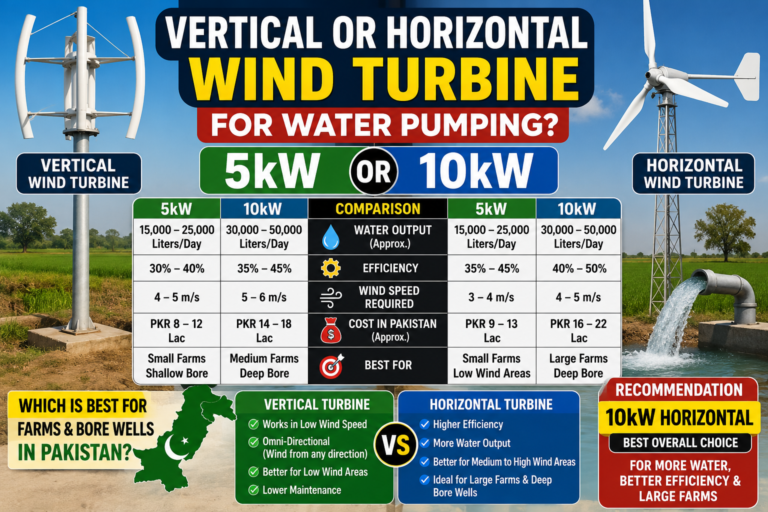
20. Horizontal or Vertical Wind Turbine for Hawksbay and Gadani?
For an open coastal site, I would normally favour a horizontal-axis wind turbine (HAWT) when maximum annual electricity production is the goal.
HAWT advantages
- high aerodynamic efficiency;
- large swept area;
- mature technology;
- good performance in clean directional wind;
- easier comparison using power curves.
VAWT advantages
A vertical-axis turbine can be useful where:
- wind direction changes rapidly;
- site geometry creates directional variability;
- turbine needs lower visual profile;
- yaw mechanism is undesirable.
But VAWTs are not automatically better simply because coastal winds are turbulent.
See Vertical Wind Turbine Price and Guide for Pakistan for more information on vertical systems. (windturbine.pk)
21. My Turbine Choice by Location
| Location | Preferred technology |
|---|---|
| Open Hawksbay plot | 3-blade HAWT |
| Open Paradise Point site | HAWT |
| Cape Monze open ridge | HAWT after turbulence study |
| Mubarak Village open land | HAWT |
| Gadani open coastline | HAWT |
| Industrial turbulent site | Site-specific HAWT/VAWT comparison |
| Building rooftop | Helical VAWT may be considered |
| Narrow urban site | VAWT may be easier physically |
For a rooftop VAWT, insist on:
- verified power curve;
- realistic swept area;
- actual rotor dimensions;
- rated wind speed;
- low-RPM PM generator;
- proper braking.
22. Best Turbine Sizes for the Western Karachi Coast
1 kW
Best for:
- battery charging;
- beach huts;
- lighting;
- CCTV;
- small homes;
- communication equipment.
A genuine 1 kW VAWT should have a meaningful swept area. A tiny 0.5–1 m² rotor marketed as 1 kW should be treated with caution.
2 kW
Good for:
- small homes;
- solar-wind hybrids;
- farmhouses;
- small fisheries facilities;
- remote sites.
A 2 kW HAWT can be a very practical size for a coastal home with good tower exposure.
3 kW
In my view, 3 kW is one of the most interesting sizes for this corridor.
Suitable for:
- farmhouses;
- villas;
- small businesses;
- larger battery systems;
- solar-wind hybrid homes.
Pakistan-specific turbine specifications and FAQs are available at Wind Turbine Pakistan FAQ. (windturbine.pk)
5 kW
Consider for:
- larger homes;
- farms;
- fish-processing;
- workshops;
- commercial facilities;
- remote businesses.
At 5 kW, I strongly recommend a proper mast-based wind survey rather than selecting a turbine based only on online wind maps.
23. Tower Height Is More Important Than Most Buyers Think
The Hawksbay research gives direct evidence.
For July:
- 10 m: 6.325 m/s
- 30 m: 6.825 m/s
- 60 m: 7.390 m/s
- 80 m: 7.643 m/s (ResearchGate)
For a home-scale turbine, 80 m is usually unrealistic.
But the lesson is still important:
Do not install a good turbine on a bad, short tower.
24. Practical Tower Recommendations
For the coastal corridor:
| Turbine size | Typical practical tower range |
|---|---|
| 500 W | 6–10 m |
| 1 kW | 9–15 m |
| 2 kW | 12–18 m |
| 3 kW | 12–20 m |
| 5 kW | 15–24 m |
These are planning ranges. Structural design may require different heights.
Where neighbouring structures exist, the rotor should be clearly above the disturbed airflow zone.
25. Rooftop Versus Ground-Mounted
Rooftop
Advantages:
- less land required;
- existing building provides some height.
Disadvantages:
- turbulence;
- vibration;
- structural fatigue;
- noise transmission;
- difficult maintenance;
- roof-edge vortices.
Ground tower
Advantages:
- cleaner airflow;
- greater height;
- easier structural engineering;
- easier maintenance;
- less vibration transferred to a building.
For Hawksbay, Gadani, Mubarak Village and similar locations where land may be available, I would generally choose a ground-mounted tower.
26. Coastal Corrosion Is a Serious Engineering Issue
The Arabian Sea environment is aggressive.
Salt-laden air attacks:
- mild steel;
- bolts;
- electrical terminals;
- bearings;
- cable connections;
- controller enclosures.
Recommended protection includes:
- hot-dip galvanised tower;
- marine-grade epoxy/PU coating where necessary;
- stainless or protected fasteners;
- sealed connectors;
- IP-rated controller enclosures;
- anti-corrosion grease;
- scheduled inspections.
A cheap turbine may fail mechanically long before the generator fails simply because the structure was not designed for a marine environment.
27. Lightning and Earthing
A coastal wind turbine is an elevated metal structure.
A professional installation should include:
- tower earth;
- generator/equipment earth;
- surge protection;
- lightning protection strategy;
- DC protection;
- AC protection;
- disconnect switches.
This becomes especially important for isolated properties along Hawksbay and Gadani.
28. Can Wind Turbines Work With Solar Systems?
Yes—and this coastal corridor is an excellent candidate for hybrid systems.
Typical architecture:
Solar panels → Solar MPPT → Battery/DC bus
and:
Wind turbine → Rectifier → Wind MPPT/controller → Battery/DC bus
then:
Battery → Hybrid inverter → Home/business
Solar generally dominates during sunny daytime hours.
Wind can contribute:
- afternoon;
- evening;
- night;
- cloudy weather;
- monsoon periods.
29. Can the Wind Turbine Charge Lithium Batteries?
Yes.
For 1–5 kW residential systems, 51.2 V LiFePO₄ batteries are particularly practical.
A turbine must not simply be connected directly to the lithium battery.
You need:
- wind turbine;
- three-phase rectifier where required;
- wind charge controller;
- dump load;
- battery BMS;
- properly configured charging voltage.
For a 51.2 V lithium battery, the controller should be configured according to the battery manufacturer’s allowable charge voltage and current.
30. Why a Dump Load Is Essential
A solar system can simply reduce PV charging when the battery becomes full.
Wind is different.
The turbine is physically rotating.
If electrical load suddenly disappears:
- rotor speed can rise;
- voltage can increase;
- turbine can overspeed.
Therefore a proper system needs:
- dump/diversion load;
- electrical brake;
- controller;
- emergency stop;
- sometimes mechanical braking.
31. Solar + Wind: Particularly Attractive at Hawksbay
Consider a farmhouse with:
- 8 kW solar;
- 3 kW wind;
- 10–20 kWh lithium battery.
During a sunny morning:
Solar dominates.
During the afternoon sea breeze:
Solar + wind operate together.
Around sunset:
Solar falls rapidly but coastal wind may continue.
At night:
Wind can continue charging or directly offset battery usage if sufficient wind remains.
This is exactly the type of complementary behaviour that makes hybrid energy interesting.
32. Site Survey Procedure
Before buying a turbine:
Stage 1 — Desktop assessment
Use:
- peer-reviewed research;
- meteorological data;
- Global Wind Atlas;
- satellite/reanalysis datasets;
- local terrain maps.
Stage 2 — Physical inspection
Check:
- nearby hills;
- huts;
- buildings;
- warehouses;
- trees;
- utility poles;
- shoreline direction;
- tower location.
Stage 3 — Wind measurement
Install an anemometer close to the proposed hub height.
Record:
- wind speed;
- gust speed;
- direction;
- time;
- seasonal variation.
Stage 4 — Power curve
Match recorded wind distribution with the exact turbine’s certified or tested power curve.
Stage 5 — Losses
Deduct:
- cable losses;
- controller losses;
- inverter losses;
- turbulence losses;
- downtime;
- battery losses.
33. How Long Should Wind Be Measured?
Professional utility-scale projects often use long measurement campaigns.
For small residential projects, practical compromises are sometimes necessary.
My recommendation:
Minimum screening
1–3 months, including part of the expected windy period.
Better
6 months
Strong decision-quality dataset
12 months
Then correlate the site measurements against longer-term regional data.
34. Anemometer Height Matters
If you plan to install a turbine at:
15 m
but measure wind at:
2 m
the result will not accurately represent the turbine.
Ideally, the anemometer should be close to expected hub height.
Where this is impossible, vertical extrapolation may be used—but introduces uncertainty.
35. Expected Performance Categories
A useful preliminary classification:
| Average wind at actual hub height | Assessment |
|---|---|
| <3 m/s | Poor |
| 3–4 m/s | Marginal |
| 4–5 m/s | Usable for selected systems |
| 5–6 m/s | Good |
| 6–7 m/s | Very good |
| >7 m/s | Excellent |
But turbine-specific power curves still matter.
36. 1 kW Turbine Example at Coastal Wind Speeds
Suppose a genuine 1 kW turbine has a realistic power curve.
| Wind | Approx. output example |
|---|---|
| 3 m/s | 20 W |
| 4 m/s | 60 W |
| 5 m/s | 140 W |
| 6 m/s | 270 W |
| 7 m/s | 450 W |
| 8 m/s | 650 W |
| 9 m/s | 820 W |
| 10 m/s | 950 W |
| 11 m/s | 1,000 W |
If a seller claims:
1 kW at 5 m/s
ask for an independent power curve.
For most compact small turbines, that should immediately raise technical questions.
37. 3 kW Turbine Example
Suppose a 3 kW HAWT has approximately a 4 m rotor.
Indicative output:
| Wind speed | Example output |
|---|---|
| 4 m/s | 150–300 W |
| 5 m/s | 350–600 W |
| 6 m/s | 650–1,000 W |
| 7 m/s | 1.1–1.5 kW |
| 8 m/s | 1.6–2.1 kW |
| 9 m/s | 2.1–2.5 kW |
| 10 m/s | 2.5–2.8 kW |
| 11–12 m/s | ~3 kW |
Again, use the actual manufacturer’s tested curve for a commercial proposal.
38. Horizontal 3 kW Turbine Specification I Would Prefer
For Hawksbay/Gadani:
| Parameter | Preferred range |
|---|---|
| Rated power | 3 kW |
| Rotor diameter | ~3.8–4.5 m |
| Blades | 3 |
| Blade material | FRP/composite |
| Rated speed | ~10–12 m/s |
| Generator | Direct-drive PMSG |
| Generator RPM | ~250–350 RPM depending on rotor |
| Controller | Wind MPPT |
| Brake | Electromagnetic + dump load |
| Tower | ~12–20 m depending on obstacles |
| Protection | Marine-corrosion treatment |
39. Wind Turbine Price in Pakistan
Current WindTurbine.pk guides show indicative prices varying substantially by turbine size and package.
For updated listings, visit: Wind Turbine Price in Pakistan
Price should never be compared without checking what is included:
- turbine;
- generator;
- controller;
- dump load;
- inverter;
- tower;
- foundation;
- cables;
- freight;
- installation.
40. What Should You Ask the Supplier?
Before purchasing, request:
- Rated power
- Maximum power
- Rotor diameter
- Swept area
- Blade length
- Cut-in wind speed
- Rated wind speed
- Full power curve
- Annual energy at 4, 5, 6 and 7 m/s mean wind
- Generator RPM
- Generator efficiency
- Controller specification
- Dump-load rating
- Brake system
- Tower load information
- Survival wind speed
- Corrosion treatment
- Warranty
- Certification
- Spare-parts availability
41. A Critical Warning About “Start-Up Wind Speed”
Many turbines advertise:
Start-up speed: 1.5 m/s
This means the blades may start rotating at 1.5 m/s.
It does not mean the turbine produces significant electricity at 1.5 m/s.
There are three different concepts:
Start-up wind speed
Rotor begins moving.
Cut-in wind speed
Generator begins providing usable output.
Rated wind speed
Turbine reaches its advertised rated power.
Always ask for all three.
42. Hawksbay: My Recommendation
Published data make Hawksbay one of the more convincing coastal small-wind prospects near Karachi.
For an open property:
Small house
1–2 kW
Farmhouse
2–3 kW
Larger property
3–5 kW
Commercial
5 kW+ after measurement
I would favour a horizontal turbine on a properly engineered tower unless roof/space constraints justify a vertical design.
43. Paradise Point: My Recommendation
The approximately 7 m/s at 30 m and 9 m/s at 61 m figures reported in the Pakistan Academy of Sciences study are extremely encouraging. (Pakistan Science Abstracts)
At an exposed site with permission and sufficient tower height, Paradise Point has potential for:
- 1–5 kW residential systems;
- 5–20 kW commercial systems;
- solar-wind hybrid systems.
But local terrain and installation restrictions must still be considered.
44. Gadani: My Recommendation
Gadani is geographically attractive, but because strong modern site-specific public wind measurements are harder to establish from the sources reviewed, my recommendation is:
Measure first, buy second.
For a 3–5 kW project:
- install an anemometer;
- measure at proposed height;
- record at least several months;
- examine direction;
- avoid wake from industrial structures;
- calculate energy using the exact turbine curve.
If mean wind at the final hub height proves to be around 5.5–6+ m/s, the economics could become very attractive.
45. Sonmiani and Smaller Coastal Settlements
These regions could be particularly suitable for hybrid systems because grid infrastructure and reliability may be more limited in remote locations.
Potential applications:
- fisheries;
- water pumping;
- homes;
- telecom;
- surveillance;
- farms;
- cold storage;
- small businesses.
A solar + wind + LiFePO₄ battery architecture may be more valuable here than wind alone.
46. ROI Example
Suppose a 3 kW system costs:
PKR 700,000 installed — purely an illustration.
Assume annual generation:
5,000 kWh
Value of displaced electricity:
PKR 55/kWh
Annual gross energy value:
[
5,000\times55=PKR\ 275,000
]
Assume maintenance:
PKR 20,000/year
Net:
[
275,000-20,000=PKR\ 255,000
]
Simple payback:
[
700,000/255,000 \approx 2.75\ years
]
But if the same turbine produces only 2,000 kWh/year:
[
2,000\times55=110,000
]
after maintenance:
[
90,000
]
Payback becomes almost:
[
700,000/90,000 \approx7.8\ years
]
That is why wind measurement is financially important.
47. Best Coastal Sites for a Pilot Installation
If the objective were to demonstrate small wind technology around Karachi, my initial priority would be:
- Paradise Point
- Hawksbay
- Mubarak Village
- Cape Monze exposed site
- Gadani open coast
- Sonmiani
- Sandspit
The first two rank highest because we have particularly useful published measurement evidence for them.
48. Final Verdict
The Hawksbay–Paradise Point–Cape Monze–Mubarak Village–Gadani–Sonmiani coastal corridor deserves far more attention for distributed wind energy than an average inland Pakistani city.
The strongest scientific evidence currently available from the reviewed sources is particularly compelling for:
Hawksbay
A detailed two-year measurement campaign reported approximately 5.9 m/s annual mean wind at 80 m, with summer monthly means at various heights reaching considerably higher values. (ResearchGate)
Paradise Point
Research published by the Pakistan Academy of Sciences reported approximately 7 m/s at 30 m and 9 m/s at 61 m, with prevailing winds mainly from the southwest. (Pakistan Science Abstracts)
Gadani and adjoining Balochistan coastline
The geography is promising, but site-specific measurement should be performed before making strong generation claims. Broader scientific work confirms that wind potential varies substantially across Balochistan and that selected locations can be useful for wind-energy applications. (ScienceDirect)
For most homes and farmhouses in this coastal belt, a sensible system would be:
2–3 kW wind turbine + existing solar PV + 51.2 V LiFePO₄ battery + wind-specific MPPT/controller + dump load + hybrid inverter.
For commercial properties, 5–10 kW systems may be justified after a proper wind survey.
The most important lesson is simple:
Don’t buy a wind turbine based only on its kW rating. Buy according to measured wind speed, rotor size, power curve and tower height.
A good turbine at a poor location will produce disappointing energy. A properly selected turbine on an exposed Hawksbay, Paradise Point or similar coastal site can be a completely different proposition.
For current Pakistan-specific products, pricing and technical guidance, readers can continue with:
WindTurbine.pk – Pakistan Wind Energy Solutions
Wind Turbine Prices in Pakistan (windturbine.pk)
How to Choose a Wind Turbine for Your Home (windturbine.pk)
Wind Turbine in Karachi – Performance & Feasibility Guide (windturbine.pk)