Advantages and Disadvantages of Horizontal Axis Wind Turbines
Horizontal Axis Wind Turbines (HAWTs) are the most widely used wind turbines in the world because they deliver high efficiency, reliable electricity generation, and proven long-term performance. Whether you are planning to install a residential wind turbine or a commercial wind power system, understanding the advantages and disadvantages of horizontal axis wind turbines is essential before making an investment.
Unlike vertical axis wind turbines, a horizontal axis wind turbine uses blades that rotate around a horizontal shaft facing the wind. This design allows the turbine to capture more wind energy and convert it into electricity with greater efficiency.
In this comprehensive guide, we will explore how horizontal axis wind turbines work, their major advantages, and why they dominate the global wind energy industry.
What Is a Horizontal Axis Wind Turbine?
A Horizontal Axis Wind Turbine (HAWT) is a wind energy system whose main rotor shaft is positioned parallel to the ground. The blades rotate like an airplane propeller and always face the direction of the wind.
Most modern wind farms, industrial wind projects, and residential wind systems use this design because it produces more electricity than most alternative turbine designs.
The main objective of a horizontal wind turbine is simple:
- Capture wind energy
- Convert rotational energy into mechanical energy
- Drive a generator
- Produce clean electricity
This technology has been continuously improved for decades and remains the industry standard worldwide.
If you want to know the prices of horizintal wind turbine please visit this page https://windturbine.pk/prices-of-wind-turbine-in-pakistan/
How Does a Horizontal Axis Wind Turbine Work?
Understanding the working principle helps explain why horizontal turbines are so efficient.
The process follows these steps:
Step 1: Wind Hits the Blades
As wind flows across the specially designed blades, aerodynamic lift is created. Instead of pushing the blades directly, the wind generates lift similar to an aircraft wing.
This lift force spins the rotor much more efficiently than simple drag-based turbines.
Step 2: Rotor Begins Rotating
The rotating blades turn the rotor hub, which transfers mechanical energy to the main shaft.
The faster the wind speed, the more rotational energy is produced—up to the turbine’s rated capacity.
Step 3: Shaft Transfers Power
The rotating shaft sends power to either:
- A gearbox (traditional design)
- A direct-drive generator (modern design)
The gearbox increases rotational speed before it reaches the generator.
Step 4: Electricity Is Generated
Inside the generator, mechanical energy becomes electrical energy.
This electricity can then:
- Power a home
- Charge batteries
- Supply a business
- Feed electricity into the utility grid
Step 5: Smart Controller Protects the Turbine
Modern horizontal wind turbines continuously monitor:
- Wind speed
- Rotor speed
- Blade angle
- Generator temperature
- Output voltage
If wind becomes dangerously strong, the control system automatically slows or stops the turbine to protect its components.
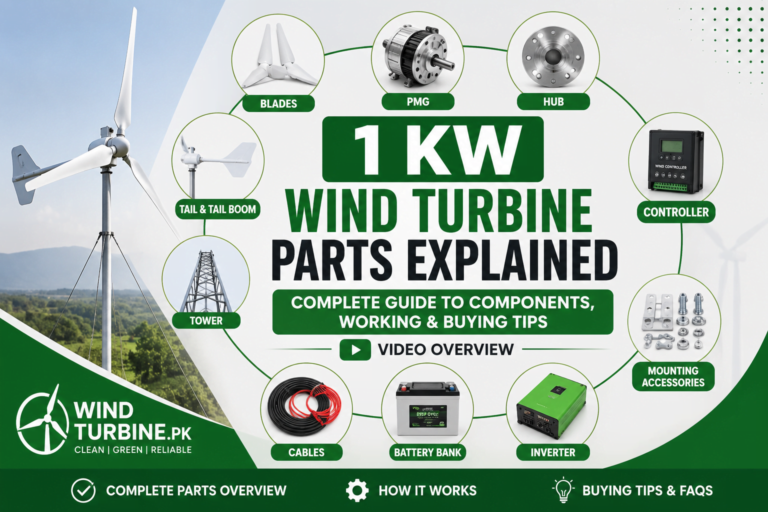
Main Components of a Horizontal Axis Wind Turbine
A horizontal wind turbine consists of several critical parts that work together.
| Component | Function |
|---|---|
| Rotor Blades | Capture wind energy |
| Hub | Connects blades to the shaft |
| Main Shaft | Transfers mechanical energy |
| Gearbox | Increases rotational speed (if equipped) |
| Generator | Produces electricity |
| Nacelle | Houses mechanical components |
| Controller | Monitors and protects the system |
| Yaw System | Turns the turbine toward the wind |
| Tower | Raises the turbine into stronger winds |
| Brake System | Stops the rotor during emergencies |
Every component plays an important role in maximizing energy production and ensuring safe operation. If you want to check feasibility online for free please visit this page https://windturbine.pk/feasibility/
Advantages of Horizontal Axis Wind Turbines
Horizontal Axis Wind Turbines dominate the renewable energy industry because they provide excellent efficiency, durability, and energy output.
Let’s examine each advantage in detail.
1. High Energy Efficiency
The biggest advantage of horizontal axis wind turbines is their exceptional efficiency.
Their aerodynamic blades create lift rather than relying mainly on drag. This allows them to extract significantly more energy from moving air.
Compared with many vertical-axis designs, horizontal turbines generally achieve higher energy conversion efficiency under suitable wind conditions.
For homeowners and businesses, higher efficiency means:
- More electricity
- Better return on investment
- Faster payback period
- Reduced dependence on grid power
This is one of the primary reasons why almost every commercial wind farm uses horizontal turbines.
2. Higher Electricity Production
Horizontal turbines are designed for maximum power generation.
Their taller towers place the rotor where wind speeds are generally stronger and more consistent.
Because wind power increases rapidly as wind speed rises, even a modest increase in average wind speed can lead to significantly higher energy production over time.
This makes horizontal turbines particularly effective in:
- Coastal regions
- Open farmland
- Mountain ridges
- Industrial sites
- Rural properties
When installed at a good location, they can generate electricity throughout the year.
3. Excellent Performance in Strong Winds
Horizontal turbines perform particularly well where wind conditions are favorable.
Many residential models begin producing electricity at relatively low wind speeds and continue increasing output until they reach their rated capacity.
Commercial machines are engineered to safely operate in demanding wind environments while maintaining stable performance through advanced control systems.
This ability to harness stronger winds is a key reason they are widely used in utility-scale power generation.
4. Proven Technology
Horizontal Axis Wind Turbines have been used commercially for decades.
Manufacturers have continuously improved:
- Blade aerodynamics
- Generator efficiency
- Gearbox reliability
- Safety systems
- Electronic controls
- Corrosion resistance
As a result, today’s turbines are more reliable than earlier generations.
Because the technology is well established, replacement parts, technical expertise, and maintenance services are generally easier to find than for less common turbine designs.
5. Long Operational Life
A quality horizontal wind turbine is built for long-term operation.
With proper installation and scheduled maintenance, many turbines remain productive for 20 years or more.
Routine maintenance usually includes:
- Inspecting blades
- Lubricating moving parts
- Checking electrical connections
- Tightening bolts
- Monitoring bearings
- Verifying control systems
Regular servicing helps maintain efficiency and reduces the risk of unexpected failures.
6. Scalable for Different Applications
Horizontal wind turbines are available in many sizes, making them suitable for a wide range of users.
Small systems can support:
- Homes
- Cabins
- Farms
- Telecom sites
Medium-sized turbines are often used for:
- Schools
- Workshops
- Commercial buildings
Large utility-scale turbines can generate electricity for thousands of homes through the power grid.
This flexibility makes HAWTs one of the most versatile renewable energy technologies available.
7. Lower Cost per Unit of Electricity Over Time
Although the initial investment can be substantial, horizontal wind turbines often deliver a competitive cost of electricity over their operating lifetime in locations with adequate wind resources.
After installation, the wind itself is free.
The primary ongoing costs are:
- Scheduled maintenance
- Occasional component replacement
- System inspections
Over many years, the energy produced can offset a significant portion of electricity costs, depending on local wind conditions and electricity prices.
8. Environmentally Friendly Energy Generation
Horizontal wind turbines generate electricity without burning fossil fuels during operation.
As a result, they:
- Produce no direct carbon dioxide emissions while generating electricity
- Consume no fuel during normal operation
- Help reduce dependence on conventional energy sources
- Support cleaner energy generation
They also use no water for electricity generation, unlike many conventional thermal power plants.
9. Works Well with Solar Energy Systems
Many homeowners combine horizontal wind turbines with solar panels to create a hybrid renewable energy system.
This combination offers an important advantage because solar and wind resources often complement one another.
For example:
- Solar panels generate electricity during sunny hours.
- Wind turbines may continue generating power during cloudy weather, evenings, or windy conditions.
When paired with battery storage and a hybrid inverter, this approach can improve overall energy availability throughout the year.
10. Strong Return on Investment in Suitable Locations
One of the biggest financial advantages of a horizontal wind turbine is its potential long-term value where average wind speeds are sufficient.
Factors affecting return on investment include:
- Local wind speed
- Electricity tariffs
- System size
- Installation quality
- Maintenance practices
- Energy consumption
Sites with consistently good wind resources generally offer the greatest opportunity for energy savings over the turbine’s lifetime.
Summary of Advantages
| Advantage | Benefit |
|---|---|
| High efficiency | Produces more electricity from available wind |
| Proven technology | Reliable and widely adopted |
| Higher power output | Suitable for homes and businesses |
| Long lifespan | Can operate for decades with maintenance |
| Scalable | Available in small to utility-scale sizes |
| Renewable energy | Generates electricity without fuel |
| Hybrid compatibility | Works well with solar and battery systems |
| Long-term savings | Can reduce electricity costs in windy locations |
Final Thoughts (Part 1)
Horizontal Axis Wind Turbines have become the global standard for wind energy because they combine high efficiency, dependable performance, and proven engineering. Their ability to generate substantial amounts of clean electricity makes them suitable for residential, commercial, agricultural, and utility-scale applications.
However, no technology is perfect. While HAWTs offer many significant benefits, they also come with practical limitations such as installation requirements, maintenance considerations, noise, and site suitability. Understanding these trade-offs is essential before investing in a wind energy system.
In Part 2, we will examine the disadvantages of Horizontal Axis Wind Turbines in detail, compare them with Vertical Axis Wind Turbines (VAWTs), answer common questions, and help you determine whether a HAWT is the right choice for your energy needs.
Disadvantages of Horizontal Axis Wind Turbines
While Horizontal Axis Wind Turbines (HAWTs) are the most popular and efficient wind turbines in the renewable energy industry, they are not the perfect solution for every location or project. Like any energy technology, they have certain limitations that should be carefully evaluated before installation.
Understanding the advantages and disadvantages of Horizontal Axis Wind Turbines allows homeowners, businesses, and investors to choose the right renewable energy system based on their budget, location, and electricity needs.
1. High Initial Investment
One of the biggest disadvantages of Horizontal Axis Wind Turbines is their relatively high upfront cost. Purchasing the turbine is only one part of the total investment.
Additional expenses often include:
- Tower installation
- Concrete foundation
- Electrical wiring
- Charge controller or hybrid inverter
- Battery storage (for off-grid systems)
- Professional installation
- Transportation
Compared to small solar systems, a wind turbine installation usually requires more engineering and structural work.
However, in locations with strong and consistent wind, the long-term energy savings can help recover the investment over time.
2. Requires Consistent Wind Speeds
A Horizontal Axis Wind Turbine only performs efficiently when there is enough wind.
If average wind speeds are too low, electricity production decreases significantly.
For most residential turbines, an annual average wind speed of 5–6 m/s (18–22 km/h) or higher is generally recommended for good performance.
Before purchasing a turbine, it is essential to conduct a professional wind resource assessment.
Poor wind conditions can result in:
- Lower electricity generation
- Longer payback periods
- Reduced return on investment
- Increased cost per unit of electricity
Location is often more important than the size of the turbine itself.
3. Needs a Tall Tower
Unlike Vertical Axis Wind Turbines, HAWTs need to be installed high above the ground.
Why?
Because wind speeds increase with height, and taller towers avoid turbulence caused by buildings, trees, and other obstacles.
Residential wind turbines commonly require towers between 12 and 30 meters, while commercial turbines may exceed 100 meters.
Although taller towers improve energy production, they also increase:
- Installation costs
- Engineering requirements
- Transportation expenses
- Permit requirements
- Maintenance difficulty
4. Installation Is More Complex
Installing a Horizontal Axis Wind Turbine is not as simple as mounting solar panels on a roof.
The installation process often involves:
- Soil testing
- Concrete foundation construction
- Tower assembly
- Crane lifting
- Electrical connections
- Safety inspections
Large turbines require specialized equipment and trained technicians, making installation both time-consuming and costly. We suggest you to get knowledge about wind turbine before installing, visit this for more information. https://windturbine.pk/blog/
5. Maintenance Can Be Challenging
Most of the important mechanical components—including the generator, gearbox, and braking system—are located at the top of the tower.
Routine maintenance may require:
- Climbing the tower
- Using lifting equipment
- Professional service technicians
- Safety equipment
Although modern turbines are highly reliable, maintenance is generally more difficult than with ground-level renewable energy systems.
6. Noise During Operation
Modern Horizontal Axis Wind Turbines are much quieter than older models, but they are not completely silent.
Common sources of noise include:
- Blade movement through the air
- Generator operation
- Gearbox (if fitted)
- Mechanical vibration
The amount of noise depends on:
- Turbine size
- Wind speed
- Distance from buildings
- Blade design
Proper installation and adequate setback distances usually minimize any impact on nearby homes.
7. Visual Impact
Some people appreciate wind turbines as symbols of clean and sustainable energy, while others feel they change the appearance of the landscape.
Large towers and rotating blades are visible from long distances, especially in open rural or coastal areas.
For this reason, some communities have planning regulations regarding turbine height, location, and appearance.
8. Wildlife Considerations
Wind turbines can affect birds and bats if they are installed in environmentally sensitive locations.
Modern wind farm developers reduce these risks by:
- Conducting environmental impact assessments
- Avoiding major migration routes
- Using improved turbine placement
- Monitoring wildlife activity
- Applying operational strategies during high-risk periods
With proper planning, wildlife impacts can be significantly reduced.
9. Performance Depends on Weather
Unlike diesel generators, wind turbines cannot generate constant electricity every hour of the day.
Power production changes according to:
- Wind speed
- Wind direction
- Seasonal weather
- Local climate conditions
Some days may produce maximum electricity, while calm days generate very little power.
For this reason, many homeowners combine wind turbines with:
- Solar panels
- Lithium battery storage
- Hybrid inverters
This hybrid approach provides a more reliable electricity supply throughout the year.
10. Requires Open Space
Horizontal Axis Wind Turbines perform best in locations where airflow is smooth and unobstructed.
Poor installation sites include areas surrounded by:
- Tall buildings
- Dense forests
- Hills
- Large industrial structures
These obstacles create turbulent wind, which reduces efficiency and places additional stress on turbine components.
For the best performance, the turbine should be installed in an open area with minimal wind obstruction.
Horizontal Axis Wind Turbine vs. Vertical Axis Wind Turbine
Many people compare Horizontal Axis Wind Turbines (HAWTs) with Vertical Axis Wind Turbines (VAWTs) before making a purchase.
The table below highlights the key differences.
| Feature | Horizontal Axis Wind Turbine | Vertical Axis Wind Turbine |
|---|---|---|
| Efficiency | High | Moderate |
| Power Output | Higher | Lower |
| Best for Large Projects | Yes | Limited |
| Residential Use | Excellent (with good wind) | Good for urban areas |
| Maintenance | More difficult | Easier |
| Tower Required | Yes | Usually shorter |
| Wind Direction | Faces the wind automatically | Accepts wind from multiple directions |
| Commercial Adoption | Very high | Limited |
Overall, Horizontal Axis Wind Turbines remain the preferred choice for utility-scale wind farms and most residential installations because of their superior efficiency and energy output. Please visit this for detail artical
Is a Horizontal Axis Wind Turbine Right for You?
A Horizontal Axis Wind Turbine can be an excellent investment if your property meets the following conditions:
- Average wind speeds are consistently high.
- The site has open space with minimal obstructions.
- You want to reduce long-term electricity costs.
- You are planning a hybrid solar and wind energy system.
- You have sufficient budget for installation and maintenance.
However, if your location experiences weak or highly turbulent winds, another renewable energy solution may provide better value.
Frequently Asked Questions (FAQs)
Are Horizontal Axis Wind Turbines more efficient than Vertical Axis Wind Turbines?
Yes. HAWTs generally achieve higher efficiency because their aerodynamic blades generate lift and continuously face the wind.
Can a Horizontal Axis Wind Turbine power an entire house?
Yes. A properly sized turbine installed at a suitable location can supply a significant portion—or in some cases all—of a home’s electricity needs. Many homeowners also combine wind turbines with solar panels and battery storage for greater reliability.
How long does a Horizontal Axis Wind Turbine last?
Most quality Horizontal Axis Wind Turbines have an expected lifespan of 20–25 years with regular maintenance.
Do Horizontal Axis Wind Turbines work at night?
Yes. Unlike solar panels, wind turbines generate electricity whenever sufficient wind is available, regardless of whether it is day or night.
Are Horizontal Axis Wind Turbines suitable for Pakistan?
Yes. They are particularly suitable for windy regions such as Karachi, Jhimpir, Gharo, parts of Balochistan, and other coastal or open rural areas where average wind speeds are favorable.
Conclusion
Horizontal Axis Wind Turbines remain the world’s most widely used wind energy technology because they combine high efficiency, reliable performance, and proven engineering. They are capable of generating substantial amounts of clean electricity for homes, farms, businesses, and utility-scale projects.
However, they are not suitable for every location. Factors such as wind speed, installation space, tower height, maintenance requirements, and project budget all play a crucial role in determining whether a HAWT is the right choice.
Before investing in any wind turbine, conduct a professional wind assessment and carefully evaluate your energy requirements. When installed in the right location, a Horizontal Axis Wind Turbine can provide decades of renewable electricity, reduce dependence on the power grid, and contribute to a cleaner, more sustainable future.