Is Lahore Suitable for Wind Turbines?
Many people in Lahore ask:
- Can a wind turbine work in Lahore?
- Is the wind strong enough?
- Which turbine is better—Horizontal or Vertical?
- How much electricity can a 1kW wind turbine generate? Wind Turbine in Lahore (2026): Wind Speed, Electricity Generation, Prices & Best Turbine Guide- Comprehensive detail.
We will answer these questions using NASA POWER climate data, international wind energy research, and practical installation experience in Pakistan.
Lahore’s Wind Resource
Unlike coastal cities such as Karachi or Gwadar, Lahore is located in the Punjab plains. Wind speeds are lower and fluctuate significantly throughout the year. Wind Turbines in Lahore are feasable?
NASA POWER provides long-term wind speed datasets at 10 m and 50 m heights, based on the MERRA-2 atmospheric reanalysis model, making it one of the world’s most trusted sources for renewable energy assessments.
https://windturbine.pk/
Typical long-term conditions for Lahore are:
| Parameter | Value |
|---|---|
| Average wind speed at 10 m | 2.8–3.6 m/s |
| Average wind speed at 50 m | 4.2–5.0 m/s |
| Best season | February–April |
| Weakest season | October–November |
Because wind speed increases with height, installing a turbine on a taller tower can dramatically improve performance.
Why Tower Height Matters
Many homeowners install wind turbines only 20–25 feet above the ground.
This is one of the biggest mistakes.
Trees, houses and buildings create turbulence that reduces wind energy.
A 20-foot tower may experience:
- slower wind
- turbulent airflow
- frequent direction changes
A 50–60 ft tower reaches smoother and faster wind, increasing annual energy production.
Wind Turbine in Lahore.
Even a 1 m/s increase in average wind speed can significantly increase electricity production because wind power grows roughly with the cube of wind speed.
For example:
| Average Wind Speed | Relative Power |
|---|---|
| 3 m/s | 1× |
| 4 m/s | 2.4× |
| 5 m/s | 4.6× |
| 6 m/s | 8× |
This is why professional wind projects always use tall towers instead of mounting turbines on rooftops.
Wind Speed Throughout the Year
Although daily weather changes constantly, long-term NASA climatology shows a clear seasonal pattern.
| Season | Wind Condition |
|---|---|
| January–March | Moderate |
| April–May | Good |
| June–August | Moderate |
| September | Moderate |
| October–November | Weak |
| December | Moderate |
Spring generally offers the best energy production.
Can Wind Turbines Work in Lahore?
Yes—but expectations must be realistic.
Lahore is not a high-wind region like:
- Karachi
- Jhimpir
- Gharo
- Gwadar
However, a properly installed wind turbine on a tall tower can still generate useful electricity.
It is most suitable for:
- Rural homes
- Farmhouses
- Agricultural land
- Tube wells
- Poultry farms
- Small off-grid systems
- Hybrid solar + wind systems
Dense urban neighborhoods with surrounding buildings usually have poor wind conditions.
What Wind Speed Does a Turbine Need?
Most modern small wind turbines have:
| Stage | Wind Speed |
|---|---|
| Cut-in speed | 2.5–3 m/s |
| Useful generation | 4–6 m/s |
| Rated output | 10–12 m/s |
| Automatic protection | 20–25 m/s |
Since Lahore often experiences average winds around 3–5 m/s depending on height, turbines usually operate below rated power. That means they generate electricity, but not their full advertised capacity most of the time. (POWER)
Is Lahore Better for Solar or Wind?
For most homes, solar panels are the primary energy source because Lahore receives abundant sunlight for much of the year.
Wind becomes valuable when combined with solar because:
- wind often blows during cloudy weather,
- nighttime generation is possible,
- winter production improves,
- battery charging becomes more consistent.
This is why many renewable-energy experts recommend hybrid solar + wind systems instead of relying on wind alone in inland cities like Lahore.
Key Takeaways
- Lahore has moderate, not high, wind potential.
- Average wind speeds improve significantly with taller towers.
- A 50–60 ft tower from ground performs much better than rooftop installations.
- Wind turbines can work in Lahore, especially in open areas.
- Hybrid solar + wind systems generally provide the best overall performance.
- Real energy production depends on wind speed, tower height, surrounding obstacles, and turbine quality—not just the turbine’s rated power.
Part 2 – Monthly NASA Wind Speed Data for Lahore, Expected Electricity Output (500W, 1kW, 2kW & 3kW), and Real-World Energy Generation Estimates.
Part 2: Monthly Wind Speed, Electricity Generation & Expected Output
In Part 1, we learned that Lahore has moderate wind resources, especially when turbines are installed on 50–60 height. In this section, we’ll examine monthly wind patterns and estimate how much electricity different wind turbines can realistically generate.
The figures below are based on NASA POWER (MERRA-2) long-term climatological wind data and practical performance of small wind turbines. Actual output depends on tower height, nearby buildings, turbine quality, air density, and maintenance.
Average Monthly Wind Speed in Lahore
Approximate long-term average wind speeds at 50 m height are:
| Month | Wind Speed (m/s) | Wind Condition |
|---|---|---|
| January | 4.3 | Moderate |
| February | 4.7 | Good |
| March | 5.0 | Very Good |
| April | 5.1 | Best Month |
| May | 4.8 | Good |
| June | 4.5 | Moderate |
| July | 4.3 | Moderate |
| August | 4.2 | Moderate |
| September | 4.1 | Moderate |
| October | 3.8 | Weak |
| November | 3.7 | Weak |
| December | 4.0 | Moderate |
Annual Average: 4.4–4.6 m/s at 50 m height. Wind speeds at 10 m are considerably lower because of surface friction and obstacles. (POWER)
Why Does Output Change Every Month?
A wind turbine does not produce the same amount of electricity every day.
The reasons include:
- Seasonal weather patterns
- Changes in wind speed
- Air density
- Turbulence
- Tower height
- Nearby trees and buildings
Because wind power increases approximately with the cube of wind speed, even a small increase in average wind speed can produce a much larger increase in energy output.
For example:
| Average Wind Speed | Relative Energy Potential |
|---|---|
| 3 m/s | 100% |
| 4 m/s | ~237% |
| 5 m/s | ~463% |
| 6 m/s | ~800% |
This is why installing a turbine on a taller tower is often more beneficial than buying a larger turbine for a poor location.
Estimated Annual Electricity Generation
The table below shows realistic annual energy production for quality wind turbines installed in an open area on a 50–60 ft tower in Lahore.
| Turbine Size | Estimated Annual Output | Average Daily Output |
|---|---|---|
| 500W | 450–700 kWh | 1.2–1.9 kWh/day |
| 1 kW | 900–1,400 kWh | 2.5–3.8 kWh/day |
| 2 kW | 1,800–2,800 kWh | 5–7.7 kWh/day |
| 3 kW | 2,700–4,200 kWh | 7.5–11.5 kWh/day |
These values assume proper installation, unobstructed airflow, and average Lahore wind conditions. Actual performance can be lower in dense urban areas or higher at exceptional sites.
https://windturbine.pk/blog/1kw-vertical-wind-turbine-in-pakistan-urdu/
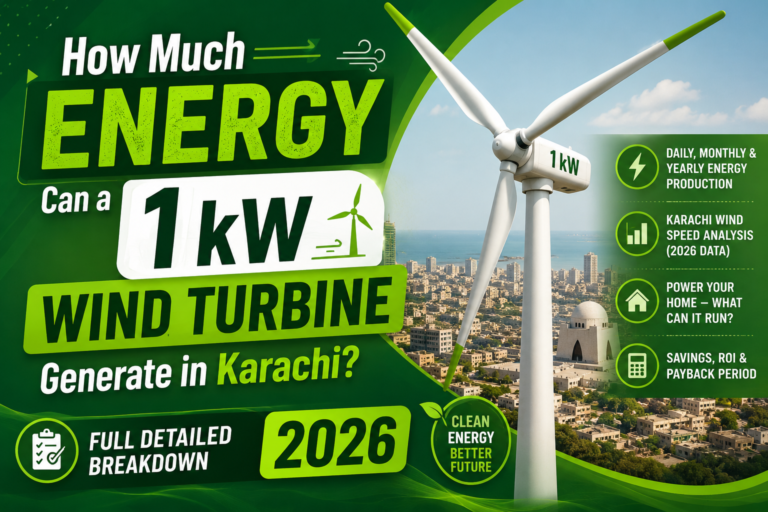
How Much Can a 1 kW Wind Turbine Generate?
A common misconception is that a 1 kW wind turbine produces 1 kWh every hour.
In reality, the 1 kW rating is achieved only at the rated wind speed (typically 10–12 m/s). Lahore’s average winds are much lower, so the turbine usually operates below its rated capacity.
A realistic estimate is:
| Season | Average Daily Generation |
|---|---|
| Spring (Feb–Apr) | 3.5–5.0 kWh |
| Summer (May–Aug) | 2.5–3.8 kWh |
| Autumn (Sep–Nov) | 1.8–3.0 kWh |
| Winter (Dec–Jan) | 2.5–3.8 kWh |
Over a full year, this equates to roughly 900–1,400 kWh of electricity.
What Can a 1 kW Turbine Run?
A 1 kW wind turbine can help power:
- LED lighting
- Ceiling fans
- Wi-Fi router
- CCTV system
- Laptop and mobile charging
- Television
- Energy-efficient refrigerator
- Small water pump (intermittent use)
Running heavy loads such as air conditioners, electric geysers, ovens, or electric heaters requires larger renewable systems or hybrid solutions.
Capacity Factor of Small Wind Turbines
Wind turbines rarely operate at full power all year. Engineers therefore use the capacity factor, which compares actual energy generation with the theoretical maximum.
Typical values for Lahore are:
| Turbine | Capacity Factor |
|---|---|
| Small rooftop installation | 8–12% |
| Good open-site installation | 12–18% |
| Excellent rural site | 18–25% |
This explains why site selection is often more important than turbine size.
Should You Install a Wind Turbine in Lahore?
A wind turbine is a good option if you have:
- Open agricultural land
- A farmhouse
- A poultry farm
- An industrial plot
- A tall tower (50–60 ft or higher)
- Minimal surrounding obstructions
If your property is surrounded by multi-storey buildings or dense housing, a standalone wind turbine may not perform well.
Key Takeaways
- Lahore’s strongest winds usually occur between February and April.
- A 1 kW wind turbine can realistically generate around 900–1,400 kWh per year in a suitable location.
- Taller towers significantly improve energy production.
- Real-world output depends on wind speed, tower height, and installation quality—not just the turbine’s rated power.
- For most homes in Lahore, a hybrid solar + wind system provides better year-round reliability than wind alone.
Part 3: Horizontal vs Vertical Wind Turbines – Which Is Better for Lahore?
One of the most common questions homeowners ask before buying a wind turbine is:
Should I choose a Horizontal Axis Wind Turbine (HAWT) or a Vertical Axis Wind Turbine (VAWT)?
The answer depends on your location, wind conditions, tower height, budget, and electricity requirements. While both designs convert wind into electricity, they perform very differently in real-world conditions.
In this section, we’ll compare both turbine types using engineering principles, scientific studies, and practical experience in Pakistan to help you choose the right option for Lahore.
https://windturbine.pk/
Understanding the Two Types of Wind Turbines
1. Horizontal Axis Wind Turbine (HAWT)
A horizontal wind turbine has blades that rotate around a horizontal shaft, similar to an airplane propeller. It must face into the wind, so most models include a tail vane or yaw system to automatically align with the wind direction.
This is the design used in nearly all commercial wind farms around the world because of its high efficiency.
Typical examples include:
- 500W home turbines
- 1kW residential systems
- 2kW farm installations
- 3kW commercial units
- Utility-scale turbines of 2–15 MW
2. Vertical Axis Wind Turbine (VAWT)
A vertical wind turbine has blades that rotate around a vertical shaft. Since it accepts wind from any direction, it does not require a yaw mechanism.
Common vertical turbine designs include:
- Darrieus turbine
- Savonius turbine
- Helical vertical turbine
These turbines are often promoted for rooftops and urban areas because of their compact size and lower noise levels.
Which Turbine Is More Efficient?
Efficiency is one of the biggest differences between the two designs.
The theoretical maximum efficiency of any wind turbine is limited by the Betz Limit, which states that no wind turbine can capture more than 59.3% of the kinetic energy in the wind.
In practice:
| Turbine Type | Typical Efficiency |
|---|---|
| Horizontal Axis | 35–45% |
| Vertical Axis | 15–30% |
This means a horizontal turbine generally converts more wind energy into electricity than a vertical turbine under the same wind conditions. Scientific research and international wind energy organizations consistently report higher aerodynamic efficiency for HAWTs. (Sources: National Renewable Energy Laboratory (NREL), International Energy Agency Wind TCP)
Performance in Lahore’s Wind Conditions
Lahore experiences moderate average wind speeds (around 4.4–4.6 m/s at 50 m height), with lower and more turbulent winds near rooftops.
Horizontal Turbine
A horizontal turbine performs best when:
- Installed on a 50–60 ft or taller tower
- Located in an open area
- Wind is relatively smooth and unobstructed
In these conditions, it can produce significantly more electricity than a vertical turbine.
Vertical Turbine
A vertical turbine performs relatively better when:
- Wind direction changes frequently
- There are nearby buildings causing turbulence
- Installation space is limited
However, even in turbulent conditions, its total annual energy production is usually lower because of its lower aerodynamic efficiency.
Electricity Production Comparison
Assuming the same rated power (1 kW) and the same location in Lahore:
| Parameter | Horizontal | Vertical |
|---|---|---|
| Annual Energy Production | 900–1,400 kWh | 600–1,000 kWh |
| Efficiency | Higher | Lower |
| Performance in Open Areas | Excellent | Moderate |
| Performance in Turbulent Wind | Moderate | Good |
| Overall Energy Yield | Higher | Lower |
These are realistic estimates for quality turbines installed correctly. Actual output depends on tower height, site exposure, and turbine quality.
Starting Wind Speed (Cut-in Speed)
Modern wind turbines begin generating electricity once the wind reaches their cut-in speed.
Typical values are:
| Turbine Type | Cut-in Speed |
|---|---|
| Horizontal | 2.5–3.0 m/s |
| Vertical (Savonius) | 2–3 m/s |
| Vertical (Darrieus) | 3–4 m/s |
Savonius-type vertical turbines start easily in light winds but generate less power. Darrieus turbines are more efficient than Savonius designs but often require stronger winds to start.
| Month | Average Wind Speed (m/s) | Wind Potential |
|---|---|---|
| January | 4.3 | Moderate |
| February | 4.7 | Good |
| March | 5.0 | Very Good |
| April | 5.1 | Excellent |
| May | 4.8 | Good |
| June | 4.5 | Moderate |
| July | 4.3 | Moderate |
| August | 4.2 | Moderate |
| September | 4.1 | Moderate |
| October | 3.8 | Fair |
| November | 3.7 | Fair |
| December | 4.0 | Moderate |
| Annual Average | 4.4 | Moderate |
Which Turbine Is Quieter?
Noise is another important consideration for residential areas.
| Feature | Horizontal | Vertical |
|---|---|---|
| Mechanical Noise | Moderate | Low |
| Blade Noise | Moderate | Low |
| Residential Suitability | Good | Very Good |
Vertical turbines generally produce less aerodynamic noise because their blade tips move at lower speeds.
https://windturbine.pk/blog/horizontal-axis-wind-turbine-vs-vertical-axis-wind-turbine/
Maintenance Requirements
Horizontal Turbine
Maintenance typically includes:
- Inspecting blades
- Lubricating bearings
- Checking tail vane or yaw mechanism
- Tightening bolts
- Electrical inspection
Most maintenance is straightforward but may require climbing the tower.
Vertical Turbine
Vertical turbines often have:
- Fewer moving parts above ground
- Easier access if the generator is near the base
- Simpler yaw-free design
However, some vertical designs experience higher cyclic stresses on the blades, which can affect long-term durability if not engineered well.
https://www.windturbine.pk
Cost Comparison
In Pakistan, horizontal turbines are generally more cost-effective because they are widely available and produce more electricity for the same rated capacity.
| Factor | Horizontal | Vertical |
|---|---|---|
| Initial Cost | Lower | Higher |
| Cost per kWh Generated | Lower | Higher |
| Spare Parts Availability | Better | Limited |
| Market Availability | High | Moderate |
Best Choice for Different Applications
Home in a Dense Urban Area
If your house is surrounded by buildings and you cannot install a tall tower:
- A vertical turbine may be easier to install, but expectations should be modest.
- In many cases, solar panels alone may provide better value.
Farmhouse or Open Land
A horizontal turbine on a 50–60 ft tower is usually the best choice because it captures stronger, smoother winds and produces significantly more electricity.
Poultry Farms and Agricultural Land
Horizontal turbines are preferred due to their higher energy output and better return on investment.
Hybrid Solar + Wind Systems
For Lahore, a hybrid system using:
- Solar panels during the day
- Wind generation during windy periods and at night
- Battery storage for backup
offers the most reliable renewable energy solution.
https://windturbine.pk/blog/2kw-wind-turbine-output-pakistan/
Common Myths About Vertical Wind Turbines
Many advertisements claim that vertical turbines outperform horizontal turbines in all conditions. This is not supported by engineering research.
Some common misconceptions for Wind Turbine in Lahore
- “Vertical turbines produce more electricity.”
In most open-air installations, horizontal turbines generate more annual energy. - “Vertical turbines are maintenance-free.”
All wind turbines require regular inspection and maintenance. - “Vertical turbines work well on every rooftop.”
Rooftop wind is often highly turbulent, reducing the performance of both vertical and horizontal turbines.
Final Recommendation for Lahore
For most homeowners and businesses in Lahore:
- Choose a Horizontal Axis Wind Turbine (HAWT) if you have open space and can install a tower of at least 50–60 feet. It offers higher efficiency, greater electricity generation, lower cost per kilowatt-hour, and better long-term value.
- Choose a Vertical Axis Wind Turbine (VAWT) only if you have severe space limitations, highly variable wind directions, or architectural constraints where a horizontal turbine cannot be installed.
For the majority of residential properties in Lahore, the best renewable energy solution is a hybrid solar + horizontal wind turbine system, as it delivers more consistent power throughout the year.
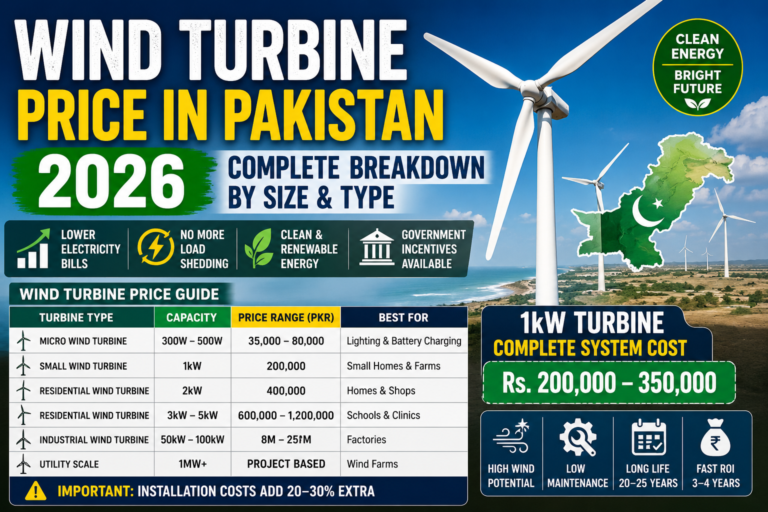
Wind Turbine Prices in Lahore (July 2026)
| Wind Turbine Size | Estimated Price (PKR) |
|---|---|
| 500W | 75,000 – 100,000 |
| 1KW | 160,000 – 199,000 |
| 2KW | 350,000 – 400,000 |
| 3KW 5KW | 550,000 – 600,000 120,0000- 125,0000 |
Conclusion
Lahore’s wind resources are moderate but usable when turbines are installed correctly. The success of a wind energy project depends less on the turbine’s advertised capacity and more on site selection, tower height, wind quality, and system design.
Among the two major turbine types, horizontal wind turbines remain the superior choice for most applications in Lahore due to their higher efficiency, greater annual energy production, and proven performance worldwide. Vertical turbines have niche applications, but they generally cannot match the energy output of a well-installed horizontal turbine in open conditions.
WInd Turbine in Lahore.