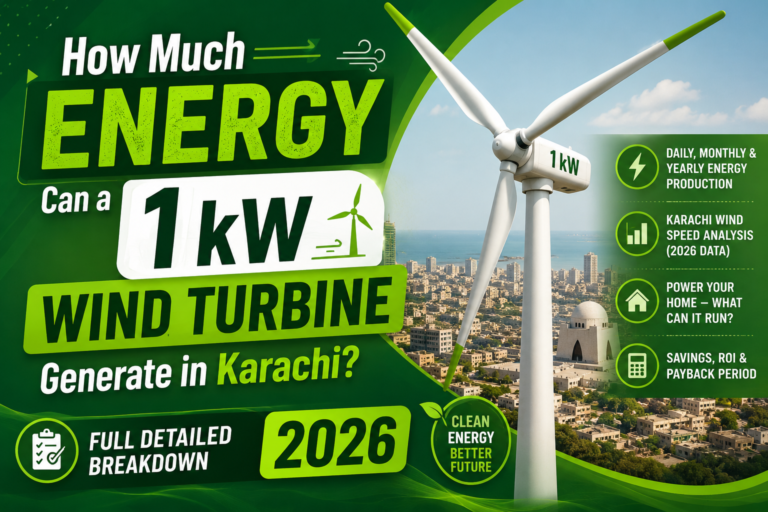
What Size Wind Turbine Do I Need for My Home in Pakistan?
Choosing the right wind turbine size for your home is not as simple as saying, “My house uses 3kW, so I need a 3kW wind turbine.” اردو ورژن آخر میں دستیاب ہے
That approach is one of the biggest mistakes in residential wind energy.
A 3kW wind turbine does not produce 3kW continuously. It may produce almost nothing during weak wind, a few hundred watts during moderate wind, and approach 3kW only when wind reaches the part of its power curve where rated output is achieved.
The correct turbine size therefore depends on two things working together:
How much electricity your home consumes + how much usable wind is available at the turbine hub height.
The U.S. Department of Energy makes the same distinction in its Small Wind Guidebook: homeowners should establish an energy budget and size the turbine using local wind conditions and expected annual energy output rather than nameplate capacity alone. (The Department of Energy’s Energy.gov)
For an initial Pakistan-specific assessment, you can also use the WindTurbine.pk Wind Feasibility Check before deciding whether a 1kW, 2kW, 3kW, 5kW or larger turbine makes sense.
Quick Answer: What Size Home Wind Turbine Do You Need?
There is no universal answer, but this is a useful starting point, assuming the property actually has a suitable wind resource.
| Home Energy Requirement | Typical Starting Range | Best Use |
|---|---|---|
| Small essential loads only | 500W–1kW | Lights, fans, CCTV, internet, charging |
| Small home + existing solar | 1–2kW | Hybrid contribution |
| Medium home | 2–5kW | Partial household energy |
| Large home / farmhouse | 3–10kW | Significant annual contribution |
| High-consumption property | 5–15kW+ | Site-specific engineering required |
| Complete off-grid home | Not sizeable by kW alone | Wind + solar + batteries + load study |
This table should not be treated as a final turbine recommendation.
A household using 500 electricity units per month might require only a few kilowatts at an excellent wind site, but considerably more rated turbine capacity at a weak site.
The turbine’s annual kilowatt-hour production is ultimately what should be compared with your home’s annual kilowatt-hour consumption.
Step 1: Find Out How Much Electricity Your Home Actually Uses
Start with your electricity bills.
Do not begin by adding the wattage of your refrigerator, fans and air conditioners. Household appliances switch on and off throughout the day, so their combined nameplate watts do not tell you your annual energy requirement.
Look at your electricity consumption in:
kWh or electricity units.
One electricity unit equals:
If your home consumes 500 units each month:
That means the home requires approximately 6,000 kWh of electrical energy per year.
Household Energy Examples
| Monthly Consumption | Annual Consumption |
|---|---|
| 200 units | 2,400 kWh |
| 300 units | 3,600 kWh |
| 500 units | 6,000 kWh |
| 800 units | 9,600 kWh |
| 1,000 units | 12,000 kWh |
| 1,500 units | 18,000 kWh |
| 2,000 units | 24,000 kWh |
This annual number should become the starting point of the turbine-sizing calculation.
Step 2: Decide How Much of Your Electricity You Want Wind to Supply
A home wind turbine does not necessarily have to supply 100% of your electricity.
For many Pakistani homes, wind makes more sense as part of a hybrid system.
For example, if your house uses:
you could design wind to provide:
| Wind Contribution Target | Required Wind Energy |
|---|---|
| 25% | 1,500 kWh/year |
| 50% | 3,000 kWh/year |
| 75% | 4,500 kWh/year |
| 100% | 6,000 kWh/year |
This distinction can dramatically change the turbine size.
A homeowner who already has solar may only want wind to provide evening, nighttime or seasonally complementary generation rather than replacing the entire electricity supply.
Step 3: Check the Wind at Your Property
This is the most important step.
Wind is the fuel of a wind turbine.
A large turbine cannot compensate for a location with consistently poor wind.
The Department of Energy states that annual energy estimates should account for the turbine’s power curve, annual average wind speed, tower height, site characteristics and preferably the frequency distribution of wind speeds. (The Department of Energy’s Energy.gov)
For Pakistan, a useful first screening method is NASA POWER.
WindTurbine.pk already has a detailed guide explaining how to obtain regional wind data at different heights:
NASA POWER Wind Data for Pakistan: How to Check Your Location
NASA data should be used for preliminary assessment rather than treated as an exact measurement above your roof.
For a major investment, actual site measurements and obstacle assessment are preferable.
Wind Speed Must Be Checked at Turbine Height
Suppose your weather application says:
Wind speed = 5 m/s.
That number means little unless you know the measurement height.
Wind close to the ground is slowed and disturbed by:
- buildings;
- boundary walls;
- trees;
- water tanks;
- sheds;
- hills;
- vegetation.
Wind generally becomes stronger and smoother as height increases.
The Department of Energy therefore recommends placing the bottom of the turbine rotor approximately 9 metres above obstacles located within roughly 90 metres as a general small-wind rule of thumb. (The Department of Energy’s Energy.gov)
Tower height can therefore be just as important as turbine capacity.
Why Wind Speed Changes Everything
Available wind power can be approximated by:
Where:
= turbine mechanical power potential
= air density
= rotor swept area
= wind speed
= power coefficient
The Department of Energy notes that real turbine power coefficients commonly fall roughly in the 0.25–0.45 range, while the theoretical maximum is about 0.59. (The Department of Energy’s Energy.gov)
The most important part of the equation is:
Wind speed is cubed.
Compare 4 m/s with 6 m/s:
The air passing through the same rotor at 6 m/s therefore contains approximately 3.4 times as much wind power as at 4 m/s.
This is why turbine size cannot be selected without knowing the wind resource.
Step 4: Understand Capacity Factor
A turbine rated at 3kW cannot normally produce:
because that calculation assumes full 3kW output every hour of the year.
Instead, wind systems operate at a capacity factor reflecting their average production relative to theoretical maximum output.
For sizing purposes:
For example, a 3kW turbine operating at a 20% annual capacity factor would produce approximately:
or an average of:
These figures are mathematical examples, not predictions for a particular turbine. Actual capacity factor depends on the power curve, rotor, wind distribution, tower and site losses.
How Turbine Size Changes with Site Performance
The following table shows average monthly electricity corresponding to different assumed annual capacity factors.
Illustrative Annual Production
| Rated Turbine | At 15% CF | At 20% CF | At 25% CF |
|---|---|---|---|
| 1kW | 110 units/month | 146 | 183 |
| 2kW | 219 | 292 | 365 |
| 3kW | 329 | 438 | 548 |
| 5kW | 548 | 730 | 913 |
| 10kW | 1,095 | 1,460 | 1,825 |
Again, this is not a manufacturer power table.
It simply demonstrates why the same 3kW turbine might be adequate for one home and inadequate for another.
Required Turbine Size Based on Household Consumption
Using the same screening calculation, suppose you want wind to offset approximately 100% of annual household consumption.
| Home Use | Annual Use | Turbine at 15% CF | At 20% CF | At 25% CF |
|---|---|---|---|---|
| 200 units/month | 2,400 kWh | 1.83kW | 1.37kW | 1.10kW |
| 300 units/month | 3,600 kWh | 2.74kW | 2.05kW | 1.64kW |
| 500 units/month | 6,000 kWh | 4.57kW | 3.42kW | 2.74kW |
| 800 units/month | 9,600 kWh | 7.31kW | 5.48kW | 4.38kW |
| 1,000 units/month | 12,000 kWh | 9.13kW | 6.85kW | 5.48kW |
| 1,500 units/month | 18,000 kWh | 13.70kW | 10.27kW | 8.22kW |
This table reveals an important point:
A household using 500 units every month does not automatically need a 500W, 1kW or even exactly a 3kW turbine.
At a 20% capacity factor, approximately 3.4kW of genuine rated capacity would theoretically be required to offset 6,000 kWh per year.
At only a 15% capacity factor, it would take approximately 4.6kW.
A Real International Benchmark
The Department of Energy gives a useful residential example: a 1.5kW wind turbine can meet approximately 300 kWh/month of consumption where annual average wind speed is about 6.26 m/s. DOE also notes that turbines in roughly the 5–15kW range may be needed to make a significant contribution to a home consuming around 10,649 kWh/year, depending strongly on the available wind. https://www.windturbine.pk
That is a powerful illustration of the role of wind speed.
A 1.5kW turbine can be very useful at a strong site.
A larger turbine at a weak site may disappoint.
Step 5: Compare Certified Annual Energy, Not Marketing Names
This is one of the most important buyer lessons.
ICC-SWCC publishes independently certified performance information for small wind turbines. Its certification database defines reference annual energy at an annual average wind speed of 5 m/s, allowing different turbines to be compared under standardized assumptions. Wind Turbine Price in Pakistan
Consider these examples:
| Certified Turbine | Certified Reference Power | Peak Power | Annual Energy at 5 m/s |
|---|---|---|---|
| Hi-VAWT DS3000 | 1.4kW | 1.4kW | 2,460 kWh |
| Skystream 3.7 | 2.1kW | 2.4kW | 3,420 kWh |
| Kestrel e400nb | 2.5kW | 3.0kW | 3,930 kWh |
| SD6 | 5.2kW | 6.1kW | 8,950 kWh |
| Bergey Excel 15 | 15.6kW | 20.6kW | 29,800 kWh |
These are not recommendations for Pakistan; they are internationally certified examples showing why annual energy production matters more than the model name printed on the turbine.
For example, a turbine carrying “3000” in its model name does not necessarily have 3kW certified reference power.
Step 6: Check the Rotor Diameter
Rated generator capacity is not enough.
The turbine must first capture energy from moving air.
For a horizontal-axis wind turbine:
where is swept area and is rotor radius.
A larger rotor captures a larger stream of air.
DOE specifically identifies rotor swept area as a key factor in turbine production. (Important before buying wind turbine)
Example
A 2-metre rotor:
A 4-metre rotor:
Doubling rotor diameter produces approximately four times the swept area.
So when comparing two “3kW” turbines, ask:
| Specification | Turbine A | Turbine B |
|---|---|---|
| Claimed rating | 3kW | 3kW |
| Rotor diameter | ? | ? |
| Swept area | ? | ? |
| Rated wind speed | ? | ? |
| Output at 5 m/s | ? | ? |
| Output at 6 m/s | ? | ? |
| Certified AEP | ? | ? |
The machine with the larger, properly engineered rotor may produce substantially more annual energy in moderate wind.
Step 7: Ask for the Turbine Power Curve
Before purchasing a turbine, request its electrical output at different wind speeds.
A useful datasheet should contain something like:
| Hub-Height Wind Speed | Electrical Output |
|---|---|
| 3 m/s | ___ W |
| 4 m/s | ___ W |
| 5 m/s | ___ W |
| 6 m/s | ___ W |
| 7 m/s | ___ W |
| 8 m/s | ___ W |
| 9 m/s | ___ W |
| 10 m/s | ___ W |
| 11 m/s | ___ W |
| 12 m/s | ___ W |
IEC 61400-12-1:2022 defines standardized methods for measuring wind-turbine power performance, including small turbines connected to a grid or battery system, and requires power curves and derived energy-production figures to include measurement uncertainty.
Therefore, when possible, give greater weight to independently measured or certified curves than to an attractive maximum-watt figure.
Step 8: Choose the Size According to Your Goal
1kW Wind Turbine
A genuine 1kW turbine can make sense when the objective is:
small essential loads, battery charging, supplementary wind generation or a wind-solar hybrid system.
It should not automatically be expected to power a modern house containing multiple air conditioners and other heavy loads.
For a detailed Pakistan-specific discussion, see the 1kW Wind Turbine Cost and Home Use Guide.
2kW Wind Turbine
A 2kW turbine becomes more useful for homes where wind is intended to supply a meaningful share of annual electricity rather than only battery charging.
A particularly good wind site can make a genuine 2kW turbine surprisingly productive, while poor urban turbulence can make it disappointing.
See the complete 2kW Wind Turbine Pakistan Guide.
3kW Wind Turbine
For many detached homes and farmhouses, 3kW is an interesting category—but only at an appropriate wind site.
A 3kW turbine operating at an illustrative 20% capacity factor would average approximately:
438 units/month.
At 15% it would be closer to:
329 units/month.
At 25%:
548 units/month.
WindTurbine.pk has a separate analysis of 3kW Wind Turbine Monthly Power Generation.
5kW Wind Turbine
A 5kW system becomes relevant for:
larger houses, villas, farmhouses and households with high annual consumption.
At an illustrative 20% capacity factor:
or approximately:
730 units/month average.
For specifications and Pakistan pricing considerations, see the 5kW Wind Turbine Buying Guide.
10kW Wind Turbine
A genuine 10kW turbine can supply substantial annual energy, but this category also requires:
larger rotor clearance, stronger foundation and tower, higher structural loads, better electrical protection and a much more serious wind-resource assessment.
A 10kW turbine should not normally be purchased simply because the house has a large electricity bill.
For a deeper technical comparison, read the 10kW Wind Turbine in Pakistan Guide.
Step 9: Rooftop or Ground-Mounted?
This decision can completely change the expected output.
It is tempting to place a turbine directly on the roof because the roof is already high.
However, DOE warns that rooftop-mounted wind turbines can experience increased turbulence, transmit vibration into the building, produce additional noise and generate less energy than appropriately tower-mounted systems.
DOE also notes that turbulence can reduce annual energy estimates by roughly 15–25% in small-wind applications because real residential sites are often much more turbulent than the test sites used to develop power curves.
This makes rooftop positioning especially important in Pakistan, where homes may have:
water tanks, parapet walls, neighbouring houses, rooftop rooms, trees and closely spaced buildings.
A larger turbine on a turbulent roof can therefore perform worse than a smaller turbine on a properly located tower.
Step 10: Consider Your Existing Solar System
For many homes in Pakistan, the best question is not:
“How large a wind turbine can replace my entire electricity supply?”
It may be:
“How much wind should I add to my existing solar and battery system?”
If solar already supplies most daytime consumption, wind can be designed as a complementary source rather than as the sole generator.
That may reduce the wind requirement substantially.
For example, a home using 600 units/month might already receive 450 units from solar. The wind system may only need to target the remaining 150 units/month rather than all 600.
In that situation, a well-performing 1–2kW wind turbine at a genuinely windy location may make more sense than installing a much larger system.
Grid-Tied, Battery or Hybrid?
The electrical architecture also affects sizing.
| System | Main Sizing Priority |
|---|---|
| Grid connected | Annual energy offset |
| Battery-based off-grid | Daily energy + storage + worst-season resource |
| Wind + solar hybrid | Combined monthly renewable production |
| Backup system | Essential-load energy |
| Farmhouse | Household + pumps + seasonal loads |
An off-grid home is particularly important.
You cannot simply match annual energy.
The system must survive periods of weak wind, so battery storage, solar contribution and worst-month conditions become essential.
Four Realistic Home Examples
Example 1 — Small Home, 250 Units per Month
Annual use:
If the objective is only a 50% contribution:
At an illustrative 20% capacity factor:
A genuine 1kW turbine could therefore be worth investigating at a good site.
It is not automatically a recommendation—the power curve still needs to support the calculation.
Example 2 — Medium Home, 500 Units per Month
Annual consumption:
For 50% wind contribution:
At 20% capacity factor:
This makes a 2kW-class turbine a sensible candidate for further analysis.
For 100% annual offset:
A genuine 3–5kW machine may therefore be required depending on actual annual production.
Example 3 — Large Home, 800 Units per Month
Annual consumption:
At a 20% capacity factor, complete annual offset would theoretically require:
So a 2kW or 3kW turbine would not be expected to fully offset the home’s annual electricity consumption.
But a 3kW turbine could still make a useful contribution as part of a solar-wind hybrid system.
Example 4 — Large Farmhouse, 1,000 Units per Month
Annual consumption:
For 100% annual offset:
| Assumed Performance | Required Rated Capacity |
|---|---|
| 15% CF | 9.13kW |
| 20% CF | 6.85kW |
| 25% CF | 5.48kW |
This is why farmhouses often justify investigating 5–10kW turbines—provided that the property actually has sufficient wind and tower space.
What If My Wind Is Only 3–4 m/s?
Buying a bigger turbine is usually not the solution.
Because wind power falls rapidly as wind speed decreases, a low-wind site can make even a large rotor unproductive.
A better strategy may be:
solar-only generation, improving energy efficiency, increasing battery capacity or using wind only if professional site analysis finds a useful elevated wind resource.
Before purchasing anything, run the WindTurbine.pk wind feasibility assessment.
What If My Wind Is 5–6 m/s?
This is where residential small wind becomes much more interesting.
The exact turbine still cannot be selected from average wind speed alone, but the site is worth detailed investigation.
You should examine:
power curve, hourly or monthly wind distribution, rotor swept area, tower height, obstacles, annual energy estimate and system cost.
WindTurbine.pk’s NASA POWER Wind Data Pakistan guide explains how to investigate wind at different heights before buying a turbine.
Do Not Select a Turbine from “Start Wind Speed”
Manufacturers frequently advertise values such as:
Start wind speed: 2 m/s
or:
Start-up wind: 2.5 m/s.
That simply means the rotor may begin moving.
It does not mean the turbine is producing useful rated electricity.
The values that matter more are:
| Specification | Why It Matters |
|---|---|
| Cut-in wind speed | When useful generation starts |
| Output at 4–8 m/s | Typical moderate-wind performance |
| Rated wind speed | Wind required for advertised rating |
| Power curve | Actual watts versus wind |
| AEP | Estimated annual electricity |
| Rotor diameter | Wind-capture area |
| Survival wind | Structural safety |
| Controller compatibility | Electrical safety/performance |
Horizontal or Vertical Wind Turbine for Home?
For straightforward electricity production on an open site, well-designed horizontal-axis wind turbines are the dominant small-wind configuration. DOE describes horizontal-axis machines as the most common type in today’s small-wind market.1 KW wind Turbine in Pakistan
A vertical-axis turbine may still make sense for certain architectural, research or site-specific applications, but do not assume that its ability to accept wind from different directions means it automatically produces more energy.
Compare certified annual energy and swept area, not appearance.
ICC-SWCC’s certified database demonstrates just how different annual production can be between turbines with similar-sounding nominal ratings.
How Much Tower Height Do I Need?
There is no universal tower height based solely on turbine kW.
The correct height depends on:
surrounding obstacles, rotor diameter, prevailing wind direction, terrain, structural design and manufacturer requirements.
A good tower should place the turbine in clean airflow.
DOE’s general guideline is to keep the bottom of the rotor approximately 9m above nearby obstacles
A 20m tower in open land can therefore outperform a 10m installation even with exactly the same turbine.
Before Buying: Compare These Specifications
Use this as your comparison sheet:
| Parameter | Turbine A | Turbine B |
|---|---|---|
| Nominal power | ||
| Certified/reference power | ||
| Rotor diameter | ||
| Swept area | ||
| Start wind speed | ||
| Cut-in wind speed | ||
| Rated wind speed | ||
| Output at 5 m/s | ||
| Output at 6 m/s | ||
| Output at 8 m/s | ||
| AEP at your site | ||
| Maximum RPM | ||
| Survival wind speed | ||
| Controller | ||
| Dump load/braking | ||
| Tower requirement | ||
| Certification/test report | ||
| Warranty |
IEC 61400-2 covers safety, engineering integrity, installation, maintenance and operation requirements for small wind turbines, while IEC 61400-12-1 covers measured power performance. (Tienda AENOR)
Before placing an order, the 15 Things to Check Before Buying a Wind Turbine in Pakistan is also worth reviewing.
Home Wind Turbine Sizing Formula
For preliminary planning:
Suppose your home consumes:
and you want wind to provide 50%:
If your preliminary feasibility study suggests approximately 20% capacity factor:
So you would begin by studying approximately 2–3kW turbines.
Then replace the generic capacity-factor assumption with the actual manufacturer’s power curve and your real wind distribution.
That second step is essential.
What Size Turbine Should Most Pakistani Homes Buy?
There is no technically responsible single answer.
For small hybrid loads, 1kW can be useful.
But if the site has poor wind, the correct turbine size may actually be:
No wind turbine at all.
A site assessment should come before purchasing equipment.
For current equipment-cost context, see the Wind Turbine Price in Pakistan guide and the dedicated Home Wind Turbine Price in Pakistan guide.
Frequently Asked Questions
Is a 1kW Wind Turbine Enough for a House?
Usually not for an entire modern home, but it can contribute meaningfully to essential loads or a hybrid system at a suitable wind site.
A strong wind site can make a 1kW turbine much more productive than most buyers expect, while a weak site can make it nearly ineffective.
Is a 2kW Wind Turbine Enough for a Home?
It may be sufficient to provide a significant portion of electricity for a low-consumption household, particularly where annual average wind at hub height is good.
For a 500-unit/month household, a 2kW turbine would generally be viewed as a contribution rather than automatically providing 100% of annual electricity.
Is a 3kW Wind Turbine Good for a Home?
Yes, it can be an attractive residential size for suitable properties.
At an illustrative 20% capacity factor, a 3kW turbine produces approximately 5,256 kWh/year, or 438 units/month averaged over the year.
Actual performance can be substantially higher or lower.
How Many kW Wind Turbine Do I Need for 500 Units per Month?
A home using 500 units/month consumes:
For complete annual offset, an illustrative calculation suggests approximately:
- 4.57kW at 15% CF
- 3.42kW at 20% CF
- 2.74kW at 25% CF
So a genuine turbine somewhere in the 3–5kW class may be worth investigating, depending on wind conditions and its certified power curve.
Can I Use a Wind Turbine with Solar Panels?
Yes. In fact, a properly designed solar-wind hybrid arrangement can be more practical than attempting to make wind provide the entire household energy requirement.
Controllers, inverter architecture, batteries and dump-load/braking requirements must be properly engineered.
Can I Put the Turbine on My Roof?
It is possible in some cases, but it should not be assumed to be the best solution. DOE warns that rooftop wind installations may suffer from turbulence, vibration, lower output and shorter equipment life compared with appropriately tower-mounted turbines.
Should I Buy a Bigger Turbine for Low Wind?
Usually no.
If wind is weak, buying more generator capacity does not create more wind energy.
First improve siting and tower height or reconsider whether wind is suitable for the site.
Final Recommendation
When asking:
“What size wind turbine do I need for my home?”
do not start with turbine wattage.
Start with:
The correct process is to determine your annual electricity consumption, decide what percentage you want wind to supply, measure or model wind at the planned hub height, compare real turbine power curves and annual energy production, account for tower height and turbulence, and only then choose the rated turbine size.
That may lead to a 1kW turbine for a small hybrid system, a 2–3kW turbine for a moderate residential application, or 5–10kW for a large home or farmhouse.
It may also reveal that your property is not suitable for wind at all—and discovering that before purchasing equipment is valuable.
For Pakistan-specific sizing, start with the WindTurbine.pk Feasibility Check, then review the NASA wind-data guide for your location and compare the results with the turbine’s genuine power curve before making a purchase decision.
—
میرے گھر کے لیے کس سائز کی ونڈ ٹربائن چاہیے؟
گھر کے لیے درست ونڈ ٹربائن سائز منتخب کرنا اتنا سادہ نہیں کہ آپ کہیں:
“میرے گھر کا لوڈ 3 کلوواٹ ہے، اس لیے مجھے 3 کلوواٹ کی ونڈ ٹربائن چاہیے۔”
یہ گھریلو ونڈ انرجی کے بارے میں سب سے عام غلط فہمیوں میں سے ایک ہے۔
3 کلوواٹ کی ونڈ ٹربائن ہر وقت 3 کلوواٹ بجلی پیدا نہیں کرتی۔ کم ہوا میں یہ تقریباً کچھ بھی پیدا نہیں کر سکتی، درمیانی ہوا میں چند سو واٹ دے سکتی ہے، جبکہ مکمل 3 کلوواٹ کے قریب پیداوار عموماً اسی وقت حاصل ہوتی ہے جب ہوا کی رفتار ٹربائن کی ریٹیڈ ونڈ اسپیڈ کے قریب پہنچ جائے۔
اس لیے صحیح ٹربائن سائز کا فیصلہ بنیادی طور پر دو چیزوں سے ہوتا ہے:
آپ کا گھر سال میں کتنی بجلی استعمال کرتا ہے + ٹربائن کی ہب ہائٹ پر کتنی قابلِ استعمال ہوا موجود ہے۔
امریکی محکمۂ توانائی بھی گھریلو ونڈ ٹربائن کے انتخاب میں یہی اصول استعمال کرنے کی سفارش کرتا ہے کہ صرف ٹربائن کی ریٹیڈ پاور نہ دیکھی جائے بلکہ گھر کی سالانہ توانائی ضرورت، مقامی ہوا، ٹاور ہائٹ اور متوقع سالانہ بجلی پیداوار کو دیکھا جائے۔
پاکستان میں ابتدائی جانچ کے لیے آپ ونڈ ٹربائن ڈاٹ پی کے ونڈ فیزیبلٹی چیک بھی استعمال کر سکتے ہیں۔
فوری جواب: گھر کے لیے کتنے کلوواٹ کی ونڈ ٹربائن چاہیے؟
ہر گھر کے لیے ایک ہی جواب درست نہیں ہوتا، لیکن اگر مقام پر مناسب ہوا موجود ہو تو یہ ابتدائی رہنمائی مددگار ہو سکتی ہے۔
| گھر کی توانائی ضرورت | ابتدائی ٹربائن رینج | مناسب استعمال |
|---|---|---|
| صرف بنیادی چھوٹے لوڈ | 500 واٹ–1 کلوواٹ | لائٹس، پنکھے، سی سی ٹی وی، انٹرنیٹ، چارجنگ |
| چھوٹا گھر + پہلے سے سولر | 1–2 کلوواٹ | ہائبرڈ سپورٹ |
| درمیانہ گھر | 2–5 کلوواٹ | بجلی کی جزوی ضرورت |
| بڑا گھر / فارم ہاؤس | 3–10 کلوواٹ | سالانہ بجلی میں نمایاں حصہ |
| بہت زیادہ بجلی استعمال کرنے والی پراپرٹی | 5–15 کلوواٹ یا زیادہ | مکمل سائٹ اسیسمنٹ ضروری |
| مکمل آف گرڈ گھر | صرف کلوواٹ سے فیصلہ نہیں ہو سکتا | ونڈ + سولر + بیٹری + لوڈ اسیسمنٹ |
یہ جدول حتمی سفارش نہیں ہے۔
مثلاً ایک گھر جو ماہانہ 500 یونٹ بجلی استعمال کرتا ہے، اچھی ہوا والے مقام پر نسبتاً چھوٹی ٹربائن سے کافی توانائی حاصل کر سکتا ہے، لیکن کمزور ہوا والے مقام پر اسی گھر کے لیے کہیں بڑی ٹربائن بھی ناکافی ہو سکتی ہے۔
اصل موازنہ ہمیشہ یہ ہونا چاہیے:
گھر کی سالانہ کلوواٹ آور ضرورت بمقابلہ ٹربائن کی متوقع سالانہ کلوواٹ آور پیداوار۔
مرحلہ 1: پہلے معلوم کریں گھر کتنی بجلی استعمال کرتا ہے
سب سے پہلے اپنے بجلی کے بل دیکھیں۔
صرف یہ جمع نہ کریں کہ فریج کتنے واٹ کا ہے، پنکھے کتنے ہیں اور ایئر کنڈیشنر کتنے کلوواٹ کے ہیں۔
گھریلو آلات پورا دن ایک ساتھ نہیں چلتے۔ اس لیے صرف تمام آلات کے واٹ جمع کرنے سے سالانہ توانائی ضرورت معلوم نہیں ہوتی۔
بجلی کے بل میں درج:
کلوواٹ آور یا یونٹس
دیکھیں۔
ایک یونٹ:
اگر گھر ماہانہ 500 یونٹ استعمال کرتا ہے:
یعنی گھر کو تقریباً 6,000 یونٹ سالانہ بجلی درکار ہے۔
گھر کی بجلی کھپت کی مثالیں
| ماہانہ استعمال | سالانہ استعمال |
|---|---|
| 200 یونٹ | 2,400 کلوواٹ آور |
| 300 یونٹ | 3,600 کلوواٹ آور |
| 500 یونٹ | 6,000 کلوواٹ آور |
| 800 یونٹ | 9,600 کلوواٹ آور |
| 1,000 یونٹ | 12,000 کلوواٹ آور |
| 1,500 یونٹ | 18,000 کلوواٹ آور |
| 2,000 یونٹ | 24,000 کلوواٹ آور |
یہ سالانہ کھپت ٹربائن سائزنگ کا بنیادی نقطہ ہونا چاہیے۔
مرحلہ 2: فیصلہ کریں کہ کتنی بجلی ونڈ سے حاصل کرنی ہے
ضروری نہیں کہ ونڈ ٹربائن گھر کی 100 فیصد بجلی پیدا کرے۔
پاکستان کے بہت سے گھروں میں ونڈ ٹربائن کو سولر ونڈ ہائبرڈ سسٹم کا حصہ بنانا زیادہ مناسب ہو سکتا ہے۔
مثال کے طور پر اگر گھر کی سالانہ کھپت:
ہے تو مختلف اہداف یہ ہو سکتے ہیں:
| ونڈ سے بجلی کا ہدف | مطلوبہ سالانہ ونڈ انرجی |
|---|---|
| 25 فیصد | 1,500 کلوواٹ آور |
| 50 فیصد | 3,000 کلوواٹ آور |
| 75 فیصد | 4,500 کلوواٹ آور |
| 100 فیصد | 6,000 کلوواٹ آور |
اگر گھر میں پہلے ہی سولر موجود ہے تو ونڈ ٹربائن کا مقصد پورے گھر کو چلانا ضروری نہیں۔
یہ رات، شام، بادلوں والے دنوں یا مخصوص موسموں میں سولر کو سپورٹ کر سکتی ہے۔
مرحلہ 3: اپنی پراپرٹی پر ہوا چیک کریں
یہ پورے حساب کا سب سے اہم حصہ ہے۔
ہوا ونڈ ٹربائن کا ایندھن ہے۔
اگر جگہ پر مناسب ہوا نہیں ہے تو بڑی ٹربائن خریدنے سے بھی مسئلہ حل نہیں ہوگا۔
ٹربائن کی سالانہ پیداوار کا حساب کرتے وقت یہ چیزیں دیکھی جانی چاہئیں:
- سالانہ اوسط ہوا
- ہب ہائٹ
- ٹاور ہائٹ
- ہوا کی رفتار کی سالانہ تقسیم
- قریبی عمارتیں
- درخت
- ٹربولنس
- ٹربائن کا پاور کرو
- روٹر سویپٹ ایریا
پاکستان میں ابتدائی جانچ کے لیے ناسا پاور ایک مفید ذریعہ ہے۔
آپ پاکستان میں ناسا پاور ونڈ ڈیٹا استعمال کرنے کی مکمل گائیڈ بھی دیکھ سکتے ہیں۔
ہوا ہمیشہ ٹربائن کی ہب ہائٹ پر دیکھیں
فرض کریں موبائل کی موسمی ایپ دکھاتی ہے:
ہوا = 5 میٹر فی سیکنڈ
صرف یہ عدد کافی نہیں ہے۔
یہ معلوم ہونا چاہیے کہ:
یہ رفتار کس اونچائی پر ہے؟
زمین کے قریب ہوا کو یہ چیزیں کمزور اور ٹربولنٹ کرتی ہیں:
- عمارتیں
- درخت
- چار دیواریاں
- پانی کی ٹینکیاں
- چھت کے کمرے
- پہاڑیاں
- پودے
- دوسری رکاوٹیں
عمومی طور پر اونچائی بڑھنے کے ساتھ ہوا زیادہ تیز اور ہموار ہوتی ہے۔
اسی لیے ٹاور ہائٹ کبھی کبھی ٹربائن کے کلوواٹ سائز سے بھی زیادہ اہم ہو سکتی ہے۔
ہوا کی رفتار میں معمولی فرق اتنا اہم کیوں ہے؟
ہوا میں موجود طاقت کا بنیادی فارمولا ہے:
جہاں:
- = دستیاب یا حاصل ہونے والی طاقت
- = ہوا کی کثافت
- = روٹر سویپٹ ایریا
- = ہوا کی رفتار
- = پاور کوایفیشنٹ
سب سے اہم حصہ ہے:
یعنی ہوا کی رفتار کا مکعب۔
اگر ہوا 4 میٹر فی سیکنڈ سے بڑھ کر 6 میٹر فی سیکنڈ ہو:
یعنی اسی روٹر کے سامنے 6 میٹر فی سیکنڈ ہوا میں تقریباً 3.4 گنا زیادہ ونڈ پاور دستیاب ہو سکتی ہے۔
اسی لیے صرف ٹربائن بڑی کرنا ہمیشہ بہتر حل نہیں۔
مرحلہ 4: کیپیسٹی فیکٹر سمجھیں
3 کلوواٹ ٹربائن کا نظریاتی زیادہ سے زیادہ سالانہ حساب:
آتا ہے۔
لیکن یہ فرض کرتا ہے کہ ٹربائن پورے سال ہر گھنٹے 3 کلوواٹ پیدا کرے۔
حقیقت میں ایسا نہیں ہوتا۔
اسی لیے کیپیسٹی فیکٹر استعمال کیا جاتا ہے۔
اگر 3 کلوواٹ ٹربائن کا سالانہ کیپیسٹی فیکٹر 20 فیصد ہو:
یعنی اوسط:
یہ صرف حسابی مثال ہے، کسی مخصوص ٹربائن کی ضمانت شدہ پیداوار نہیں۔
مختلف ٹربائن سائز کی ممکنہ سالانہ پیداوار
نیچے دی گئی جدول صرف یہ سمجھانے کے لیے ہے کہ کیپیسٹی فیکٹر کے فرق سے پیداوار کتنی بدل سکتی ہے۔
| ٹربائن | 15 فیصد کیپیسٹی فیکٹر | 20 فیصد | 25 فیصد |
|---|---|---|---|
| 1 کلوواٹ | 110 یونٹ ماہانہ | 146 | 183 |
| 2 کلوواٹ | 219 | 292 | 365 |
| 3 کلوواٹ | 329 | 438 | 548 |
| 5 کلوواٹ | 548 | 730 | 913 |
| 10 کلوواٹ | 1,095 | 1,460 | 1,825 |
یہ مینوفیکچرر پاور ٹیبل نہیں ہے۔
اصل پیداوار ٹربائن کے پاور کرو اور آپ کی جگہ کی ہوا پر منحصر ہوگی۔
گھر کے یونٹس کے مطابق ممکنہ ٹربائن سائز
اگر مقصد تقریباً 100 فیصد سالانہ بجلی ونڈ سے حاصل کرنا ہو تو ابتدائی حساب کچھ یوں بنتا ہے:
| ماہانہ استعمال | سالانہ استعمال | 15 فیصد پر ٹربائن | 20 فیصد پر | 25 فیصد پر |
|---|---|---|---|---|
| 200 یونٹ | 2,400 | 1.83 کلوواٹ | 1.37 | 1.10 |
| 300 یونٹ | 3,600 | 2.74 | 2.05 | 1.64 |
| 500 یونٹ | 6,000 | 4.57 | 3.42 | 2.74 |
| 800 یونٹ | 9,600 | 7.31 | 5.48 | 4.38 |
| 1,000 یونٹ | 12,000 | 9.13 | 6.85 | 5.48 |
| 1,500 یونٹ | 18,000 | 13.70 | 10.27 | 8.22 |
یہ جدول ایک اہم بات ثابت کرتی ہے:
500 یونٹ ماہانہ استعمال کرنے والے گھر کے لیے صرف 500 واٹ یا 1 کلوواٹ ٹربائن کافی ہونا ضروری نہیں۔
اگر حقیقی کیپیسٹی فیکٹر 20 فیصد ہو تو مکمل سالانہ بجلی پوری کرنے کے لیے تقریباً 3.4 کلوواٹ حقیقی ریٹیڈ کیپیسٹی درکار ہو سکتی ہے۔
عالمی مثال
امریکی محکمۂ توانائی کے مطابق ایک 1.5 کلوواٹ ونڈ ٹربائن تقریباً 300 کلوواٹ آور ماہانہ بجلی استعمال کرنے والے گھر کی ضرورت پوری کر سکتی ہے، اگر سالانہ اوسط ہوا تقریباً 6.26 میٹر فی سیکنڈ ہو۔
اس مثال سے اہم سبق یہ ملتا ہے:
اچھی ہوا میں چھوٹی ٹربائن بہت مفید ہو سکتی ہے، جبکہ کمزور ہوا میں بڑی ٹربائن بھی مایوس کر سکتی ہے۔
مرحلہ 5: صرف کلوواٹ نام نہیں، سالانہ پیداوار دیکھیں
بعض ٹربائنز کا ماڈل نام یا اشتہاری ریٹنگ بہت متاثر کن ہوتی ہے، لیکن اصل فیصلہ سالانہ کلوواٹ آور پیداوار کی بنیاد پر ہونا چاہیے۔
بین الاقوامی طور پر سرٹیفائیڈ چھوٹی ونڈ ٹربائنز کے درمیان بھی سالانہ پیداوار میں بڑا فرق دیکھا جا سکتا ہے۔
| ٹربائن | سرٹیفائیڈ ریفرنس پاور | پیک پاور | 5 میٹر فی سیکنڈ پر سالانہ انرجی |
|---|---|---|---|
| ہائی وی اے ڈبلیو ٹی ڈی ایس 3000 | 1.4 کلوواٹ | 1.4 | 2,460 کلوواٹ آور |
| اسکائی اسٹریم 3.7 | 2.1 کلوواٹ | 2.4 | 3,420 |
| کیسٹرل ای 400 این بی | 2.5 کلوواٹ | 3.0 | 3,930 |
| ایس ڈی 6 | 5.2 کلوواٹ | 6.1 | 8,950 |
| برجی ایکسل 15 | 15.6 کلوواٹ | 20.6 | 29,800 |
یہ پاکستان کے لیے سفارش نہیں بلکہ یہ دکھانے کے لیے مثال ہے کہ:
دو ٹربائنز کا نام یا کلوواٹ ریٹنگ ایک جیسی لگ سکتی ہے، لیکن سالانہ پیداوار بہت مختلف ہو سکتی ہے۔
مرحلہ 6: روٹر ڈائیمیٹر ضرور دیکھیں
صرف جنریٹر کی کلوواٹ ریٹنگ کافی نہیں۔
سب سے پہلے روٹر کو ہوا سے توانائی پکڑنی ہوتی ہے۔
ہوری زونٹل ایکسس ونڈ ٹربائن کے لیے:
اگر روٹر ڈائیمیٹر 2 میٹر ہو:
اگر روٹر ڈائیمیٹر 4 میٹر ہو:
یعنی روٹر ڈائیمیٹر دو گنا کرنے سے سویپٹ ایریا تقریباً چار گنا ہو جاتا ہے۔
اس لیے دو 3 کلوواٹ ٹربائنز کا موازنہ کرتے وقت صرف یہ نہ دیکھیں:
3 کلوواٹ بمقابلہ 3 کلوواٹ
بلکہ یہ دیکھیں:
| تفصیل | ٹربائن اے | ٹربائن بی |
|---|---|---|
| کلیمڈ پاور | 3 کلوواٹ | 3 کلوواٹ |
| روٹر ڈائیمیٹر | ؟ | ؟ |
| سویپٹ ایریا | ؟ | ؟ |
| ریٹیڈ ونڈ اسپیڈ | ؟ | ؟ |
| 5 میٹر فی سیکنڈ پر آؤٹ پٹ | ؟ | ؟ |
| 6 میٹر فی سیکنڈ پر آؤٹ پٹ | ؟ | ؟ |
| سالانہ انرجی | ؟ | ؟ |
مرحلہ 7: پاور کرو ضرور مانگیں
ٹربائن خریدنے سے پہلے مینوفیکچرر سے مکمل پاور کرو لیں۔
مثلاً:
| ہوا کی رفتار | برقی آؤٹ پٹ |
|---|---|
| 3 میٹر فی سیکنڈ | ___ واٹ |
| 4 | ___ |
| 5 | ___ |
| 6 | ___ |
| 7 | ___ |
| 8 | ___ |
| 9 | ___ |
| 10 | ___ |
| 11 | ___ |
| 12 | ___ |
اگر کمپنی صرف یہ کہتی ہے:
“3 کلوواٹ ونڈ ٹربائن”
لیکن 4، 5، 6 اور 7 میٹر فی سیکنڈ پر آؤٹ پٹ نہیں بتاتی تو حقیقی سالانہ پیداوار کا اندازہ لگانا مشکل ہوگا۔
مرحلہ 8: اپنے مقصد کے مطابق ٹربائن منتخب کریں
1 کلوواٹ ونڈ ٹربائن
1 کلوواٹ ٹربائن ان حالات میں مفید ہو سکتی ہے:
- بنیادی لوڈ
- بیٹری چارجنگ
- سی سی ٹی وی
- انٹرنیٹ
- لائٹس
- چھوٹا ہائبرڈ سسٹم
- موجودہ سولر کو سپورٹ کرنا
یہ عام جدید گھر کے تمام ایئر کنڈیشنرز اور بڑے لوڈ کو مسلسل چلانے کے لیے کافی سمجھنا درست نہیں۔
پاکستان میں 1 کلوواٹ ٹربائن کے بارے میں مزید تفصیل کے لیے 1 کلوواٹ ونڈ ٹربائن قیمت اور گھریلو استعمال دیکھیں۔
2 کلوواٹ ونڈ ٹربائن
2 کلوواٹ ٹربائن گھر کی سالانہ بجلی میں معنی خیز حصہ ڈال سکتی ہے، بشرطیکہ مقام پر مناسب ہوا موجود ہو۔
اچھی سائٹ پر 2 کلوواٹ ٹربائن مفید ہو سکتی ہے، جبکہ ٹربولنٹ شہری چھت پر یہی ٹربائن توقع سے بہت کم بجلی دے سکتی ہے۔
مزید معلومات:
2 کلوواٹ ونڈ ٹربائن پاکستان گائیڈ
3 کلوواٹ ونڈ ٹربائن
بہت سے الگ گھروں اور فارم ہاؤسز کے لیے 3 کلوواٹ کیٹیگری دلچسپ ہو سکتی ہے۔
اگر فرضی کیپیسٹی فیکٹر:
20 فیصد
ہو تو:
یعنی اوسطاً تقریباً:
438 یونٹ ماہانہ
15 فیصد پر:
329 یونٹ ماہانہ
25 فیصد پر:
548 یونٹ ماہانہ
تفصیلی تجزیہ:
3 کلوواٹ ونڈ ٹربائن ماہانہ پیداوار
5 کلوواٹ ونڈ ٹربائن
5 کلوواٹ ونڈ ٹربائن زیادہ مناسب ہو سکتی ہے:
- بڑے گھر
- ولا
- فارم ہاؤس
- زیادہ بجلی استعمال کرنے والے گھر
- چھوٹے کمرشل مقامات
اگر کیپیسٹی فیکٹر 20 فیصد ہو:
یعنی تقریباً:
730 یونٹ ماہانہ
مزید معلومات:
5 کلوواٹ ونڈ ٹربائن پاکستان گائیڈ
10 کلوواٹ ونڈ ٹربائن
حقیقی 10 کلوواٹ ٹربائن بڑی مقدار میں سالانہ بجلی پیدا کر سکتی ہے۔
لیکن اس کے ساتھ یہ چیزیں بھی بڑی ہو جاتی ہیں:
- روٹر
- ٹاور
- فاؤنڈیشن
- ساختی لوڈ
- برقی حفاظت
- کنٹرولر
- ڈمپ لوڈ
- انسٹالیشن لاگت
صرف بڑا بجلی کا بل دیکھ کر 10 کلوواٹ ٹربائن خریدنا مناسب طریقہ نہیں۔
مزید تفصیل:
10 کلوواٹ ونڈ ٹربائن پاکستان مکمل گائیڈ
مرحلہ 9: روف ٹاپ یا گراؤنڈ ماؤنٹڈ؟
یہ فیصلہ ٹربائن کی پیداوار کو بہت زیادہ متاثر کر سکتا ہے۔
چھت پہلے سے بلند ہوتی ہے، اس لیے روف ٹاپ ٹربائن آسان حل لگتی ہے۔
لیکن چھت پر یہ مسائل پیدا ہو سکتے ہیں:
- ٹربولنس
- عمارت میں وائبریشن
- شور
- کم بجلی پیداوار
- بیرنگ اور دوسرے حصوں پر اضافی دباؤ
- ٹربائن کی عمر میں کمی
پاکستانی گھروں کی چھتوں پر عموماً یہ چیزیں موجود ہوتی ہیں:
- پانی کی ٹینکیاں
- چار دیواری
- کمرے
- سولر پینلز
- پڑوسی عمارتیں
- درخت
اس لیے ایک بڑی ٹربائن خراب روف ٹاپ سائٹ پر، ایک چھوٹی ٹربائن کی اچھی ٹاور سائٹ سے بھی کم بجلی پیدا کر سکتی ہے۔
مرحلہ 10: اگر پہلے سے سولر موجود ہے تو کیا کریں؟
پاکستان کے بہت سے گھروں کے لیے بہتر سوال یہ ہے:
مجھے اپنے موجودہ سولر سسٹم کے ساتھ کتنی ونڈ پاور شامل کرنی چاہیے؟
فرض کریں گھر:
600 یونٹ ماہانہ
استعمال کرتا ہے۔
سولر پہلے ہی:
450 یونٹ
فراہم کرتا ہے۔
باقی ضرورت:
ہے۔
اس صورت میں پوری 600 یونٹ ضرورت کے مطابق ونڈ ٹربائن منتخب کرنے کی ضرورت نہیں۔
اچھی ونڈ سائٹ پر 1–2 کلوواٹ ہائبرڈ ونڈ سسٹم زیادہ مناسب ہو سکتا ہے۔
گرڈ ٹائی، بیٹری یا ہائبرڈ؟
سسٹم کی قسم بھی ٹربائن سائز پر اثر انداز کرتی ہے۔
| سسٹم | اہم سائزنگ بنیاد |
|---|---|
| گرڈ کنیکٹڈ | سالانہ انرجی آف سیٹ |
| بیٹری بیسڈ آف گرڈ | روزانہ انرجی + بیٹری + کمزور موسم |
| ونڈ سولر ہائبرڈ | دونوں ذرائع کی مشترکہ ماہانہ پیداوار |
| بیک اپ سسٹم | ضروری لوڈ |
| فارم ہاؤس | گھر + پمپ + موسمی لوڈ |
مکمل آف گرڈ گھر میں صرف سالانہ یونٹس دیکھنا کافی نہیں۔
کم ہوا والے کئی دنوں کے لیے بیٹری اور سولر کا انتظام بھی ضروری ہوگا۔
عملی مثال 1: چھوٹا گھر، 250 یونٹ ماہانہ
سالانہ استعمال:
اگر مقصد صرف 50 فیصد بجلی ونڈ سے حاصل کرنا ہو:
20 فیصد کیپیسٹی فیکٹر پر:
اس صورت میں ایک حقیقی 1 کلوواٹ ونڈ ٹربائن مزید جانچ کے قابل ہو سکتی ہے۔
عملی مثال 2: درمیانہ گھر، 500 یونٹ ماہانہ
سالانہ کھپت:
اگر 50 فیصد ونڈ سے چاہیے:
20 فیصد کیپیسٹی فیکٹر پر:
اس لیے 2 کلوواٹ کلاس کی ٹربائن مزید تجزیے کے لیے مناسب امیدوار ہو سکتی ہے۔
اگر پورے 6,000 یونٹ سالانہ ونڈ سے حاصل کرنے ہوں:
لہٰذا حقیقی پاور کرو کے مطابق تقریباً 3–5 کلوواٹ ٹربائن کی ضرورت پڑ سکتی ہے۔
عملی مثال 3: بڑا گھر، 800 یونٹ ماہانہ
سالانہ استعمال:
20 فیصد کیپیسٹی فیکٹر پر مکمل سالانہ آف سیٹ کے لیے:
یعنی 2 یا 3 کلوواٹ ٹربائن پورے گھر کی سالانہ بجلی مکمل طور پر پوری کرنے کے لیے کافی نہیں ہوگی۔
البتہ 3 کلوواٹ ٹربائن سولر ونڈ ہائبرڈ سسٹم میں اچھا حصہ ڈال سکتی ہے۔
عملی مثال 4: بڑا فارم ہاؤس، 1,000 یونٹ ماہانہ
سالانہ استعمال:
| متوقع کیپیسٹی فیکٹر | درکار ٹربائن سائز |
|---|---|
| 15 فیصد | 9.13 کلوواٹ |
| 20 فیصد | 6.85 کلوواٹ |
| 25 فیصد | 5.48 کلوواٹ |
اسی لیے مناسب ہوا والے بڑے فارم ہاؤس میں 5–10 کلوواٹ ٹربائنز کا جائزہ لینا منطقی ہو سکتا ہے۔
اگر ہوا صرف 3–4 میٹر فی سیکنڈ ہو؟
عام طور پر اس کا حل بڑی ٹربائن خریدنا نہیں ہے۔
کم ہوا میں دستیاب توانائی بہت تیزی سے کم ہو جاتی ہے۔
ایسی سائٹ پر بہتر حل ممکن ہیں:
- زیادہ سولر پینلز
- بجلی کی بچت
- بہتر بیٹری بینک
- اونچا ٹاور
- یا ونڈ ٹربائن نہ لگانا
پہلے ونڈ ٹربائن فیزیبلٹی چیک کریں۔
اگر ہوا 5–6 میٹر فی سیکنڈ ہو؟
یہ سطح گھریلو ونڈ انرجی کے لیے کافی زیادہ دلچسپ ہو جاتی ہے۔
لیکن صرف اوسط ہوا دیکھ کر ٹربائن منتخب نہ کریں۔
یہ چیزیں بھی چیک کریں:
- پاور کرو
- ماہانہ ہوا
- گھنٹہ وار ہوا
- سویپٹ ایریا
- ٹاور ہائٹ
- ٹربولنس
- سالانہ پیداوار
- مکمل لاگت
اپنے مقام کی ابتدائی ہوا جانچنے کے لیے ناسا پاور ونڈ ڈیٹا پاکستان گائیڈ دیکھیں۔
اسٹارٹ ونڈ اسپیڈ سے ٹربائن منتخب نہ کریں
بہت سی ٹربائنز پر لکھا ہوتا ہے:
اسٹارٹ ونڈ اسپیڈ: 2 میٹر فی سیکنڈ
یا:
2.5 میٹر فی سیکنڈ
اس کا مطلب صرف یہ ہو سکتا ہے کہ روٹر گھومنا شروع کر دے۔
یہ ضروری نہیں کہ اس وقت قابلِ استعمال بجلی پیدا ہو رہی ہو۔
زیادہ اہم پیرامیٹر یہ ہیں:
| پیرامیٹر | اہمیت |
|---|---|
| کٹ اِن ونڈ اسپیڈ | مفید بجلی کہاں سے شروع ہوتی ہے |
| 4–8 میٹر فی سیکنڈ پر آؤٹ پٹ | عام ہوا میں حقیقی کارکردگی |
| ریٹیڈ ونڈ اسپیڈ | مکمل ریٹنگ کس ہوا پر ملتی ہے |
| پاور کرو | ہر رفتار پر واٹ |
| سالانہ انرجی | سال بھر کی متوقع پیداوار |
| روٹر ڈائیمیٹر | ہوا پکڑنے کا رقبہ |
| سروائیول ونڈ اسپیڈ | ساختی حفاظت |
| کنٹرولر کمپٹیبیلٹی | برقی حفاظت |
ہوری زونٹل یا ورٹیکل ونڈ ٹربائن؟
کھلی اور صاف ہوا والی جگہ پر بجلی پیدا کرنے کے لیے ہوری زونٹل ایکسس ونڈ ٹربائن سب سے زیادہ عام ڈیزائن ہے۔
ورٹیکل ونڈ ٹربائن بعض مخصوص حالات میں مفید ہو سکتی ہے، لیکن صرف یہ بات کہ وہ مختلف سمتوں سے آنے والی ہوا قبول کر سکتی ہے، اس کا مطلب یہ نہیں کہ وہ لازماً زیادہ بجلی پیدا کرے گی۔
موازنہ کریں:
- سویپٹ ایریا
- پاور کرو
- سالانہ انرجی
- سرٹیفیکیشن
- ریٹیڈ ونڈ اسپیڈ
- روٹر سائز
مجھے کتنا اونچا ٹاور چاہیے؟
صرف کلوواٹ کی بنیاد پر ٹاور ہائٹ طے نہیں کی جا سکتی۔
ٹاور کا فیصلہ ان عوامل پر ہونا چاہیے:
- قریبی عمارتوں کی اونچائی
- درخت
- روٹر ڈائیمیٹر
- زمین کی ساخت
- غالب ہوا کی سمت
- مینوفیکچرر کی ہدایات
- ساختی ڈیزائن
کئی صورتوں میں اونچے اور بہتر ٹاور پر چھوٹی ٹربائن، کم اونچائی پر بڑی ٹربائن سے زیادہ سالانہ بجلی پیدا کر سکتی ہے۔
خریدنے سے پہلے یہ موازنہ ضرور کریں
| پیرامیٹر | ٹربائن اے | ٹربائن بی |
|---|---|---|
| نامیاتی پاور | ||
| روٹر ڈائیمیٹر | ||
| سویپٹ ایریا | ||
| اسٹارٹ ونڈ اسپیڈ | ||
| کٹ اِن ونڈ اسپیڈ | ||
| ریٹیڈ ونڈ اسپیڈ | ||
| 5 میٹر فی سیکنڈ پر آؤٹ پٹ | ||
| 6 میٹر فی سیکنڈ پر آؤٹ پٹ | ||
| 8 میٹر فی سیکنڈ پر آؤٹ پٹ | ||
| سالانہ پیداوار | ||
| زیادہ سے زیادہ آر پی ایم | ||
| سروائیول ونڈ اسپیڈ | ||
| کنٹرولر | ||
| ڈمپ لوڈ / بریک | ||
| ٹاور ضرورت | ||
| ٹیسٹ رپورٹ | ||
| وارنٹی |
ونڈ ٹربائن خریدنے سے پہلے ونڈ ٹربائن خریدنے سے پہلے 15 اہم چیزیں بھی دیکھیں۔
گھر کے لیے ونڈ ٹربائن سائزنگ فارمولا
ابتدائی منصوبہ بندی کے لیے:
مثلاً گھر کی سالانہ کھپت:
ہے۔
آپ چاہتے ہیں کہ 50 فیصد بجلی ونڈ سے آئے:
اگر ابتدائی کیپیسٹی فیکٹر 20 فیصد مانا جائے:
اس صورت میں آپ 2–3 کلوواٹ ٹربائنز کا تفصیلی جائزہ شروع کریں گے۔
لیکن حتمی انتخاب میں فرضی کیپیسٹی فیکٹر کے بجائے:
اصل ٹربائن پاور کرو + آپ کی سائٹ کی ہوا
استعمال کی جانی چاہیے۔
زیادہ تر پاکستانی گھروں کے لیے کون سا سائز مناسب ہے؟
ایک ہی جواب سب کے لیے درست نہیں۔
1 کلوواٹ
چھوٹے ہائبرڈ سسٹم، بنیادی لوڈ اور بیٹری سپورٹ کے لیے مفید ہو سکتی ہے۔
2–3 کلوواٹ
مناسب ہوا والی سائٹ پر درمیانے گھر کے لیے معنی خیز سالانہ حصہ دے سکتی ہے۔
5 کلوواٹ
بڑے گھر، ولا اور فارم ہاؤس کے لیے زیادہ مناسب ہو سکتی ہے۔
5–10 کلوواٹ
بہت زیادہ بجلی استعمال کرنے والی پراپرٹی، بڑے فارم ہاؤس یا چھوٹے کمرشل مقام کے لیے۔
لیکن اگر سائٹ پر ہوا کمزور ہو تو درست ٹربائن سائز یہ بھی ہو سکتا ہے:
کوئی ونڈ ٹربائن نہ لگائیں۔
غلط ٹربائن خریدنے سے پہلے یہ جان لینا زیادہ فائدہ مند ہے۔
پاکستان میں موجود ونڈ ٹربائن قیمتوں کے لیے ونڈ ٹربائن قیمت پاکستان ملاحظہ کریں۔
اکثر پوچھے جانے والے سوالات
کیا 1 کلوواٹ ونڈ ٹربائن گھر کے لیے کافی ہے؟
عام طور پر مکمل جدید گھر کے لیے نہیں۔
لیکن اچھے ونڈ مقام پر یہ بنیادی لوڈ، بیٹری چارجنگ یا سولر ہائبرڈ سسٹم میں مفید حصہ ڈال سکتی ہے۔
کیا 2 کلوواٹ ونڈ ٹربائن گھر کے لیے کافی ہے؟
کم بجلی استعمال کرنے والے گھر میں اچھی ہوا کی صورت میں یہ سالانہ بجلی کا قابلِ ذکر حصہ فراہم کر سکتی ہے۔
لیکن 500 یونٹ ماہانہ استعمال کرنے والے گھر کے لیے اسے خودکار طور پر 100 فیصد حل نہیں سمجھنا چاہیے۔
کیا 3 کلوواٹ ونڈ ٹربائن گھر کے لیے اچھی ہے؟
مناسب سائٹ پر ہاں۔
20 فیصد کیپیسٹی فیکٹر کی حسابی مثال میں:
3 کلوواٹ → تقریباً 5,256 کلوواٹ آور سالانہ
یعنی:
438 یونٹ ماہانہ اوسط
پیدا کر سکتی ہے۔
اصل پیداوار مختلف ہو سکتی ہے۔
500 یونٹ ماہانہ کے لیے کتنی کلوواٹ ٹربائن چاہیے؟
500 یونٹ ماہانہ:
ہیں۔
مکمل سالانہ آف سیٹ کے لیے حسابی طور پر:
- 15 فیصد پر: 4.57 کلوواٹ
- 20 فیصد پر: 3.42 کلوواٹ
- 25 فیصد پر: 2.74 کلوواٹ
لہٰذا حقیقی پاور کرو کے مطابق تقریباً 3–5 کلوواٹ کلاس کی ٹربائن مزید جانچ کے لیے مناسب ہو سکتی ہے۔
کیا ونڈ ٹربائن سولر کے ساتھ چل سکتی ہے؟
جی ہاں۔
بہت سے پاکستانی گھروں کے لیے سولر + ونڈ ہائبرڈ سسٹم صرف ونڈ پر انحصار کرنے سے زیادہ عملی ہو سکتا ہے۔
لیکن:
- کنٹرولر
- انورٹر
- بیٹری
- ڈمپ لوڈ
- بریکنگ
- وائرنگ
صحیح انجینئرنگ کے مطابق منتخب ہونے چاہئیں۔
کیا ونڈ ٹربائن چھت پر لگائی جا سکتی ہے؟
کچھ حالات میں ممکن ہے، لیکن ہر چھت مناسب نہیں ہوتی۔
روف ٹاپ تنصیب میں:
- ٹربولنس
- وائبریشن
- شور
- ساختی لوڈ
- کم پیداوار
کے مسائل پیدا ہو سکتے ہیں۔
گراؤنڈ ماؤنٹڈ ٹاور اکثر صاف اور بہتر ہوا تک رسائی فراہم کرتا ہے۔
کم ہوا میں بڑی ٹربائن خریدنی چاہیے؟
عام طور پر نہیں۔
بڑی جنریٹر ریٹنگ ہوا پیدا نہیں کرتی۔
پہلے:
- بہتر سائٹ
- زیادہ ٹاور ہائٹ
- ہوا کی حقیقی پیمائش
دیکھیں۔
اگر ہوا پھر بھی کم ہو تو سولر بہتر سرمایہ کاری ہو سکتی ہے۔
حتمی سفارش
جب آپ پوچھیں:
“میرے گھر کے لیے کس سائز کی ونڈ ٹربائن چاہیے؟”
تو جواب صرف کلوواٹ میں تلاش نہ کریں۔
درست فارمولا یہ ہے:
صحیح طریقہ یہ ہے:
- گھر کی سالانہ بجلی کھپت معلوم کریں۔
- فیصلہ کریں کہ کتنے فیصد بجلی ونڈ سے چاہیے۔
- مجوزہ ہب ہائٹ پر ہوا معلوم کریں۔
- ہوا کی سالانہ اور گھنٹہ وار تقسیم دیکھیں۔
- ٹربائن کا حقیقی پاور کرو حاصل کریں۔
- روٹر سویپٹ ایریا چیک کریں۔
- ٹاور ہائٹ اور ٹربولنس دیکھیں۔
- سالانہ کلوواٹ آور پیداوار نکالیں۔
- اس کے بعد ٹربائن سائز منتخب کریں۔
نتیجہ کسی کے لیے:
1 کلوواٹ
ہو سکتا ہے۔
کسی کے لیے:
2–3 کلوواٹ
اور کسی بڑے گھر یا فارم ہاؤس کے لیے:
5–10 کلوواٹ
ہو سکتا ہے۔
اور بعض جگہوں پر بہترین تکنیکی فیصلہ یہ ہوگا کہ:
ونڈ ٹربائن نہ لگائی جائے۔
پاکستان میں اپنے مقام کے لیے ابتدائی حساب شروع کرنے کے لیے ونڈ ٹربائن ڈاٹ پی کے فیزیبلٹی چیک استعمال کریں اور پھر ناسا پاور ونڈ ڈیٹا گائیڈ کے ذریعے اپنی سائٹ کی ہوا کا جائزہ لیں۔
- Wind Turbine in Gharo
- Wind Turbine in Jhimpir
- Wind Turbine in Keti Bandar
- Wind Turbine in Thatta
- Wind Turbine in Mirpur Sakro
- Wind Turbine in Jungshahi
- Wind Turbine in Jherruck
- Wind Turbine in Baghan
- Wind Turbine in Sujawal
- Wind Turbine in Jati
- Wind Turbine in Mirpur Bathoro
- Wind Turbine in Darro
- Wind Turbine in Badin
- Wind Turbine in Golarchi
- Wind Turbine in Kadhan
- Wind Turbine in Seerani
- Wind Turbine in Ahmed Rajo
- Wind Turbine in Jamshoro
- Wind Turbine in Manjhand
- Wind Turbine in Nooriabad
- Wind Turbine in Hyderabad
- Wind Turbine in Karachi
- Wind Turbine in DHA City Karachi
- Wind Turbine in Tharparkar
- Wind Turbine in Ali Bandar