Wind Turbine in Gwadar, Pakistan: Wind-Speed Data, Output, Turbine Selection & Complete 2026 Guide
Gwadar is one of Pakistan’s most interesting locations for small and medium-scale wind energy. Its position on the Arabian Sea gives it stronger and more persistent coastal winds than many inland cities, while nearby locations such as Pasni, Ormara and Jiwani also show significant wind-energy potential in multiple research studies. WInd Turbine in Gwadar.
But Gwadar should not be treated as a location where any wind turbine will automatically perform well. The real result depends on:
- exact site location;
- distance from the shoreline;
- tower height;
- surrounding hills and buildings;
- local turbulence;
- seasonal wind pattern;
- rotor size;
- turbine power curve;
- generator and controller efficiency.
For buyers considering a 1 kW, 2 kW, 3 kW or 5 kW wind turbine in Gwadar, this guide brings together data from Pakistan Meteorological Department-based studies, recent coastal-wind research, NASA-derived research and practical small-wind engineering.
For current turbine prices in Pakistan, see Wind Turbine Price in Pakistan – 2026 Guide. (windturbine.pk)
Why Gwadar Is Different From Most Pakistani Cities
Gwadar is located on a peninsula projecting into the Arabian Sea. The surrounding marine environment exposes much of the city and neighbouring coastal belt to winds that are less affected by the surface roughness found in large inland urban centres.
That does not mean every part of Gwadar receives clean airflow. Local features include:
- Koh-e-Batil and other elevated terrain;
- port infrastructure;
- buildings;
- warehouses;
- coastline curvature;
- cliffs and ridges;
- urban development.
All of these can accelerate, deflect or disturb wind.
The advantage is that open coastal properties, industrial sites, farm sites and elevated unobstructed areas may have significantly better wind conditions than conventional inland rooftops.
What Research Says About Gwadar Wind Energy
There is unusually useful research available for the Makran coast.
A 2019 study evaluated Gwadar, Ormara and Lasbela using four years of measured wind data from 2010–2013. The original measurements were made at mast heights of 7 m, 9.6 m and 23 m, then extrapolated to higher turbine hub heights. For Gwadar, the researchers extrapolated the measurements to 80 m. (econ-environ-geol.org)
The study estimated Gwadar’s annual Weibull wind-power density at approximately:
276–308 W/m²
at the analysed higher height. (econ-environ-geol.org)
That is a meaningful wind resource.
However, an 80 m wind-resource result cannot be directly applied to a 10 m residential turbine. Wind generally becomes stronger and cleaner with increasing height.
Recent 2023 Coastal Pakistan Research
A more recent study analysed hourly wind-speed data for six coastal locations:
- Gwadar
- Jiwani
- Karachi Wind Turbine in Karachi
- Keti Bandar
- Ormara
- Pasni https://windturbine.pk/blog/wind-turbine-hawksbay-paradise-point/
using NASA POWER data. The research specifically examined wind at 10 m and 50 m above ground level, providing further evidence that the Makran coast deserves serious wind-energy assessment. (PubMed)
This is important because it confirms Gwadar’s wind resource using a dataset and methodology different from the older PMD-based research.
Monthly Wind-Speed Data for Gwadar
A 2023 coastal-wind analysis reported the following monthly values for Gwadar in its comparative wind-resource table. These figures are useful for understanding the seasonal pattern, though they should not be treated as a substitute for measurements at a customer’s actual turbine location. (MDPI)
| Month | Mean Wind Speed | Wind Power Density |
|---|---|---|
| January | 3.98 m/s | 82.5 W/m² |
| February | 4.76 m/s | 123.9 W/m² |
| March | 4.83 m/s | 119.7 W/m² |
| April | 5.27 m/s | 140.0 W/m² |
| May | 5.84 m/s | 173.8 W/m² |
| June | 5.04 m/s | 124.7 W/m² |
| July | 4.85 m/s | 100.1 W/m² |
| August | 4.49 m/s | 83.3 W/m² |
| September | 4.05 m/s | 63.3 W/m² |
| October | 3.60 m/s | 48.4 W/m² |
| November | 3.74 m/s | 67.7 W/m² |
| December | 4.71 m/s | 145.0 W/m² |
| Annual | 4.68 m/s | 106 W/m² |
The strongest monthly mean in that analysis was May at approximately 5.84 m/s. (MDPI)
Notice that this dataset gives a much lower result than the 2019 study’s higher-altitude extrapolation. That is not necessarily a contradiction. It demonstrates exactly why measurement height and dataset matter.
Another Recent PMD-Based Study: 2021–2022
A 2025 study used Pakistan Meteorological Department wind measurements recorded at 10 m height during 2021–2022 for:
- Gwadar City
- Ormara
- Pasni
- Jiwani.
For Gwadar City, calculated monthly wind-power density ranged from approximately:
19.2 W/m² to 111.9 W/m²
with the stronger coastal season generally occurring around spring and early summer. (ResearchGate)
Again, these are 10 m values.
A turbine mounted substantially higher can experience a significantly different resource.
Why Different Studies Give Different Numbers
You may see one Gwadar study showing moderate wind and another showing much stronger wind.
This happens because research may use:
- 10 m data;
- 23 m data;
- extrapolated 50 m data;
- extrapolated 80 m data;
- daily measurements;
- hourly measurements;
- different years;
- different measurement locations;
- different statistical models.
The correct conclusion is therefore not:
“Gwadar wind speed is exactly 4.68 m/s.”
Nor:
“Gwadar always has 7 m/s wind.”
The correct conclusion is:
Gwadar has a meaningful coastal wind resource, but expected turbine output must be calculated at the actual site and hub height.
Gwadar vs Pasni vs Ormara vs Jiwani
A useful comparison comes from the recent coastal analysis. (MDPI)
| Location | Annual Mean Wind Speed | Annual Wind Power Density |
|---|---|---|
| Gwadar | 4.68 m/s | 106 W/m² |
| Jiwani | 4.42 m/s | 93.7 W/m² |
| Ormara | 5.27 m/s | 145.7 W/m² |
| Pasni | 4.67 m/s | 116.3 W/m² |
In this particular dataset, Ormara was strongest.
Older PMD-based research comparing Pasni and Gwadar likewise found Pasni to have higher wind-energy yield than Gwadar, with the highest wind-power density predicted in May. (Set Publisher)
This is useful for WindTurbine.pk because the opportunity is larger than Gwadar city alone. The entire Makran coastal belt deserves targeted wind-energy marketing.
Which Locations Around Gwadar Should Be Investigated?
A practical preliminary ranking would be:
| Area | Small-wind potential | Main consideration |
|---|---|---|
| Gwadar open coast | Good | Sea exposure |
| Gwadar outskirts | Good | Low obstruction |
| Elevated open Gwadar sites | Potentially very good | Check turbulence from hills |
| Port-side industrial areas | Potentially good | Building/crane wakes |
| Pasni | Good to very good | Strong research evidence |
| Ormara | Very good | Strong regional datasets |
| Jiwani | Good | Coastal exposure |
| Pishukan | Promising | Requires measurement |
| Ganz | Promising | Open coastal environment |
| Surbandar | Promising | Local obstacles matter |
| Coastal villages west of Gwadar | Promising | Excellent hybrid applications |
These classifications are screening assessments, not measured site guarantees.
Is Gwadar Better Than Karachi for Small Wind?
Not necessarily everywhere.
Karachi has extremely strong locations such as Hawksbay, Paradise Point and parts of the greater Sindh coastal wind corridor.
Gwadar has a major advantage in many areas:
less dense development and more open coastal exposure.
That can matter enormously for a 1–5 kW turbine.
In a dense city, a turbine may experience:
- building wake;
- turbulence;
- water-tank obstruction;
- roof-edge vortices.
At an open Gwadar site, the wind may be cleaner even when the numerical average wind speed is similar.
For comparison with Karachi, see Wind Turbine in Karachi – Performance Analysis. (windturbine.pk)
How Wind Speed Controls Electricity Production
Wind power follows:
[
P=\frac{1}{2}\rho AV^3
]
where:
- (P) = power available in wind;
- (\rho) = air density;
- (A) = rotor swept area;
- (V) = wind velocity.
The important term is:
[
V^3
]
Wind speed is cubed.
This means a modest increase in wind speed produces a very large increase in available energy.
Example: 4 m/s vs 6 m/s Wind
At 4 m/s:
[
4^3=64
]
At 6 m/s:
[
6^3=216
]
Therefore:
[
216/64=3.375
]
The airflow at 6 m/s contains approximately 3.4 times the power of airflow at 4 m/s.
This is why tower height and site selection are so important.
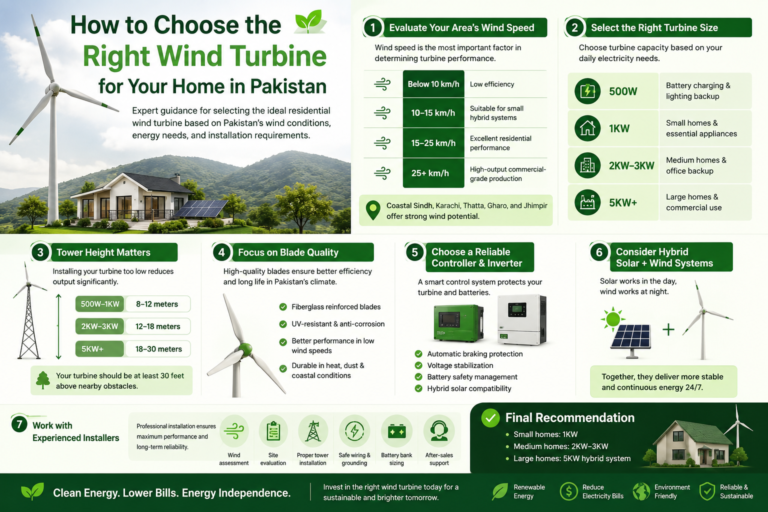
What Wind Speed Is Good for a Small Turbine in Gwadar?
A useful practical classification is:
| Average wind at actual hub height | Assessment |
|---|---|
| Below 3 m/s | Poor |
| 3–4 m/s | Marginal |
| 4–5 m/s | Usable with carefully selected turbine |
| 5–6 m/s | Good |
| 6–7 m/s | Very good |
| Above 7 m/s | Excellent |
Do not confuse start-up speed with average wind speed.
A turbine advertised as:
Start-up wind speed: 1.5 m/s
may only begin rotating at that speed.
It may produce almost no useful electrical energy.
Start-Up, Cut-In and Rated Wind Speed
These three specifications are different.
| Term | Meaning |
|---|---|
| Start-up speed | Rotor begins moving |
| Cut-in speed | Useful electrical generation begins |
| Rated wind speed | Turbine reaches advertised rated power |
| Cut-out / protection speed | Turbine limits or stops for safety |
| Survival speed | Maximum structural design wind |
A normal small turbine may have:
- start-up: 1.5–2.5 m/s;
- cut-in: 2.5–3.5 m/s;
- rated: 10–12 m/s.
WindTurbine.pk’s FAQ similarly notes that small turbines usually need substantially stronger wind to reach full rated power than merely to start rotating. (windturbine.pk)
Expected Turbine Output at Gwadar Wind Speeds
Consider an illustrative 1 kW quality wind turbine.
Its approximate power curve might look like this:
| Wind speed | Example output |
|---|---|
| 3 m/s | 10–30 W |
| 4 m/s | 40–80 W |
| 5 m/s | 100–180 W |
| 6 m/s | 200–320 W |
| 7 m/s | 350–500 W |
| 8 m/s | 500–700 W |
| 9 m/s | 700–850 W |
| 10 m/s | 850–950 W |
| 11–12 m/s | ~1,000 W |
This is an engineering illustration, not a manufacturer-specific certified power curve.
Expected 2 kW Wind Turbine Output
For a realistic quality 2 kW horizontal turbine:
| Wind speed | Approximate output range |
|---|---|
| 4 m/s | 80–180 W |
| 5 m/s | 200–400 W |
| 6 m/s | 400–700 W |
| 7 m/s | 700–1,050 W |
| 8 m/s | 1.0–1.4 kW |
| 9 m/s | 1.3–1.7 kW |
| 10 m/s | 1.6–1.9 kW |
| 11–12 m/s | Around 2 kW |
Actual turbine power curves vary substantially.
For Pakistan-specific 2 kW technical specifications, the WindTurbine.pk FAQ provides a reference configuration including a 3-blade HAWT, permanent-magnet generator, MPPT controller and roughly 2.5–3.5 m rotor class. Wind Turbine Pakistan Technical FAQ (windturbine.pk)
Expected 3 kW Wind Turbine Output
For Gwadar, 3 kW may be one of the most practical sizes for larger homes, farmhouses, commercial facilities or hybrid renewable systems.
| Wind speed | Example 3 kW output |
|---|---|
| 4 m/s | 150–300 W |
| 5 m/s | 350–600 W |
| 6 m/s | 650–1,000 W |
| 7 m/s | 1.0–1.5 kW |
| 8 m/s | 1.5–2.1 kW |
| 9 m/s | 2.0–2.5 kW |
| 10 m/s | 2.4–2.8 kW |
| 11–12 m/s | ~3 kW |
Expected 5 kW Wind Turbine Output
A 5 kW turbine becomes interesting for:
- larger villas;
- fish-processing facilities;
- shops;
- telecom;
- farms;
- workshops;
- isolated commercial properties.
| Wind speed | Example output |
|---|---|
| 4 m/s | 250–500 W |
| 5 m/s | 600–1,000 W |
| 6 m/s | 1.1–1.7 kW |
| 7 m/s | 1.8–2.6 kW |
| 8 m/s | 2.7–3.5 kW |
| 9 m/s | 3.5–4.2 kW |
| 10 m/s | 4.2–4.7 kW |
| 11–12 m/s | ~5 kW |
For current 5 kW Pakistan pricing and package details, see 5 kW Wind Turbine Price in Pakistan. (windturbine.pk)
How Many Units Can a Wind Turbine Produce in Gwadar?
It is better to estimate annual generation with capacity factor rather than pretending a 3 kW turbine produces 3 kW continuously.
The formula is:
[
Annual\ Energy =
Rated\ Power \times 8760 \times Capacity\ Factor
]
Annual production scenarios
| Turbine | 10% CF | 15% CF | 20% CF | 25% CF | 30% CF |
|---|---|---|---|---|---|
| 1 kW | 876 kWh | 1,314 kWh | 1,752 kWh | 2,190 kWh | 2,628 kWh |
| 2 kW | 1,752 | 2,628 | 3,504 | 4,380 | 5,256 |
| 3 kW | 2,628 | 3,942 | 5,256 | 6,570 | 7,884 |
| 5 kW | 4,380 | 6,570 | 8,760 | 10,950 | 13,140 |
For an ordinary low tower in Gwadar City, the capacity factor may be toward the lower side.
For a properly surveyed, tall, open coastal site, it may be substantially higher.
Monthly Generation Scenarios
3 kW turbine
| Capacity factor | Monthly average generation |
|---|---|
| 10% | ~219 units |
| 15% | ~329 units |
| 20% | ~438 units |
| 25% | ~548 units |
| 30% | ~657 units |
5 kW turbine
| Capacity factor | Monthly average generation |
|---|---|
| 10% | ~365 units |
| 15% | ~548 units |
| 20% | ~730 units |
| 25% | ~913 units |
| 30% | ~1,095 units |
These are mathematical scenarios, not guaranteed production figures.
Why May Is Particularly Interesting
Several coastal studies show strong spring-to-summer wind behaviour.
The 2015 PMD-based Pasni/Gwadar research found that the highest predicted wind-power density occurred in May. (Set Publisher)
The more recent monthly dataset also gave Gwadar its highest monthly mean:
5.84 m/s in May. (MDPI)
This agreement across different studies makes May particularly noteworthy.
A likely seasonal pattern is:
| Period | Gwadar wind-energy expectation |
|---|---|
| January | Moderate |
| February | Improving |
| March | Moderate-good |
| April | Good |
| May | Strong |
| June | Good |
| July | Moderate-good |
| August | Moderate |
| September | Declining |
| October | Lower |
| November | Lower |
| December | Moderate |
Wind + Solar Makes More Sense Than Wind Alone
Gwadar is an excellent place to consider a hybrid renewable-energy system.
A typical architecture is:
Solar panels → Solar MPPT → Battery/DC bus
plus
Wind turbine → Rectifier → Wind MPPT/controller → Battery/DC bus
then
Battery → Hybrid inverter → Home/business
This provides complementary generation.
Solar works best during:
- clear daylight;
- midday;
- dry sunny periods.
Wind can generate during:
- afternoons;
- evenings;
- nights;
- cloudy coastal periods;
- windy weather.
Can You Add a Wind Turbine to an Existing Solar System?
Yes, but the turbine should normally have its own wind controller.
Do not simply connect a wind turbine to a solar MPPT input unless the inverter manufacturer specifically approves wind operation.
A wind turbine behaves differently from solar panels:
- voltage changes with RPM;
- frequency changes with rotor speed;
- mechanical overspeed must be controlled;
- surplus power requires a dump load.
WindTurbine.pk also confirms that wind can be integrated with existing solar systems when the correct control architecture is used. (windturbine.pk)
Can It Charge a 51.2 V Lithium Battery?
Yes.
A 51.2 V LiFePO₄ battery is a particularly practical option for:
- 1 kW;
- 2 kW;
- 3 kW;
- 5 kW
hybrid systems.
But the wind controller must be compatible with:
- battery voltage;
- BMS current limit;
- maximum charge voltage;
- charging profile.
A wind turbine should not be directly connected to the battery.
Why a Dump Load Is Essential
Suppose:
- turbine is producing 2 kW;
- lithium battery suddenly becomes full;
- BMS stops accepting current.
Solar panels can simply be electrically limited.
A wind turbine is still spinning.
Without a safe electrical load:
- voltage can rise;
- rotor RPM can increase;
- turbine may overspeed.
A proper system needs:
- wind controller;
- dump load;
- electromagnetic braking;
- overvoltage protection;
- manual emergency stop.
Horizontal or Vertical Wind Turbine for Gwadar?
For most open Gwadar coastal sites, my first preference would be a horizontal-axis wind turbine if maximum annual electricity production is the objective.
Horizontal turbine
Best for:
- open coastline;
- farm;
- industrial land;
- open villa;
- rural property;
- tall tower installation.
Advantages:
- higher aerodynamic efficiency;
- larger swept area for price;
- proven technology;
- better energy yield in clean airflow.
Vertical turbine
Can be useful for:
- buildings;
- changing wind direction;
- architecturally constrained sites;
- turbulent urban wind.
A vertical turbine should not be selected merely because it looks easier to install.
For a detailed Pakistan VAWT discussion, see Vertical Wind Turbine Price & Buying Guide. (windturbine.pk)
Best Turbine Type by Gwadar Application
| Application | Preferred option |
|---|---|
| Open coastal home | 1–3 kW HAWT |
| Villa | 2–3 kW HAWT |
| Farmhouse | 3–5 kW HAWT |
| Fishery facility | 3–10 kW HAWT |
| Commercial site | 5–10+ kW |
| Port/industrial site | Engineered HAWT |
| Turbulent building roof | Helical VAWT may be considered |
| Telecom | 1–3 kW hybrid |
| Remote coastal village | Solar + wind + lithium |
Recommended 1 kW System
For small loads:
| Component | Recommended specification |
|---|---|
| Turbine | 1 kW quality HAWT or large helical VAWT |
| HAWT rotor | roughly 2–3 m class depending design |
| Generator | 3-phase PMG |
| Voltage | 48 V |
| Controller | Wind MPPT/diversion |
| Battery | 51.2 V LiFePO₄ |
| Tower | 9–15 m depending obstacles |
| Protection | Dump load + brake + SPD |
For a vertical 1 kW system, avoid very small rotors claiming huge power. Swept area and actual power curve matter more than the label.
Recommended 3 kW System for Gwadar
A practical coastal 3 kW configuration:
| Parameter | Recommendation |
|---|---|
| Rated power | 3 kW |
| Rotor diameter | ~3.8–4.5 m |
| Blades | 3 |
| Blade material | FRP/composite |
| Generator | Direct-drive PMSG |
| Rated RPM | ~250–350 RPM, rotor-dependent |
| Rated wind speed | 10–12 m/s |
| Controller | Wind MPPT |
| Protection | Dump load + electromagnetic brake |
| Tower | 12–20 m |
| Coating | Hot-dip galvanised / marine protection |
| Battery | 51.2 V LiFePO₄ if off-grid/hybrid |
Recommended 5 kW System
For larger coastal loads:
- 5 kW horizontal turbine;
- large swept area;
- direct-drive PMSG;
- tall engineered tower;
- wind MPPT;
- dump-load system;
- hybrid inverter;
- 10–30 kWh lithium storage depending demand.
WindTurbine.pk currently lists the 5 kW turbine class around PKR 1.2 million before other project-dependent components. (windturbine.pk)
Tower Height in Gwadar
Height can transform project economics.
For preliminary planning:
| Turbine size | Tower range |
|---|---|
| 500 W | 6–10 m |
| 1 kW | 9–15 m |
| 2 kW | 10–18 m |
| 3 kW | 12–20 m |
| 5 kW | 15–24 m |
These are not structural design specifications. Final tower height depends on:
- turbine thrust;
- terrain;
- obstacles;
- foundation;
- local wind extremes.
Remember: Height Means Above Ground Level
If:
- your house is 10 m tall;
- turbine rotor centre is another 7 m above the roof;
then:
hub height = approximately 17 m above ground level.
So a research value reported at 50 m or 80 m cannot be directly used as the expected wind speed at your 17 m turbine.
Hills Around Gwadar Can Help or Hurt
Gwadar’s terrain makes site selection more complex than a completely flat coastal plain.
When wind crosses elevated terrain it may:
- accelerate over a ridge;
- separate behind a ridge;
- create turbulence;
- produce vertical airflow components.
A turbine on the wrong side of a hill may receive very poor-quality wind even if average local wind looks strong.
Good location
Smoothly exposed ridge or open plateau with clean upstream flow.
Bad location
Immediately behind a steep hill where airflow separates.
Rooftop Installation in Gwadar
A roof may provide useful height, but it can also create:
- edge vortices;
- vibration;
- noise transmission;
- structural fatigue.
For larger 2–5 kW turbines, a ground-mounted tower is usually preferable where land is available.
Vertical helical turbines may be easier to accommodate on some buildings, but they must still be positioned above the strongest turbulence zone.
Marine Corrosion: Extremely Important in Gwadar
Gwadar’s coastal environment means salt contamination must be considered from day one.
Affected parts include:
- tower;
- bolts;
- blade fasteners;
- bearings;
- generator casing;
- cable terminals;
- control enclosures.
Recommended features:
- hot-dip galvanised tower;
- marine-grade coating;
- stainless or corrosion-resistant fasteners;
- sealed cable glands;
- IP54/IP65 electrical equipment as appropriate;
- corrosion-resistant connectors;
- regular freshwater cleaning where practical.
A cheap untreated steel tower may deteriorate quickly near the coast.
Foundation and Structural Design
A turbine foundation must be designed for more than turbine weight.
It must withstand:
- overturning moment;
- thrust force;
- gusts;
- cyclic loading;
- vibration;
- tower weight;
- soil conditions.
For Gwadar, coastal soil and site-specific ground conditions need consideration.
An engineer should determine:
- RCC foundation dimensions;
- anchor bolts;
- reinforcement;
- guy-wire anchors if used;
- corrosion protection.
Lightning and Surge Protection
A wind turbine is one of the tallest conductive structures on a property.
A complete system should include:
- tower earthing;
- surge protection devices;
- proper earth electrodes;
- generator/controller grounding;
- AC protection;
- DC protection;
- isolation switches.
Water and Telecom Applications
Wind power in the Makran belt has additional applications beyond homes.
Water pumping
Wind + solar can support:
- bore pumps;
- transfer pumps;
- filtration;
- desalination support loads.
Telecom
Suitable for:
- towers;
- repeaters;
- CCTV;
- remote security.
A 1–3 kW wind-solar hybrid can provide useful resilience for remote installations.
Fisheries and Cold Storage
The coastal economy creates an interesting use case for wind.
Potential loads include:
- lighting;
- freezers;
- ice-making auxiliaries;
- pumps;
- refrigeration controls;
- communications.
Large refrigeration loads generally need much more power than a small turbine alone can provide, but a 5–20 kW wind system can contribute to a larger solar/grid hybrid plant.
Gwadar Electricity Resilience
Gwadar has historically faced energy-infrastructure constraints, making distributed renewable energy particularly relevant. Public reporting has documented periods in which the city depended on external electricity supplies and solar as alternatives. (AP News)
For individual businesses and remote properties, hybrid generation can reduce dependence on any single energy source.
Wind Survey: What Should You Actually Do?
For serious projects:
Stage 1 — Desktop screening
Use:
- research papers;
- NASA POWER;
- Global Wind Atlas;
- PMD studies;
- satellite imagery.
Stage 2 — Physical inspection
Identify:
- hills;
- buildings;
- coastline orientation;
- tower locations;
- power cable routes.
Stage 3 — Install an anemometer
Measure near the proposed turbine hub height.
Stage 4 — Record
Preferably collect:
- mean wind speed;
- gust speed;
- direction;
- 10-minute average;
- hourly average.
Stage 5 — Compare to turbine power curve
Do not estimate annual kWh from rated watts alone.
How Long Should You Measure Wind?
For a small home turbine:
1–3 months can be useful for preliminary screening.
Better:
6 months
Best before a larger investment:
12 months
Then correlate measurements with longer-term climatic data.
A 5–10 kW commercial turbine deserves substantially more serious assessment than a 500 W battery charger.
Which Wind Speed Should the Anemometer Measure?
Do not measure:
- inside the garden;
- against a wall;
- directly above a parapet;
- beside a water tank.
Measure as close as reasonably possible to the intended rotor hub height.
That is the wind the turbine will actually use.
Common Mistakes in Gwadar Wind Projects
- Using an 80 m research value for a 10 m tower.
- Buying a turbine only because it starts at 1.5 m/s.
- Assuming “5 kW” means continuous 5 kW.
- Installing behind a hill.
- Ignoring salt corrosion.
- Selecting a tower that is too short.
- Buying a small rotor with an unrealistic rating.
- Connecting wind directly to a solar MPPT.
- Installing without a dump load.
- Ignoring battery BMS limits.
Wind Turbine Price in Gwadar
Wind turbine hardware pricing is broadly similar to the rest of Pakistan, but Gwadar installation can be more expensive because of:
- freight;
- tower transport;
- foundation works;
- specialist labour;
- corrosion protection.
Current WindTurbine.pk indicative pricing includes: Wind Turbine Price in Gawadar
| Capacity | Indicative turbine price |
|---|---|
| 500 W | PKR 75,000–100,000 |
| 1 kW | PKR 160,000–199,000 |
| 2 kW | PKR 350,000–400,000 |
| 3 kW | PKR 550,000–600,000 |
| 5 kW | Around PKR 1.2–1.25 million |
These should be treated as equipment-level market references; tower, installation, inverter, battery and civil works may be additional.
Full updated pricing is available at WindTurbine.pk Prices.
ROI Example for Gwadar
Assume:
- turbine: 3 kW;
- complete installed investment: PKR 750,000;
- annual output: 4,500 kWh;
- displaced electricity value: PKR 55/kWh;
- annual maintenance: PKR 20,000.
Gross annual saving:
[
4500 \times 55 = 247,500
]
Net:
[
247,500-20,000=227,500
]
Payback:
[
750,000 / 227,500 \approx 3.3\ years
]
But if poor siting reduces production to only 2,000 kWh:
Gross value:
[
2,000 \times 55 = 110,000
]
Net:
[
110,000-20,000=90,000
]
Payback:
[
750,000 / 90,000\approx8.3\ years
]
Same turbine. Same price. Very different economics.
My Recommendation for Gwadar City
For a normal home with reasonably open surroundings:
1–2 kW wind + solar + lithium
is a sensible starting point.
For a detached villa or larger property:
2–3 kW
may be more useful.
For an exposed farmhouse or commercial property:
3–5 kW
becomes interesting after a wind survey.
My Recommendation for Ormara
The research evidence for Ormara is particularly strong. The recent comparative dataset reported an annual mean around 5.27 m/s, higher than Gwadar, Jiwani and Pasni in that study. (MDPI)
For open Ormara locations, I would seriously investigate:
- 2 kW;
- 3 kW;
- 5 kW
horizontal turbines.
The 2019 analysis also estimated significantly higher wind-power density for Ormara than Gwadar at the study’s extrapolated turbine heights. (econ-environ-geol.org)
My Recommendation for Pasni
Pasni is another high-priority location.
The long-term PMD-based study directly comparing Pasni and Gwadar concluded that Pasni had the higher wind-energy yield. (Set Publisher)
Open coastal businesses, farms and homes around Pasni should therefore be considered strong candidates for wind-solar hybrid systems.
My Recommendation for Jiwani
Jiwani remains worth assessing, particularly because:
- it has strong marine exposure;
- research specifically includes Jiwani;
- multiple PMD-based studies have analysed its wind behaviour.
A ten-year PMD dataset from 1998–2007 has also been used in published research comparing Jiwani with Ormara. (ResearchGate)
Best Makran Coast Locations to Target Commercially
For WindTurbine.pk, I would rank marketing priorities approximately:
| Priority | Location |
|---|---|
| 1 | Ormara |
| 2 | Pasni |
| 3 | Gwadar |
| 4 | Jiwani |
| 5 | Pishukan |
| 6 | Surbandar |
| 7 | Ganz |
| 8 | Other open Makran coastal settlements |
The first four have much stronger published research evidence.
Final Verdict: Is a Wind Turbine Worth It in Gwadar?
Yes, at the right site.
Published research confirms that Gwadar has a meaningful coastal wind resource. Different datasets produce different absolute values because measurement heights, years and methodologies vary, but the broader conclusion is consistent: Gwadar and the Makran coastline deserve serious wind-energy consideration. (econ-environ-geol.org)
For Gwadar specifically, the recent comparative dataset reported an annual mean wind speed of about 4.68 m/s, with May reaching roughly 5.84 m/s, while research at larger extrapolated heights indicates substantially higher wind-power potential. (MDPI)
For most residential and small-business projects, my preferred setup would be:
Solar PV + 2–3 kW wind turbine + 51.2 V LiFePO₄ battery + wind-specific MPPT/controller + dump load + hybrid inverter.
For larger coastal properties:
3–5 kW HAWT on a properly engineered 12–20 m tower is worth investigating.
The most important rule remains:
Measure the wind at your actual installation height before buying the turbine.
A 5 kW turbine installed behind a hill can perform worse than a properly located 2 kW turbine in clean coastal airflow.
For additional Pakistan-specific information, continue with WindTurbine.pk, Wind Turbine Price in Pakistan, Vertical Wind Turbine Guide, and Wind Turbine Technical FAQs. (windturbine.pk)Gawadar