Small Wind Turbines for Home
A data-driven investigation into whether Pakistan’s wind resource can actually power your home, your shop, or your farm — and what it will cost you.
By Expert Wind Energy Analysis · April 2025 · Sources: PMD · UET Lahore · MDPI · World Bank · AEDB
Spoiler: Partly Reality — but geography is everything. Here is the full evidence.
Pakistan is in an energy crisis. Load-shedding stretches up to 12 hours a day in many urban areas. Electricity bills have tripled since 2021. Diesel generators run on borrowed money and borrowed time. Against this backdrop, a growing number of homeowners and small-business owners are asking the same urgent question: can a small wind turbine on my rooftop or in my backyard actually make a difference?
The answer, backed by peer-reviewed research and on-the-ground data, is more nuanced than any salesperson will tell you. Pakistan has world-class wind corridors — but they are not where most people live. The economics, the geography, and the technology all converge on a single truth: location decides everything. This article cuts through the marketing noise and lays out the real picture, with real numbers.
Section One
Pakistan’s Wind Potential Is Real — At the National Scale
Let us start with the macro picture, because it is genuinely impressive. Pakistan sits at the crossroads of monsoon systems and continental pressure gradients, giving it one of the most underutilised wind resources in South Asia. The numbers are not aspirational — they are measured.
346 GW
Technical Wind Potential
Total national estimate, 2025 industry analysis
50,000 MW
Gharo-Jhimpir Corridor
Over 9,700 km² of prime wind land in Sindh alone
2 GW . Installed Capacity (2025)
Projected to reach 4 GW by 2030 at 14.87% CAGR
Pakistan ARE Policy, revised upward in 2024
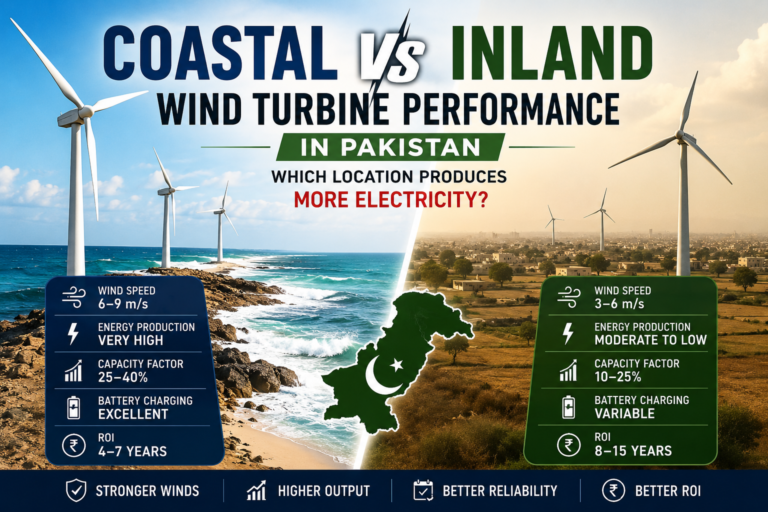
The Gharo-Jhimpir wind corridor in Sindh — identified by the Pakistan Meteorological Department (PMD) as the country’s premier wind zone — records average speeds consistently above 7 m/s. At Jamshoro, peak speeds have been measured at 13.9 m/s; at Nooriabad, 10.6 m/s. These are internationally competitive figures. Multiple large commercial wind farms — built by Chinese, European, and Pakistani developers — are already generating power there, with project payback periods as short as 4.5 to 7.2 years documented in peer-reviewed feasibility studies.
But here is the critical fact that most marketing material carefully avoids: these premier wind zones are not where most Pakistanis live. The real question for homes and businesses is what the wind resource looks like in Lahore, Islamabad, Multan, Peshawar — and even most of Karachi. The answer, as we shall see, is very different.
Section Two
Pakistan’s Cities Are Mostly Low-Wind Zones
A February 2025 peer-reviewed study by researchers at the University of Engineering and Technology (UET) Lahore systematically assessed wind resources at 12 sites across low-wind regions of Pakistan. Their conclusion was sobering for anyone dreaming of a rooftop turbine in Punjab or urban KPK:
“The wind power density of all sites at 50 metres ranges from 33 to 244 W/m², categorising the wind power class as either poor or marginal across every site studied.”— UET Lahore, Department of Mechanical Engineering, Wind Engineering Journal, February 2025
The PMD has published detailed wind speed analyses for major Pakistani cities, collected across multiple decades. Below is a city-by-city breakdown based on PMD measurements and peer-reviewed published research:
| Location | Avg. Wind Speed (10 m height) | Wind Class | Small Turbine Viability |
|---|---|---|---|
| Gharo / Jhimpir (Sindh) | 7.0 – 9.0+ m/s | Class 4 – 6 | Excellent |
| Thatta / Badin (Sindh) | 5.6 – 7.0 m/s | Class 3 – 4 | Good |
| Karachi Coastal (DHA, Hawks Bay) | 4.2 – 6.9 m/s (seasonal peaks) | Class 2 – 3 | Conditional |
| Karachi Inland / Urban | 2.0 – 2.5 m/s (annual avg.) | Class 1 (Poor) | Not Viable |
| Hyderabad / Quetta | 3.0 – 4.5 m/s | Class 1 – 2 | Low-Power VAWTs Only |
| Mirpur Khas / Makran Coast | 4.2 – 5.0 m/s | Class 2 | Small Turbines Viable |
| Kalarkahar, Punjab | 4.0 – 5.0 m/s | Class 2 | Conditional |
| KPK Hill / Rural Areas | 4.0 – 6.0 m/s (site-dependent) | Class 2 – 3 | Hybrid Systems Viable |
| Lahore / Faisalabad / Multan | 1.5 – 3.0 m/s | Class 1 (Poor) | Not Viable |
| Islamabad / Rawalpindi | 1.5 – 2.5 m/s | Class 1 (Poor) | Not Viable |
The critical benchmark that almost no vendor mentions: wind energy professionals internationally agree that a site requires at least 4.5 to 5.0 m/s of average annual wind speed for a small turbine to be economically worthwhile. A PMD study of Karachi city recorded an annual average of just 4.2 m/s — and when a 600 kW test turbine was evaluated against this data, it yielded a capacity factor of only 13%. The internationally accepted minimum for economic viability is 25%. That gap is the difference between a sound investment and an expensive regret.
In Lahore, Islamabad, and most of inland Punjab, wind speeds hover between 1.5 and 3.0 m/s for most of the year. No commercially available small turbine produces meaningful power at those speeds. The physics simply do not cooperate.
Section Three
Which Turbines Are Actually Available in Pakistan?
The small wind turbine market in Pakistan is modest but real. Several importers operate, primarily out of Karachi. Understanding the two main turbine types is essential before making any purchase decision.
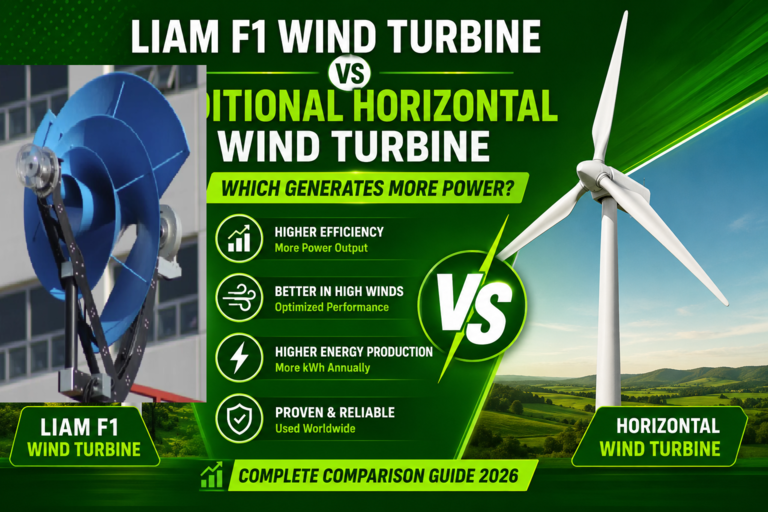
Horizontal Axis Wind Turbines (HAWT)
The classic propeller-style turbine — what most people picture when they think of wind energy. HAWTs are more aerodynamically efficient, extracting more energy per square metre of rotor area. However, they require consistent wind direction, significant open space, and are typically mounted on masts between 10 and 30 metres high. They produce noise and vibration that can be problematic in dense neighbourhoods. In Pakistan, HAWTs are best suited for rural properties in coastal Sindh, the Makran coast, and select elevated sites in KPK and Balochistan.
https://windturbine.pk/prices-of-wind-turbine-in-pakistan/
Vertical Axis Wind Turbines (VAWT)
Increasingly discussed for urban Pakistan, and for good reason. VAWTs rotate on a vertical axis and can capture wind from any direction without needing to turn toward it — a genuine advantage in the turbulent, multi-directional airflows found above urban rooftops. They operate at lower cut-in speeds, sometimes as low as 1.5 m/s, and can be mounted directly on rooftops without tall masts. The trade-off is lower efficiency per unit of swept area. Pakistani researchers have specifically identified VAWTs as the most appropriate technology for cities like Karachi, Hyderabad, and Quetta, where annual averages of 3 to 4.5 m/s make HAWTs impractical. Even so, power output in these conditions remains modest.
Who Is Manufacturing and Supplying in Pakistan?
A documented review of Pakistan’s small wind sector identified severalPakistani importers
- Chinese manufacturers (direct import): Widely available 1–10 kW units; prices are competitive but quality and after-sales support vary significantly
- Pakistani re-sellers of European and American brands: www.windturbine.pk Higher quality and price; suitable for commercial buyers requiring reliability guarantees
Historical precedent confirms that small wind is not purely theoretical in Pakistan. Between 2006 and 2009, the Alternative Energy Development Board (AEDB) oversaw the installation of 135 micro wind turbines across rural Sindh, collectively electrifying 1,431 homes with over 151 kW of capacity. Gul Muhammad village became the first settlement in Pakistan powered entirely by wind energy — 26 turbines of 500W each. These installations worked precisely because they were sited where the wind resource was adequate.
https://windturbine.pk/prices-of-wind-turbine-in-pakistan/
What Does It Actually Cost?
| System Size | Typical Use Case | All-In Cost (PKR) | USD Equivalent | Payback Period* |
|---|---|---|---|---|
| 300W – 500W | Lighting, phone charging, fans | PKR 60,000 – 180,000 | ~$285 – $645 | 3–5 years |
| 1 kW – 2 kW | Small home (basic load) | PKR 350,000 – 800,000 | ~$1,250 – $2,860 | 5–8 years |
| 3 kW – 5 kW | Medium home or small shop | PKR 1,000,000 – 2,500,000 | ~$3,570 – $8,930 | 6–10 years |
| 10 kW – 20 kW | Business or commercial use | PKR 3,800,000 – 9,000,000 | ~$13,570 – $32,140 | 7–12 years |
* Payback periods assume consistent wind speeds of 5 m/s or above. In low-wind urban areas (Lahore, Islamabad), payback periods can stretch to 20 years or more — making the investment economically irrational at current turbine prices.
For context: a similarly-sized solar photovoltaic system in Pakistan currently delivers better per-rupee returns in most locations, has a more mature supply chain, and benefits from NEPRA’s established net-metering framework. This is why solar has dramatically outpaced wind for residential adoption. Wind’s genuine, non-negotiable advantage is its ability to generate power around the clock — including at night, during overcast days, and through monsoon cloud cover — which solar categorically cannot do.
The Hybrid Advantage — The Smartest Strategy
For homes and businesses in areas with moderate wind (3–5 m/s), the most economically sound approach is a solar-wind hybrid system. Solar handles daytime generation efficiently; a small wind turbine supplements output at night and during the monsoon season when solar is weakest. This combination reduces required battery storage capacity, smooths out daily and seasonal generation gaps, and improves overall system reliability. KPK hill communities, Balochistan coastal areas, and Kalarkahar in Punjab are the strongest candidates for this approach in Pakistan.
Section Five
Honest Assessment: The Complete Picture
Arguments For Small Wind in Pakistan
- Generates electricity 24 hours a day — unlike solar
- Coastal Sindh and Makran have world-class resources (5–9+ m/s)
- Proven record: 135 micro turbines electrified 1,431 homes in Sindh
- Government’s 60% renewables target (2030) is creating policy momentum
- Off-grid rural communities in Balochistan and KPK benefit enormously
- Karachi coastal residents (Hawks Bay, DHA seafront) can achieve viable returns
- VAWTs increasingly practical for low-speed urban rooftop contexts
- Payback of 4.5–7 years achievable at prime wind sites
- No fuel cost; completely insulated from diesel and gas price shocks
- Local manufacturers exist, reducing dependence on imports
- Zero operational carbon emissions
Arguments Against (Especially for Urban Pakistan)
- Lahore, Islamabad, most of Punjab: wind too low (1.5–3 m/s) to justify any investment
- Urban turbulence and building interference sharply reduce real output
- High upfront cost compared with solar per reliable watt
- Housing society regulations may prohibit rooftop installations
- Noise and vibration from HAWTs problematic in dense neighbourhoods
- Qualified maintenance technicians scarce outside Karachi
- Marketed capacity figures assume ideal speeds — rarely achieved in practice
- No NEPRA net-metering framework designed specifically for small wind
- No standardised consumer wind assessment service before purchase
- Circular debt crisis creates ongoing grid-connection uncertainty
- Import duties on turbine components remain a cost barrier
Section Six
Who Should — and Who Should Not — Invest in Small Wind?
Strong candidates: invest with confidence
Coastal Sindh residents and businesses within 50 km of the Gharo-Jhimpir corridor, Karachi Thatta, and Badin are in the sweet spot. Wind speeds here are consistent and strong year-round. Feasibility studies show payback periods of 5 to 8 years, with some commercial installations returning investment in as little as 4.5 years. Fishing communities, coastal farms, cold-storage operations, and small industries in this belt have the strongest economic case of any population in the country.
Rural communities in Balochistan and KPK that are off-grid or subject to chronic grid failure find small turbines — particularly in hybrid solar-wind configurations — genuinely transformational. Government studies identify these regions as priority zones for decentralised renewable energy. Here, the alternative is not solar versus wind; it is a turbine versus a diesel generator consuming rupees forever.
Karachi coastal neighbourhoods — Hawks Bay, Clifton beachfront, DHA Phase 8 seafront — experience seasonal wind speeds reaching 6 to 9 m/s in summer months. A properly sited 2 to 5 kW turbine can meaningfully reduce electricity bills. Professional site assessment before purchase is not optional — it is essential.
Who should invest in solar instead (or a hybrid):
Lahore, Islamabad, Multan, Faisalabad, and most inland Punjab: With annual average wind speeds of 1.5 to 3.0 m/s, standalone wind investment is economically unjustifiable at any currently available turbine price. Solar delivers far superior returns in these locations. A small VAWT as a secondary generator added to an existing solar system is worth investigating if budget allows — but wind must never be the primary energy source here.
Urban Karachi (non-coastal, inland areas): The PMD documented an annual average of 4.2 m/s for city-side Karachi, producing a capacity factor of just 13% on test turbines. Given additional real-world losses from building turbulence and rooftop interference, solar is the better investment for the vast majority of urban Karachi households. The coastal exception applies only within a few kilometres of the waterfront.
Section Seven
Policy Context: What the Government Is — and Is Not — Doing
Pakistan’s Alternative and Renewable Energy (ARE) Policy, revised in 2024 with an ambitious target of generating 60% of electricity from renewable sources by 2030, has undoubtedly created strong momentum for the clean energy sector. However, the majority of these benefits have been directed toward utility-scale wind farms rather than residential or small commercial wind turbine systems.
At present, the government has introduced several initiatives to encourage large-scale renewable energy investments. For example, the 2024 Finance Act extended accelerated depreciation benefits to Wind Independent Power Producers (IPPs), making utility-scale projects more financially attractive. In addition, CPEC Phase II continues to channel investment into green energy infrastructure, including wind and solar developments across Pakistan.
Moreover, the ARE Policy allows foreign investors to enjoy 100% equity ownership and maintain hard-currency accounts, making Pakistan an increasingly attractive destination for international renewable energy investment. As a result, clean energy investment surged by an impressive 915%, reaching USD 475 million in 2023. Therefore, there is no doubt that international confidence in Pakistan’s wind energy sector is growing.
Nevertheless, it is important to understand that these incentives primarily benefit large commercial wind projects. Unfortunately, homeowners, farmers, and small businesses currently receive no dedicated subsidies, tax rebates, or financing programs specifically designed for installing small wind turbines. Consequently, individuals must largely rely on private investment when considering small-scale wind energy solutions.
Reality or Myth?
So, are small wind turbines in Pakistan a reality or merely a myth?
The answer is both—depending entirely on location.
On one hand, small wind turbines are a genuine and practical reality in areas with strong and consistent wind resources. For instance, the coastal regions of Sindh, the Makran Coast, remote parts of Balochistan, and several elevated areas of Khyber Pakhtunkhwa (KPK) offer favorable wind conditions throughout much of the year. In these locations, small wind turbines can successfully provide reliable electricity, reduce dependence on diesel generators, and even deliver energy independence where the national grid has remained unreliable for decades.
Furthermore, Pakistan already has access to modern wind turbine technology, experienced local manufacturers, and proven installation expertise. As a result, thousands of homes and businesses have successfully adopted small wind systems in suitable locations. Therefore, the technology itself is not experimental—it has already demonstrated real-world success.
On the other hand, the situation is significantly different for most urban areas of Pakistan. In cities such as Lahore, Islamabad, inland Karachi, and much of Punjab, average wind speeds are generally too low for small wind turbines to perform efficiently. Consequently, electricity generation remains limited, capacity factors are poor, and investment returns become disappointing.
Moreover, longer payback periods often make standalone wind systems financially unattractive. By comparison, investing the same amount in a solar power system usually produces higher electricity output, lower maintenance costs, and faster financial returns. Therefore, while wind turbine marketing may appear promising, the actual performance depends almost entirely on local wind conditions rather than the turbine itself.
Most importantly, every potential buyer should measure wind speed before purchasing any turbine. Ideally, a professional wind assessment should be conducted at the exact installation site for at least three months, covering different seasons whenever possible. Only then can an informed investment decision be made.
If the measured annual average wind speed is below 4.5 m/s, then purchasing a small wind turbine is generally not recommended. Instead, redirecting the budget toward a solar energy system will almost always deliver better performance and a stronger return on investment.