2kW Wind Turbine Output in Pakistan
& buyer guide — based on Karachi wind patterns
⚡ Overview
A 2kW wind turbine sounds powerful — but actual performance depends on wind speed, height, and location.
This page gives you a real, data-based case study for Pakistan so you can make an informed decision.
Case Study Location
Karachi, Pakistan
Karachi is one of the best cities in Pakistan for wind energy due to strong sea breeze, especially in summer.
System Setup
Turbine Size: 2kW
Tower Height: 25–30 ft (typical home installation)
Area Type: Residential (with some buildings around)
Efficiency Factor
Real-world efficiency: 25% – 35%
Data Source: Global Wind Atlas
📊 Monthly Wind Speed & Energy Output
Realistic monthly breakdown based on Karachi wind patterns
| Month | Avg Wind Speed | Estimated Units (kWh) | Performance |
|---|---|---|---|
| Jan | 3.5 m/s | 60 – 90 | Very Low |
| Feb | 3.8 m/s | 70 – 110 | Low |
| Mar | 4.5 m/s | 120 – 180 | Moderate |
| Apr | 5.5 m/s | 220 – 320 | Good |
| May | 6.5 m/s | 350 – 500 | Strong |
| Jun | 7.5 m/s | 500 – 700 | Excellent |
| Jul | 7.8 m/s | 550 – 750 | Peak Output |
| Aug | 7.2 m/s | 480 – 680 | Excellent |
| Sep | 6.0 m/s | 300 – 450 | Good |
| Oct | 4.8 m/s | 150 – 220 | Moderate |
| Nov | 4.0 m/s | 80 – 130 | Low |
| Dec | 3.6 m/s | 60 – 100 | Very Low |
Yearly Energy Production
Total Yearly Output: 3,000 – 4,200 units (kWh)
Average Monthly: 250 – 350 units
👉 Output depends heavily on wind season (summer vs winter)
What Can It Run?
Average Month (250–350 units):
✅ 3–5 ceiling fans (full day)
✅ Lights (entire home)
✅ 1 refrigerator
⚠️ Air Conditioner → Only partially (best in windy months)
⚡ Hourly Output (July – Peak Wind Month)
Real example: 2kW Wind Turbine (Karachi – July)
During peak summer, wind speeds in Karachi reach around 7.8 m/s, resulting in strong and consistent energy production.
⚙️ Assumptions: Turbine Size: 2kW | Average Wind Speed: 7.8 m/s | Real Output Range: 500 – 800W | Peak Output: ~900W | Wind varies throughout the day
| Time | Wind Trend | Power Output (Watts) | Units (kWh) |
|---|---|---|---|
| 12 AM | Moderate | 450 | 0.45 |
| 1 AM | Moderate | 480 | 0.48 |
| 2 AM | Moderate | 500 | 0.50 |
| 3 AM | Slight Drop | 420 | 0.42 |
| 4 AM | Low | 350 | 0.35 |
| 5 AM | Low | 300 | 0.30 |
| 6 AM | Rising | 400 | 0.40 |
| 7 AM | Moderate | 500 | 0.50 |
| 8 AM | Good | 600 | 0.60 |
| 9 AM | Strong | 700 | 0.70 |
| 10 AM | Strong | 750 | 0.75 |
| 11 AM | Peak | 800 | 0.80 |
| 12 PM | Peak | 850 | 0.85 |
| 1 PM | Peak | 900 | 0.90 |
| 2 PM | Peak | 850 | 0.85 |
| 3 PM | Strong | 780 | 0.78 |
| 4 PM | Strong | 720 | 0.72 |
| 5 PM | Good | 650 | 0.65 |
| 6 PM | Moderate | 550 | 0.55 |
| 7 PM | Moderate | 500 | 0.50 |
| 8 PM | Moderate | 480 | 0.48 |
| 9 PM | Slight Drop | 450 | 0.45 |
| 10 PM | Moderate | 500 | 0.50 |
| 11 PM | Moderate | 520 | 0.52 |
Daily Production (July)
~18 – 22 units per day
Monthly (July): ~550 – 700 units
👉 Wind turbine produces electricity 24 hours a day, including night time
Understanding the Pattern
🌅 Morning → wind increases gradually
☀️ Afternoon → maximum output (peak generation)
🌙 Night → stable generation continues
👉 Unlike solar, wind energy does not stop at night
☀️ Wind vs Solar (2kW System Comparison)
🌬️ Wind (2kW)
Average Units/Hour:0.5 – 0.8
Peak Output:~0.9 kW
Night Production:✅ Yes (24/7)
Daily Total (Good Wind):18 – 22 units
☀️ Solar (2kW)
Average Units/Hour:0.8 – 1.5
Peak Output:~2.0 kW
Night Production:❌ No
Daily Total (Good Sun):10 – 12 units
☀️ Typical Solar Output (Pakistan)
⚡ Key Insight (Very Important)
👉 Solar produces more power per hour, but only during the day
👉 Wind produces less power per hour, but works 24/7
🔥 Daily Reality
☀️ Solar (2kW): ~10 – 12 units/day
🌬️ Wind (2kW – good wind conditions): ~18 – 22 units/day
🚀 Best Solution: Hybrid System
👉 Combine both systems:
Daytime → Solar ☀️ | Nighttime → Wind 🌬️
✔️ Continuous power supply
✔️ Reduced battery dependency
✔️ Better overall efficiency
❗ Reality vs Marketing (Important)
❌ Common Misconception: “2kW turbine will always give 2kW power”
✅ Actual Reality: Rated power achieved at 12–14 m/s wind. Karachi average: 5–7 m/s
👉 Real output is usually: 15% – 35% of rated capacity
⚠️ Important Note: Actual output depends on tower height, surrounding buildings, wind consistency, and installation location.
🌪️ Why Wind Speed Matters So Much
👉 Wind power follows a cubic rule
Slight increase in wind = huge increase in power
Low wind = very low output
Real-Life Performance Example
A typical residential setup in Karachi:
1.2kW turbine → Output: 200–300W average
👉 This matches real-world expectations and validates this case study.
🚀 How to Increase Output
Increase Tower Height
30 ft → 50 ft
👉 Up to 30–50% more energy
Avoid Obstacles
Buildings reduce wind speed
Open rooftop or farm works best
Use Hybrid System
Combine solar + wind
👉 Power available day + night
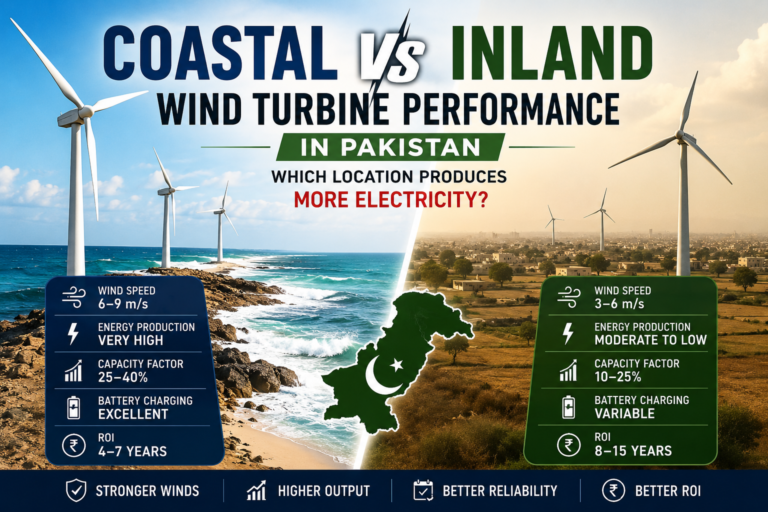
🌍 Where Wind Works Best in Pakistan
✅ Best Regions
Coastal Sindh (Karachi, Thatta, Gharo)
Open areas in Balochistan
❌ Low Performance Areas
Punjab cities (Lahore, Faisalabad)
Dense urban zones
✅ Final Takeaway
👉 A 2kW wind turbine alone is a supporting energy source
👉 But when combined with solar, it becomes a complete energy solution for Pakistan
- A strong supporting energy source
- Best in coastal and windy regions
- Ideal when combined with solar system
📞 Need Help Choosing the Right System?
We help you:
✅ Select the right turbine size | ✅ Estimate real output for your location | ✅ Design hybrid (solar + wind) systems
👉 Contact us today to get a free consultation
📚 Also check out: