How Much Electricity Can VAWT Actually Generate?
An engineering-based guide to vertical-axis wind turbine performance, rotor design, speed requirements, monthly electricity generation, and real-world suitability in Pakistan.
A vertical wind turbine installed on a farmhouse in Gharo and another installed on a residential rooftop in Karachi may look identical. Both may carry a 3 kW label. Both may start rotating when the wind blows.
Yet their annual electricity production could be dramatically different.
Why?
Because the electricity generated by a vertical-axis wind turbine (VAWT) depends on far more than its advertised generator capacity. The most important factors are wind speed, rotor swept area, aerodynamic design, blade efficiency, installation height, electrical losses, and the number of hours the turbine operates at different wind speeds.
Vertical Wind Turbine
This becomes particularly important in Pakistan, where small vertical wind turbines are increasingly marketed for houses, farms, schools, workshops, and commercial buildings.
Manufacturers often promote vertical turbines as compact, quiet, suitable for changing wind directions, and capable of operating in relatively low winds. Some of these characteristics can be useful, but they do not automatically translate into high electricity production.
A turbine that begins rotating at 2 m/s may produce almost no usable electrical power at that speed. A 5 kW generator attached to an undersized rotor may never deliver 5 kW at the advertised rated wind speed. And a turbine installed on a turbulent rooftop may produce considerably less electricity than the same model installed on an unobstructed tower.
The important question is not simply whether a vertical wind turbine can rotate. It is how many usable kilowatt-hours it can generate over an entire year.
In this guide, we examine:
- How different vertical-axis turbine designs generate electricity.
- How much electricity 1 kW, 2 kW, 3 kW, 4 kW and 5 kW vertical turbines can potentially produce.
- The relationship between rotor diameter, blade height, wind speed, and electrical output.
- Why rated wind speed is one of the most important specifications.
- Whether vertical turbines are suitable for Pakistani rooftops.
- Wind-energy opportunities in 15 locations across Pakistan.
- How to estimate annual electricity production using real wind data.
- What buyers should check before investing in a vertical wind turbine.
The calculations use established wind-energy equations. Where an actual certified turbine power curve is unavailable, the article identifies estimates as illustrative rather than presenting them as verified manufacturer performance.
1. What Is a Vertical Axis Wind Turbine?
A vertical-axis wind turbine is a wind-energy machine whose main rotor shaft is oriented vertically, or approximately vertically.
Unlike a conventional horizontal-axis wind turbine, which generally requires its rotor to face the incoming wind, many vertical-axis designs can accept wind arriving from different horizontal directions without a conventional yaw mechanism.
The rotor blades rotate around a central vertical axis, driving a generator either directly or through a mechanical transmission.
The generated electrical power is then processed through appropriate equipment, such as a rectifier, wind controller, inverter, battery system, or compatible grid interface.
Vertical turbines are often promoted for urban environments because of their distinctive appearance and omnidirectional operation.
However, their performance depends strongly on rotor type.
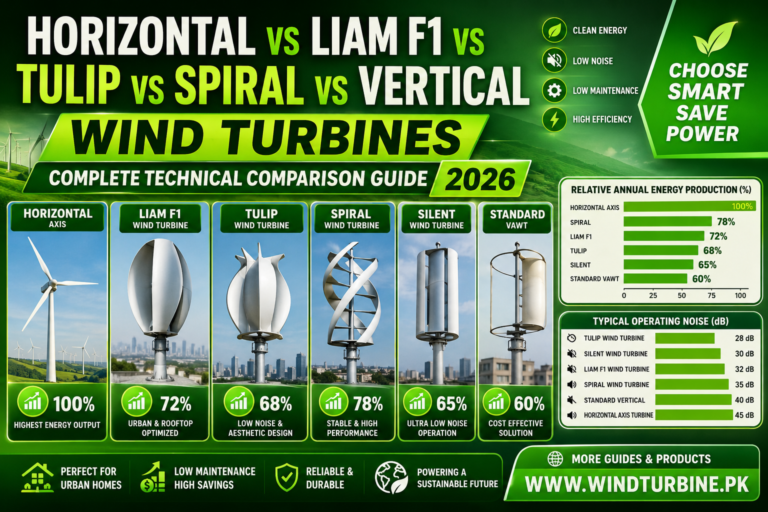
A Savonius turbine and an H-Rotor Darrieus turbine are both vertical-axis machines, but they operate using different aerodynamic principles.
Their starting behaviour, operating speed, torque characteristics, efficiency, and annual electricity generation can differ substantially.
This is why comparing two vertical turbines using only their rated kW is technically inadequate.
2. Types of Vertical Wind Turbines: Which Design Generates More Electricity?
There are several important vertical-axis rotor configurations.
H-Rotor Darrieus Wind Turbine
The H-Rotor Darrieus turbine typically uses straight vertical blades connected to a central rotating shaft by support arms.
Its blades generate aerodynamic lift as they travel through the wind.
A properly designed H-Rotor can achieve relatively high aerodynamic efficiency compared with drag-based Savonius designs.
Its performance depends on factors including:
- Blade airfoil profile.
- Number of blades.
- Blade chord length.
- Rotor solidity.
- Tip-speed ratio.
- Blade pitch angle.
- Support-arm drag.
- Reynolds number.
- Generator loading.
H-Rotor designs are particularly relevant when the objective is useful electricity production rather than simply demonstrating rotation in low wind.
However, some fixed-pitch H-Rotors have poor self-starting characteristics and may require careful aerodynamic design or assistance to start reliably.
Helical Darrieus Wind Turbine
A helical Darrieus turbine uses twisted blades arranged around the vertical axis.
The helical geometry can distribute aerodynamic forces more smoothly during rotation.
This may reduce torque pulsation and improve mechanical behaviour compared with some straight-bladed configurations.
However, helical blades are more complicated to manufacture, and the design does not automatically guarantee greater annual electricity production.
A helical turbine must still be evaluated using its rotor dimensions, aerodynamic performance, starting behaviour, and measured electrical power curve.
Savonius Wind Turbine
A Savonius turbine usually uses curved or scoop-shaped blades.
It primarily operates through aerodynamic drag rather than the lift-based mechanism used by Darrieus turbines.
Savonius rotors are often attractive for educational projects and applications requiring relatively high starting torque at low rotational speed.
However, their aerodynamic efficiency is generally lower than that of well-optimized lift-based Darrieus rotors.
A Savonius turbine may start rotating easily without producing much electricity.
For buyers interested in maximum electricity generation from a limited rotor area, this distinction is critical.
Hybrid Savonius–Darrieus Turbine
Hybrid designs combine elements of Savonius and Darrieus rotors.
The objective is often to improve self-starting while retaining some of the efficiency advantages of a lift-based rotor.
But adding a Savonius section can also increase drag and reduce performance at higher rotational speeds.
The overall result depends on the design.
A hybrid turbine should not automatically be considered superior to a well-designed H-Rotor.
Which vertical turbine design should Pakistani buyers consider?
| Rotor type | Main operating principle | Potential strength | Main limitation |
|---|---|---|---|
| H-Rotor Darrieus | Aerodynamic lift | Good efficiency potential | Starting and cyclic loads |
| Helical Darrieus | Aerodynamic lift | Smoother torque in some designs | Manufacturing complexity |
| Savonius | Aerodynamic drag | Starting torque | Lower efficiency potential |
| Hybrid Savonius–Darrieus | Lift and drag | Possible starting improvement | Added drag and complexity |
| Variable-pitch Darrieus | Controlled aerodynamic lift | Performance optimization potential | More moving components |
For 1–5 kW applications where annual electricity generation is the primary goal, a well-engineered H-Rotor or helical Darrieus design is worth serious consideration.
But the final selection should depend on measured performance, not rotor appearance alone.
3. The Most Misunderstood Specification: A 5 kW Vertical Turbine Does Not Produce 5 kW Continuously
Consider a vertical-axis turbine advertised as:
Rated power: 5,000 W
This means the machine is intended to deliver approximately 5 kW under specified rated conditions.
Those conditions should include a rated wind speed.
Suppose the rated wind speed is 12 m/s.
That is equivalent to:
12 × 3.6 = 43.2 km/h
A turbine rated at 12 m/s should not be expected to deliver 5 kW whenever the wind is blowing at 4, 5, or 6 m/s.
At these lower speeds, the available wind power is much smaller.
A turbine may spend a large portion of the year operating below its rated output.
Theoretical maximum electricity generation
If a vertical turbine operated at full rated power for 24 hours every day:
| VAWT capacity | Maximum daily units | Maximum 30-day units |
|---|---|---|
| 1 kW | 24 | 720 |
| 2 kW | 48 | 1,440 |
| 3 kW | 72 | 2,160 |
| 4 kW | 96 | 2,880 |
| 5 kW | 120 | 3,600 |
These are theoretical arithmetic maxima for a 30-day period at constant rated power.
They are not realistic monthly production forecasts for typical small vertical turbines.
The correct question is:
How often does the turbine operate at each wind speed, and how much electrical power does it generate at those speeds?
4. How Wind Speed Determines Vertical Turbine Power
The available power in wind is described by:
Pwind = ½ × ρ × A × V³
Where:
- Pwind = kinetic power in the airflow, in watts.
- ρ = air density, in kg/m³.
- A = rotor swept area, in m².
- V = wind speed, in m/s.
The electrical output is approximately:
Pelectrical = ½ × ρ × A × V³ × Cp × η
Where:
- Cp = rotor aerodynamic power coefficient.
- η = combined mechanical and electrical conversion efficiency, as applicable.
The equation contains one especially important term:
V³
Wind speed is cubed.
If wind speed doubles from 4 m/s to 8 m/s, the available wind power increases eightfold.
This does not mean the electrical output of every turbine increases exactly eightfold, because rotor efficiency and electrical performance change with operating conditions.
Nevertheless, it explains why wind speed matters so much.
Available wind power per square metre of swept area
Assuming air density of 1.225 kg/m³:
| Wind speed | Available wind power per m² |
|---|---|
| 3 m/s | 16.5 W |
| 4 m/s | 39.2 W |
| 5 m/s | 76.6 W |
| 6 m/s | 132.3 W |
| 7 m/s | 210.1 W |
| 8 m/s | 313.6 W |
| 9 m/s | 446.5 W |
| 10 m/s | 612.5 W |
| 11 m/s | 815.2 W |
| 12 m/s | 1,058.4 W |
These values represent the total kinetic power available in the airflow, not the electrical power a turbine can deliver.
A real vertical turbine extracts only part of this energy.
For example, if a rotor captures 30% of the available wind power and its electrical conversion efficiency is 85%, the delivered electrical power would be approximately 25.5% of the available kinetic power.
These assumptions are useful for preliminary engineering calculations, but they should not replace an actual measured power curve.
5. Why Rotor Diameter and Blade Height Are Critical for Vertical Turbines
One of the biggest mistakes in the small vertical wind turbine market is focusing on generator capacity while ignoring rotor dimensions.
For a conventional straight-bladed H-Rotor, the projected swept area is approximately:
A = D × H
Where:
D = rotor diameter.
H = active rotor height.
Consider a vertical turbine with:
- Rotor diameter: 1.5 m.
- Blade height: 2.0 m.
Its swept area is:
1.5 × 2.0 = 3.0 m²
At 10 m/s, the kinetic power passing through this area is:
0.5 × 1.225 × 3.0 × 10³
= 1,837.5 W
If the rotor Cp is 0.30:
Mechanical power = 551 W.
Assuming 85% electrical conversion efficiency:
Electrical output ≈ 468 W
Therefore, under these assumptions, the turbine would generate approximately 468 W at 10 m/s.
A manufacturer advertising this rotor as a 2 kW turbine at 10 m/s would need to provide exceptionally strong evidence because the claimed output would exceed the available aerodynamic limits.
This is a fundamental physical constraint.
Why generator capacity is not enough
A generator rated at 2 kW may be mechanically capable of converting 2 kW of shaft power into electricity under appropriate conditions.
But the wind rotor must first capture enough energy to drive that generator.
Attaching a larger generator to a small rotor does not create more wind energy.
It can even make starting and low-wind operation more difficult if the generator imposes excessive electrical or mechanical resistance.
6. How Large Should a 1–5 kW H-Rotor Actually Be?
Let us calculate the approximate swept area required to achieve different electrical outputs.
For this preliminary illustration, assume:
- Air density: 1.225 kg/m³.
- Rotor Cp: 0.30.
- Combined electrical efficiency: 85%.
- Fixed wind speed: either 10 m/s or 12 m/s.
These are engineering assumptions, not measured specifications for a particular turbine.
Required swept area
| Target electrical output | Area at 10 m/s | Area at 12 m/s |
|---|---|---|
| 1 kW | 6.40 m² | 3.71 m² |
| 2 kW | 12.81 m² | 7.41 m² |
| 3 kW | 19.21 m² | 11.12 m² |
| 4 kW | 25.61 m² | 14.82 m² |
| 5 kW | 32.01 m² | 18.53 m² |
The table shows an important reality.
A turbine designed to deliver its rated output at 10 m/s requires substantially more swept area than one designed to reach the same output at 12 m/s, assuming the same Cp and electrical efficiency.
But a turbine requiring 12 m/s to reach rated output may generate less electricity at a moderate-wind location.
Example H-Rotor dimensions at 12 m/s
Using the same assumptions:
| Rated output | Example diameter | Example height | Approximate swept area |
|---|---|---|---|
| 1 kW | 1.9 m | 2.0 m | 3.8 m² |
| 2 kW | 2.5 m | 3.0 m | 7.5 m² |
| 3 kW | 2.8 m | 4.0 m | 11.2 m² |
| 4 kW | 3.0 m | 5.0 m | 15.0 m² |
| 5 kW | 3.7 m | 5.1 m | 18.9 m² |
These dimensions are illustrative aerodynamic sizing examples, not final designs or recommendations for a particular manufacturer.
The actual turbine must also be designed for blade loading, fatigue, rotor solidity, generator torque, structural strength, overspeed protection, and safe operation in storms.
The purpose of the table is to demonstrate why a genuine multi-kilowatt vertical wind turbine usually needs a substantial rotor.
7. How Much Electricity Can a 1–5 kW Vertical Turbine Generate Per Month?
To compare monthly generation, we can use capacity factor.
Capacity factor is:
CF = Actual annual electricity ÷ (Rated capacity × 8,760 hours)
A capacity factor of 20% means that the turbine’s total annual generation is equivalent to operating at full rated output for 20% of the year.
It does not mean the turbine operates only 20% of the time.
The turbine may operate for many more hours at partial power. 3 KW Wind Turbine in Pakistan
Monthly (Units) electricity generation scenarios
| Vertical turbine capacity | 5% CF | 10% CF | 15% CF | 20% CF | 25% CF |
|---|---|---|---|---|---|
| 1 kW | 37 | 73 | 110 | 146 | 183 |
| 2 kW | 73 | 146 | 219 | 292 | 365 |
| 3 kW | 110 | 219 | 329 | 438 | 548 |
| 4 kW | 146 | 292 | 438 | 584 | 730 |
| 5 kW | 183 | 365 | 548 | 730 | 913 |
Values are average monthly units calculated from annual energy divided by 12. They are illustrative capacity-factor scenarios, not verified generation forecasts for any VAWT model or Pakistan location.
Annual electricity generation scenarios
| VAWT capacity | 10% CF | 15% CF | 20% CF | 25% CF |
|---|---|---|---|---|
| 1 kW | 876 | 1,314 | 1,752 | 2,190 |
| 2 kW | 1,752 | 2,628 | 3,504 | 4,380 |
| 3 kW | 2,628 | 3,942 | 5,256 | 6,570 |
| 4 kW | 3,504 | 5,256 | 7,008 | 8,760 |
| 5 kW | 4,380 | 6,570 | 8,760 | 10,950 |
It is essential not to interpret these capacity factors as established performance ranges for every vertical turbine.
Some poorly designed or badly located installations may perform below 5%.
Higher capacity factors require suitable wind conditions, good aerodynamic design, appropriate electrical loading, and reliable operation.
A site-specific annual-energy calculation is necessary to determine which scenario, if any, is realistic.
8. Detailed Analysis: 1 kW Vertical Wind Turbine in Pakistan
A 1 kW vertical-axis turbine is a relatively small wind-energy system.
It may be considered for:
- Small off-grid electrical loads.
- Battery charging.
- Farm monitoring equipment.
- Remote cabins.
- Supplementary household electricity.
- Wind-solar hybrid systems.
But a 1 kW rating does not mean the turbine can continuously supply a 1 kW electrical load. https://windturbine.pk/blog/1kw/
Example: 1 kW H-Rotor at 6 m/s
Assume a turbine with:
- Swept area: 3.7 m².
- Wind speed: 6 m/s.
- Cp: 0.30.
- Electrical efficiency: 85%.
Estimated electrical output:
0.5 × 1.225 × 3.7 × 6³ × 0.30 × 0.85
≈ 125 W
If this exact wind speed were maintained for 24 hours, the energy would be approximately:
0.125 × 24 = 3.0 units
But a real day has changing wind speeds, so this is a constant-speed illustration, not a daily forecast.
Can it power a home?
A 1 kW VAWT may contribute electricity to a home, but whether it can cover household demand depends on actual annual production and the timing of consumption.
A home requiring 400 units monthly would need approximately 4,800 kWh annually.
A 1 kW turbine would need a capacity factor of approximately 54.8% to supply that annual amount.
Such a result would be an exceptionally demanding expectation for a small VAWT and should not be assumed.
For a technical introduction, see 1 kW Vertical Wind Turbine in Pakistan.
9. Detailed Analysis: 2 kW Vertical Wind Turbine in Pakistan
A 2 kW vertical turbine may be considered for farmhouses, rural homes, small businesses, and supplementary off-grid electricity generation.
At a 15% capacity factor, it would generate:
2 × 8,760 × 0.15 = 2,628 units annually
Average monthly generation:
2,628 ÷ 12 = 219 units
At a 20% capacity factor:
292 units per average month
At a 25% capacity factor:
365 units per average month.
https://windturbine.pk/blog/2kw-wind-turbine/
Example: 2 kW VAWT at 7 m/s
Assume:
- Swept area: 7.4 m².
- Wind speed: 7 m/s.
- Cp: 0.30.
- Electrical efficiency: 85%.
Estimated electrical output:
0.5 × 1.225 × 7.4 × 7³ × 0.30 × 0.85
≈ 397 W
That is approximately 20% of its 2 kW rated capacity at that instant.
If the wind remained at 7 m/s for 10 hours, it would generate approximately 4.0 units during those hours.
Actual generation depends on the changing wind throughout the day.
Important buying consideration
A 2 kW vertical turbine should be evaluated using its full electrical power curve.
Do not assume that a low advertised startup speed guarantees high output.
10. Detailed Analysis: 3 kW Vertical Wind Turbine in Pakistan
A 3 kW vertical-axis turbine may be relevant for larger residential hybrid systems, agricultural properties, small commercial facilities, and remote installations.
At 15% capacity factor:
3,942 units annually
At 20%:
5,256 units annually
At 25%:
6,570 units annually
Example: 3 kW H-Rotor at 8 m/s
Assume:
- Swept area: 11.1 m².
- Wind speed: 8 m/s.
- Cp: 0.30.
- Electrical efficiency: 85%.
Estimated output:
0.5 × 1.225 × 11.1 × 8³ × 0.30 × 0.85
≈ 888 W
That is approximately 30% of the 3 kW rated output.
The example demonstrates why a 3 kW vertical turbine may produce less than 1 kW during moderate wind conditions.
Can a 3 kW vertical turbine generate 500 units per month?
To produce an average of 500 units monthly:
500 × 12 = 6,000 kWh annually.
Required capacity factor:
6,000 ÷ (3 × 8,760) = 22.8%
This may be achievable at a suitable site with an appropriate turbine, but it requires evidence.
The manufacturer’s tested electrical power curve and local wind data should support the forecast.
11. Detailed Analysis: 4 kW Vertical Wind Turbine in Pakistan
A 4 kW vertical turbine occupies the middle ground between 3 kW and 5 kW systems.
It may be considered for commercial buildings, farms, schools, and larger hybrid energy systems.
At 15% capacity factor:
438 units per average month
At 20%:
584 units per average month
At 25%:
730 units per average month
Example: 4 kW VAWT at 8 m/s
Assume:
- Swept area: 14.8 m².
- Wind speed: 8 m/s.
- Cp: 0.30.
- Electrical efficiency: 85%.
Estimated output:
0.5 × 1.225 × 14.8 × 8³ × 0.30 × 0.85
≈ 1,183 W
This is approximately 30% of rated power.
Is 4 kW better than 3 kW?
Only if the larger turbine offers additional useful annual electricity at a reasonable additional cost.
A larger generator without an appropriately larger rotor may not produce much additional energy.
For this reason, buyers should compare expected annual kWh rather than simply comparing the generator ratings.
12. Detailed Analysis: 5 kW Vertical Wind Turbine in Pakistan
A 5 kW vertical-axis turbine is a more substantial small-wind installation.
Potential applications include:
- Agricultural properties.
- Farmhouses.
- Remote commercial facilities.
- Schools.
- Wind-solar hybrid installations.
- Supplementary industrial electricity generation.
Its theoretical maximum annual generation is 43,800 kWh, but actual generation depends on wind conditions.
At a 15% capacity factor:
6,570 units annually
At a 20% capacity factor:
8,760 units annually
At a 25% capacity factor:
10,950 units annually
Example: 5 kW H-Rotor at 8 m/s
Assume:
- Swept area: 18.5 m².
- Wind speed: 8 m/s.
- Cp: 0.30.
- Electrical efficiency: 85%.
Estimated output:
0.5 × 1.225 × 18.5 × 8³ × 0.30 × 0.85
≈ 1,479 W
That is approximately 30% of the 5 kW rated output.
Can a 5 kW VAWT produce 1,000 units per month?
To generate an average of 1,000 units monthly, the turbine must produce approximately 12,000 kWh annually.
Required capacity factor:
12,000 ÷ 43,800 = 27.4%
That is a meaningful performance target, not something every 5 kW turbine can achieve.
A buyer should ask the manufacturer for annual-energy estimates supported by a credible power curve and realistic wind conditions.
For more information, read 5 kW Vertical Wind Turbine in Pakistan.
13. Why Two 3 kW Vertical Turbines Can Produce Very Different Electricity
Imagine two manufacturers offering 3 kW H-Rotor turbines.
Manufacturer A offers a large rotor with a measured electrical power curve and a rated wind speed of 11 m/s.
Manufacturer B offers a much smaller rotor and claims 3 kW at 10 m/s, but provides no independent test results.
Both advertisements say 3 kW.
But the machines may not deliver comparable output.
The differences could involve:
- Rotor swept area.
- Blade airfoil efficiency.
- Rotor solidity.
- Generator efficiency.
- Starting torque.
- Rated wind speed.
- Electrical controller settings.
- Structural losses.
- Operating tip-speed ratio.
The larger, well-designed rotor may produce more useful electricity during moderate winds.
This is why a properly documented 2 kW turbine can sometimes outperform a poorly designed 3 kW turbine in annual energy generation.
The label alone is not sufficient.
14. Can Vertical Wind Turbines Really Work in Low Wind Speeds?
Low-wind operation is one of the most common marketing claims for vertical turbines.
Some advertisements state that a turbine starts at 1.5 or 2 m/s.
But three different operating conditions must be distinguished.
Starting wind speed: The wind speed at which the rotor begins to rotate.
Cut-in electrical wind speed: The wind speed at which the electrical system begins delivering measurable usable power.
Rated wind speed: The wind speed at which the turbine reaches its rated electrical output.
These are not interchangeable.
A rotor may spin at 2 m/s while producing almost no electricity.
A generator may produce an open-circuit voltage without delivering meaningful power to a battery or inverter.
A proper power curve should show actual delivered electrical watts, not simply rotor RPM or unloaded voltage.
Why low-wind claims can be misleading
At 3 m/s, the total available wind power is only approximately 16.5 W per square metre of swept area.
Even a 10 m² rotor intercepts only approximately 165 W of kinetic wind power at that speed.
The actual electrical output must be lower after aerodynamic and electrical losses.
Therefore, claims of hundreds of watts from a very small rotor at 3 m/s deserve careful examination.
15. Are Vertical Wind Turbines Suitable for Rooftops in Pakistan?
Vertical turbines are frequently advertised as rooftop-friendly.
Their compact geometry and lack of conventional yaw mechanisms can make them attractive for certain building-integrated applications.
However, rooftops are challenging wind environments.
Buildings create separation zones, vortices, upward and downward airflow, and strong turbulence.
The wind speed measured above an unobstructed field may differ greatly from the wind experienced at the edge of a building.
What research shows
A peer-reviewed study published in Applied Energy investigated the performance of a small vertical-axis wind turbine installed on a rooftop under highly turbulent conditions.
The research examined the influence of horizontal wind speed, vertical wind components, wind direction, and turbulence intensity on electrical power output.
The results showed that turbulence and vertical wind components can significantly influence performance, and that the effect is not uniformly beneficial. Wind Turbine Price in Pakistan
This challenges the simplistic marketing claim that vertical turbines always perform better in turbulent wind.
Practical implications for Pakistan
A rooftop VAWT in Karachi, Lahore, or Islamabad should not be selected merely because the turbine is advertised as suitable for urban wind.
The installation should consider:
- Actual wind exposure.
- Roof structural capacity.
- Vibration transmission.
- Turbine support design.
- Noise.
- Maintenance access.
- Lightning and earthing.
- Safe distance from occupants.
- Structural fatigue.
- Local permissions.
For many sites, a properly engineered freestanding tower in an open area may provide better performance than a low rooftop installation.
16. What Does Wind Research Say About Pakistan?
Pakistan has several important wind-resource regions, but the quality of the wind varies significantly with geography and height.
Southern Sindh, particularly the Gharo–Jhimpir and Keti Bandar regions, is well known for wind-energy development.
Coastal Balochistan also contains locations worth investigating.
Peer-reviewed research on coastal Pakistan
A 2025 study published in Scientific Reports analysed wind-speed data from six coastal locations:
- Gwadar. Wind Turbine in Gwadar
- Jiwani. wind-turbine-hawksbay-paradise-point/
- Karachi. https://windturbine.pk/
- Keti Bandar.
- Ormara.
- Pasni.
- Jamshoro https://windturbine.pk/blog/wind-turbine-in-jamshoro/
The researchers used hourly NASA POWER wind data for 2023 and studied wind characteristics at 10 m and 50 m.
The reported annual mean wind-speed range was approximately:
10 m height: 3.94–5.02 m/s
50 m height: 4.93–6.30 m/s
Keti Bandar was at the upper end of both ranges.
The study also investigated statistical wind-speed distributions, showing why a single annual mean is insufficient for predicting electricity generation.
Why this matters for vertical turbines
A small VAWT may be installed at a height considerably lower than a large commercial wind turbine.
Therefore, wind data measured or modelled at 50 m cannot be applied directly to a 10 m or 15 m installation.
Wind shear, surface roughness, local obstructions, and turbulence must be considered.
For a detailed explanation,
17. Fifteen Locations in Pakistan Worth Assessing for Vertical Wind Turbines
The following locations deserve preliminary wind-resource screening.
They are not ranked by guaranteed VAWT electricity output.
| Location | Why investigate it? | Main VAWT consideration |
|---|---|---|
| Gharo, Sindh | Established wind corridor | Open-site tower design |
| Jhimpir, Sindh | Major wind-energy development | Hub-height wind assessment |
| Keti Bandar, Sindh | Strong coastal wind-resource evidence | Corrosion and foundations |
| Thatta, Sindh | Selected coastal and rural areas | Local wind variability |
| Mirpur Sakro, Sindh | Coastal agricultural region | Wind distribution |
| Karachi coastal belt | Sea-breeze exposure | Building turbulence |
| Port Qasim, Karachi | Industrial open-land opportunities | Industrial obstacles |
| Sujawal, Sindh | Wind-measurement programme | Mast data comparison |
| Badin / Tando Ghulam Ali | Agricultural and measured sites | Site-specific resource |
| Sanghar, Sindh | Wind measurement records | Local exposure |
| Jamshoro, Sindh | Selected open areas | Terrain effects |
| Gwadar, Balochistan | Coastal wind research | Corrosion and servicing |
| Ormara, Balochistan | Coastal wind resource | Height and exposure |
| Pasni, Balochistan | Published wind analysis | Seasonal variation |
| Jiwani, Balochistan | Coastal wind research | Remote-site logistics |