100 kW to 1 MW Commercial Wind Turbines in Pakistan: A Complete Guide to Cost, Energy Production, Feasibility and ROI
A factory may have an electricity bill of millions of rupees every month and enough open land for a wind turbine. It is tempting to start by asking: For for detail or information about Commercial Wind Turbine Pakistan email Info@windturbine.pk
“What is the price of a 500 kW wind turbine?”
That is usually the wrong first question.
commercial wind turbine Pakistan, the correct sequence is:
How much wind is available → at what height → during which hours → from which direction → which turbine matches that wind → how many kWh will it produce → how much can the business actually use → what will the complete installed project cost → what is the financial return?
A wind turbine is not like a diesel generator where a 500 kW machine can generally be expected to produce 500 kW whenever fuel is supplied and operating conditions permit. A wind turbine’s output is controlled by the wind available at that moment.
A 500 kW wind turbine is therefore a 500 kW-rated machine, not a 500 kW continuous source of electricity.
This distinction is the foundation of commercial wind economics.
Pakistan already has substantial utility-scale wind operating experience. PPIB’s commissioned-project portfolio lists numerous operating wind farms in Sindh, including projects at Jhimpir, Gharo and Jamshoro. Examples include the 60 MW Metro Wind project at Jhimpir, 99 MW UEP Wind project at Jhimpir/Thatta, and 50 MW Master Green Energy project at Jamshoro.
But that does not mean every factory in Sindh—or every factory near one of these wind farms—automatically has a good commercial wind project.
The project must be evaluated at the exact site.
1. Start With the Business, Not the Turbine
Before selecting 100 kW, 250 kW, 500 kW or 1 MW, collect the business’s electrical data.
At minimum:
| Information required | Why it matters |
|---|---|
| 12 months electricity bills | Annual consumption and seasonal variation |
| Monthly kWh | Energy requirement |
| Maximum demand in kW | Size of electrical load |
| 15-minute/hourly load data | Best way to match wind generation to consumption |
| Working hours | Determines self-consumption |
| Transformer rating | Initial electrical compatibility check |
| Existing solar capacity | Hybrid-system planning |
| Generator capacity | Existing backup arrangement |
| GPS coordinates | Wind-resource screening |
| Site layout | Turbine placement |
| Available land | Tower, foundation, crane and setbacks |
| Nearby buildings/trees | Wake and turbulence assessment |
| Grid connection | Interconnection assessment |
Consider two factories.
Factory A
Annual consumption:
2,000,000 kWh
but it operates mainly from 8 AM to 5 PM.
Factory B
Annual consumption:
2,000,000 kWh
but it operates 24 hours.
Their annual consumption is identical.
Their ideal wind-turbine size may not be identical because the timing of electricity consumption matters.
That leads to a crucial commercial concept:
Self-consumption
The most valuable wind electricity is often electricity the factory can use when it is generated, subject to the applicable tariff and interconnection arrangement.
So a serious commercial study should not compare only:
with:
It should also compare them hour by hour.
2. Understanding 100 kW, 250 kW, 500 kW and 1 MW
These figures describe rated power.
| Turbine size | Rated power | Maximum theoretical annual generation* |
|---|---|---|
| 100 kW | 100 kW | 876,000 kWh |
| 250 kW | 250 kW | 2,190,000 kWh |
| 500 kW | 500 kW | 4,380,000 kWh |
| 1 MW | 1,000 kW | 8,760,000 kWh |
*Rated power × 8,760 hours. This is a mathematical ceiling, not expected production.
A 500 kW turbine does not normally produce:
per year.
Why?
Because wind speed changes continuously.
The turbine may produce:
0 kW → 40 kW → 180 kW → 350 kW → 500 kW
as wind conditions change.
It may also shut down during very low wind, faults, maintenance, grid outage or wind above its operating limit.
Therefore the commercial question is not:
How many kW is the turbine?
It is:
How many net kWh per year will this particular turbine produce at this particular site?
Wind Turbines for Factory or Business in Pakistan
3. The Physics Behind Commercial Wind Energy
The kinetic power available in wind is:
where:
= power available in the wind
= air density
= rotor swept area
= wind speed
There are two especially important parts of this equation.
Rotor area matters
A larger rotor intercepts more moving air.
Wind speed matters enormously
Wind speed is cubed.
Suppose everything else remains equal.
At 5 m/s:
6
and 7 m/s:
Relative available wind power therefore changes dramatically.
| Wind speed | Relative |
|---|---|
| 4 m/s | 64 |
| 5 m/s | 125 |
| 6 m/s | 216 |
| 7 m/s | 343 |
| 8 m/s | 512 |
| 9 m/s | 729 |
| 10 m/s | 1,000 |
Going from 5 m/s to 7 m/s gives:
So the air stream contains roughly 2.74 times the kinetic power per square metre.
This does not mean the turbine necessarily produces exactly 2.74 times the electricity. The turbine’s power curve, efficiency, controls and rated limit determine actual electrical output.
But it explains why commercial wind projects are extraordinarily sensitive to site quality.
4. Why “Average Wind Speed = 6 m/s” Is Not Enough
Suppose two sites both report:
Annual average wind speed = 6 m/s
That sounds identical.
But consider simplified distributions:
Site A
Wind stays near 5–7 m/s for much of the year.
Site B
There are many hours below 3 m/s and fewer periods of very high wind.
The arithmetic average may be similar.
The turbine’s annual energy can be different.
This is why WindTurbine.pk should not base a commercial recommendation on one average wind-speed number.
A better analysis uses hourly data.
For example:
| Wind-speed range | Hours/year |
|---|---|
| 0–1 m/s | ___ |
| 1–2 m/s | ___ |
| 2–3 m/s | ___ |
| 3–4 m/s | ___ |
| 4–5 m/s | ___ |
| 5–6 m/s | ___ |
| 6–7 m/s | ___ |
| 7–8 m/s | ___ |
| 8–9 m/s | ___ |
| 9–10 m/s | ___ |
| 10–11 m/s | ___ |
| 11–12 m/s | ___ |
| 12+ m/s | ___ |
Then those hours are combined with the turbine’s actual power curve.
That is much closer to how a meaningful AEP calculation begins.
5. NASA POWER Is Useful—but Know Its Limitation
For initial screening, NASA POWER wind methodology provides wind speed and direction at multiple heights. NASA states that POWER meteorological data are based on MERRA-2 assimilation products, with wind information including 10 m and 50 m grid-level data. (Power Resources)
But NASA itself gives an extremely important warning:
its wind parameters are intended to describe the mean wind flow of a region, rather than local airflow affected by individual buildings and local topography.
That means NASA data are excellent for answering:
“Is this region worth investigating?”
They cannot by themselves answer:
“Exactly how much wind will hit my turbine behind this factory building?”
NASA also publishes validation information. Its daily 10 m wind-speed comparison reports an overall mean bias error of about 0.33 m/s and RMSE of about 1.45 m/s across the validation dataset; these are broad validation statistics, not a Pakistan-site-specific accuracy guarantee. (Power Resources)
For a large investment, regional data should therefore be followed by site-specific assessment and, where justified, an on-site measurement campaign.
6. Hub Height Can Make or Break the Project
A factory owner may ask:
“Wind at our site is only 4.5 m/s. Is the project rejected?”
The immediate follow-up should be:
At what height?
Wind near the ground is slowed and disturbed by surface roughness, vegetation and buildings.
The wind at:
10 m
can be significantly different from wind at:
30 m, 50 m or 80 m.
NASA POWER itself allows corrected wind estimates at user-defined heights from 10 to 300 m, based on 50 m wind and a surface-dependent exponent. (Power Resources)
For commercial projects, therefore, compare candidate turbine hub heights rather than assuming the 10 m wind represents a 50 m tower.
But don’t simply extrapolate indefinitely and call the result bankable.
For a serious project, actual terrain, roughness, obstacles, atmospheric conditions and measurement uncertainty must be addressed.
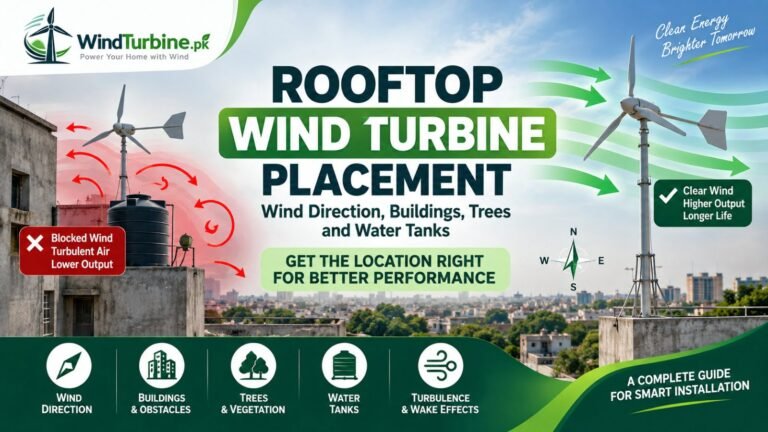
7. Buildings Can Destroy an Otherwise Good Site
This matters particularly for factories.
Industrial sites contain:
- production halls;
- warehouses;
- silos;
- chimneys;
- cooling towers;
- water tanks;
- trees;
- large boundary structures.
Wind hitting these obstacles creates wakes and turbulence.
A turbine immediately behind a large warehouse may therefore experience very different conditions from an open field 500 m away.
The U.S. Department of Energy’s small-wind guidance uses a useful rule of thumb: the bottom of the rotor should be approximately 9 m (30 ft) above obstacles within about 90 m (300 ft). DOE also stresses that turbine siting should account for buildings, trees, terrain and future obstructions. (The Department of Energy’s Energy.gov)
That particular rule is intended as small-wind siting guidance, not as a universal foundation or setback standard for 100 kW–1 MW turbines.
For larger commercial machines, project-specific wake, turbulence, site suitability and safety engineering become even more important. Commercial Wind Turbine Pakistan
8. Wind Direction Matters Too
Suppose the strongest winds come from southwest.
Now suppose the proposed turbine is northeast of a 25 m-high factory building.
The building is directly upwind during the site’s most valuable wind conditions.
Moving the turbine could potentially improve the project more than buying a larger generator.
A commercial wind assessment should therefore examine a wind rose showing:
- direction frequency;
- wind speed by direction;
- preferably energy contribution by direction.
Wind direction is not decorative information.
It is part of micro-siting.
For smaller installations and introductory siting guidance, see WindTurbine.pk’s wind feasibility assessment.
9. Commercial Wind Turbine Pakistan, Turbine Power Curve: The Most Important Supplier Document
Suppose Supplier A offers:
500 kW turbine
and Supplier B also offers:
500 kW turbine.
They are not necessarily equivalent.
You need the power curve.
An illustrative curve might look like this:
| Wind speed | Turbine A | Turbine B |
|---|---|---|
| 3 m/s | 0 kW | 0 kW |
| 4 m/s | 20 | 30 |
| 5 m/s | 55 | 75 |
| 6 m/s | 120 | 150 |
| 7 m/s | 220 | 260 |
| 8 m/s | 340 | 375 |
| 9 m/s | 440 | 460 |
| 10 m/s | 500 | 495 |
| 11 m/s | 500 | 500 |
These numbers are deliberately illustrative—not data for actual commercial turbines.
If your site spends thousands of hours between 4 and 7 m/s, differences in that part of the curve may matter far more than both machines having “500 kW” written on their nameplates.
The relevant international standard is IEC 61400-12-1:2022, which defines procedures for measuring turbine power performance and requires measured power curves and derived energy-production figures to include an assessment of uncertainty. (IEC Webstore)
A commercial buyer should therefore ask:
Who measured this power curve? Under what method? Is it calculated or measured? Is there a test report? What air density applies?
10. Rotor Diameter: Don’t Buy a Turbine by kW Label Alone
A turbine extracts energy from the area swept by its blades.
Suppose two hypothetical 500 kW turbines have:
Turbine A rotor = 30 m
Turbine B rotor = 40 m
Swept area A:
Swept area B:
The second rotor sweeps about 78% more area.
That does not automatically make it the better turbine—loads, generator rating, power curve, turbine class, control strategy and site conditions matter—but it demonstrates why:
Rated kW alone is not enough to compare turbines.
One useful metric is specific power:
For the examples:
Turbine A:
Turbine B:
Lower-specific-power machines often have different low-wind behaviour than higher-specific-power machines. The actual choice must still be tested against the site’s wind distribution.
11. Commercial Wind Turbine Pakistan: What Is Capacity Factor?
Capacity factor is often misunderstood.
If a 500 kW turbine generates:
then:
It does not mean the turbine runs continuously at 150 kW.
It means the annual energy equals 30% of the energy that would have been produced if the machine operated at rated power all year.
12. 100 kW vs 250 kW vs 500 kW vs 1 MW: Energy Sensitivity
Before having a real site-specific AEP, capacity-factor scenarios are useful for understanding scale.
Gross annual energy — mathematical sensitivity only
| Capacity Factor | 100 kW | 250 kW | 500 kW | 1 MW |
|---|---|---|---|---|
| 15% | 131 MWh | 329 MWh | 657 MWh | 1,314 MWh |
| 20% | 175 MWh | 438 MWh | 876 MWh | 1,752 MWh |
| 25% | 219 MWh | 548 MWh | 1,095 MWh | 2,190 MWh |
| 30% | 263 MWh | 657 MWh | 1,314 MWh | 2,628 MWh |
| 35% | 307 MWh | 767 MWh | 1,533 MWh | 3,066 MWh |
| 40% | 350 MWh | 876 MWh | 1,752 MWh | 3,504 MWh |
These numbers are simply:
They are not WindTurbine.pk generation promises.
And capacity factor should not be selected merely because a nearby utility wind farm reports a particular number. Wind Turbine For Business in Karachi to Hyderabad
13. What Do Real Pakistan Wind Farms Tell Us?
Pakistan does provide useful real-world reference points.
PPIB reports:
| Project | Location | Capacity | Turbine configuration | Reported net CF |
|---|---|---|---|---|
| M Wind | Jhimpir | 60 MW | 30 × 2 MW Gamesa G114 | 38% |
| U Wind | Jhimpir/Thatta | 99 MW | 66 × 1.5 MW Goldwind GW77 | 31% |
| A Energy | Jhimpir/Thatta | 49.3 MW | 29 × 1.7 MW GE | 37.5% |
These are valuable evidence that good commercial wind resources exist in Pakistan.
But they must not be copied directly into a factory feasibility model.
Those projects have:
- utility-scale towers;
- large rotors;
- professionally selected sites;
- specific turbine models;
- wind-farm layouts;
- long-term project engineering.
A 100 kW turbine behind a warehouse in Karachi is not the same aerodynamic system as a utility-scale turbine at Jhimpir.
14. Pakistan’s Wind Corridor: What the Government Says
The Sindh Energy Department describes the Gharo–Keti Bandar wind corridor as approximately:
60 km wide
and:
more than 180 km long
and identifies areas including:
Thatta, Badin, Jamshoro, Hyderabad and Tharparkar.
The department states an exploitable potential above 60,000 MW. (SINDH ENERGY DEPARTMENT –)
Sindh Energy Department – wind investment information
This makes these areas logical places for commercial wind screening.
But “inside the wind corridor” is still not equivalent to “project feasible.”
A project needs site-level data.
15. How WindTurbine.pk Should Calculate AEP
For a commercial project, the methodology should move from simple to detailed.
Stage 1 — Regional screening
Obtain multi-year wind information.
Stage 2 — Height analysis
Assess the resource near candidate hub heights.
Stage 3 — Hourly distribution
Create wind-speed bins or use hourly time series.
Stage 4 — Direction
Analyse the wind rose and obstacle sectors.
Stage 5 — Candidate turbine
Obtain the actual power curve.
Stage 6 — Hourly power calculation
For every hour :
where is the turbine power curve.
Then:
Stage 7 — Correct where technically required
Air density, hub-height transformation and other appropriate site/model corrections may be required.
Stage 8 — Apply project losses
Only after gross production is understood.
16. Gross AEP vs Net AEP
Gross AEP is not what ultimately reaches the useful electrical point.
Potential loss categories can include:
| Loss category | Examples |
|---|---|
| Turbine availability | Faults and maintenance |
| Electrical | Cables, transformer, converter |
| Wake | Other turbines |
| Curtailment | Grid or operational limits |
| Environmental | Site-specific restrictions |
| Performance | Blade condition, degradation |
| Grid | Unavailability/interconnection constraints |
| Other | Project-specific factors |
A simple conceptual relationship is:
This is preferable to blindly saying:
“Assume 15% total losses.”
Losses should be identified, justified and documented.
17. P50 and P90: Where Commercial Wind Becomes Investment Analysis
A serious project should not present annual production as one perfect number.
Suppose a model gives:
1,300 MWh/year
There is uncertainty in:
- wind measurement;
- long-term variability;
- spatial extrapolation;
- vertical extrapolation;
- power curve;
- losses;
- availability;
- modelling.
Therefore commercial wind assessments often express energy probabilistically.
P50
Central energy estimate under the defined uncertainty model.
P90
A more conservative energy estimate with a higher probability of being exceeded.
For a financed project, the difference matters enormously.
IEC’s newest relevant framework, IEC 61400-15-1:2025, addresses the definition, measurement and prediction of long-term meteorological/wind-flow characteristics, their integration with turbine and balance-of-plant characteristics, environmental extremes, and traceable reporting for site-suitability input conditions.
18. Now Match Wind Generation to the Factory
This is where many feasibility studies become too simplistic.
Suppose a 500 kW turbine is estimated to produce:
1,314 MWh/year
and the factory consumes:
2,000 MWh/year.
It is tempting to conclude:
“65.7% of the factory’s electricity will come from wind.”
Not necessarily.
The factory and turbine may produce/consume electricity at different times.
A much better analysis uses:
8,760 hourly factory-load values
and:
8,760 hourly turbine-output values.
Then for each hour:
19. Example of Hourly Load Matching
| Time | Factory load | Wind output | Directly used | Surplus | Grid import |
|---|---|---|---|---|---|
| 01:00 | 100 kW | 250 kW | 100 | 150 | 0 |
| 06:00 | 150 | 180 | 150 | 30 | 0 |
| 10:00 | 450 | 120 | 120 | 0 | 330 |
| 14:00 | 500 | 300 | 300 | 0 | 200 |
| 20:00 | 350 | 400 | 350 | 50 | 0 |
This table immediately tells management far more than annual totals.
It allows calculation of:
Self-consumption ratio
and:
Renewable coverage
These are two different metrics.
20. Why 24/7 Industries Can Be Interesting
A facility operating 24 hours may be able to consume wind generation during periods when a daytime-only facility cannot.
Potential examples worth evaluating include:
- textile processing;
- cold storage;
- food processing;
- water treatment;
- pumping;
- continuous manufacturing;
- data/telecom infrastructure;
- industrial refrigeration.
That does not mean wind automatically works for these businesses.
It means their continuous load profile can potentially make self-consumption easier if the site has a suitable wind resource.
21. 100 kW vs 250 kW vs 500 kW vs 1 MW — Practical Comparison
| Factor | 100 kW | 250 kW | 500 kW | 1 MW |
|---|---|---|---|---|
| Rated capacity | 100 kW | 250 kW | 500 kW | 1,000 kW |
| 30% CF gross AEP | 263 MWh | 657 MWh | 1,314 MWh | 2,628 MWh |
| Project complexity | Commercial | Commercial | Major industrial | Major infrastructure |
| Grid study importance | High | High | Very high | Critical |
| Foundation engineering | Required | Required | Major | Major |
| Heavy transport | Model-dependent | Significant | Significant | Major |
| Crane planning | Required/model dependent | Yes | Yes | Specialist |
| O&M capability | Required | Required | Essential | Essential |
| Best fit | Medium industrial demand | Larger demand | Large plant | Very large load/project |
Notice what is not in this table:
universal tower height, universal rotor diameter and universal price.
Those depend on the selected turbine. Wind Turbine For Business
22. How to Size the Turbine From Factory Consumption
A useful first screening formula is:
Suppose a business wants approximately:
1,000,000 kWh/year
from wind.
At a hypothetical 25% CF:
At 35%:
Same annual energy target.
Very different required turbine rating.
This shows why you cannot size the machine until you understand the wind resource.
And this calculation is only preliminary because it does not yet include losses or hourly self-consumption.
23. Commercial Wind Cost: Stop Asking Only for the Turbine FOB Price
For a 100 kW–1 MW project, the turbine itself is only one part of CAPEX.
The proper equation is closer to:
A commercial quotation should clearly separate these components.
| CAPEX item | What should be checked |
|---|---|
| Rotor/nacelle | Turbine model and specification |
| Tower | Type, height, coating |
| Controller/converter | Included or separate |
| Transformer | Rating and voltage |
| SCADA | Monitoring/control |
| Freight | Factory-to-port |
| Marine insurance | Shipment risk |
| Customs/taxes | Current Pakistan treatment |
| Inland transport | Port-to-site |
| Road/access works | Blade/tower/crane access |
| Geotechnical study | Soil investigation |
| Foundation | Concrete, reinforcement, anchor system |
| Crane | Erection capacity/days |
| Electrical BoP | Cables, panels, switchgear |
| Grid works | Protection/metering/interconnection |
| Earthing/lightning | Complete protection |
| Engineering | Civil/electrical/mechanical |
| Commissioning | Tests and handover |
| Initial spares | Critical components |
| Contingency | Project risk |
This is why quoting a universal “500 kW turbine price in Pakistan” without defining scope can be misleading.
For WindTurbine.pk’s published residential/small-system pricing, see current Wind Turbine Prices in Pakistan. The page currently covers systems up to 5 kW; commercial 100 kW–1 MW projects should be treated as engineered quotations rather than extrapolating small-turbine PKR/kW pricing.
24. Why Utility Wind-Farm Costs Cannot Be Used as a Simple Price List
PPIB provides useful historical project data.
For example:
M1 Wind: 60 MW, project price listed at US$73.932 million.
M G E: 50 MW, project price US$63.906 million.
UP Wind: 99 MW, project price US$243.42 million.
These figures are valuable historical references, but they are not current 2026 quotes for a 100 kW or 500 kW turbine.
They involve different:
- project years;
- turbine technologies;
- financing;
- exchange rates;
- EPC scope;
- infrastructure;
- tariffs;
- scale.
Using them to say:
“Therefore a 500 kW project costs exactly X”
would be poor analysis.
Commercial-scale pricing should be obtained from current supplier/EPC quotations after preliminary engineering.
25. OPEX: Wind Has No Fuel Bill, But It Is Not Maintenance-Free
Annual operating cost can include:
- scheduled service;
- oil/grease where applicable;
- filters;
- bolt inspection;
- blade inspection;
- corrosion control;
- bearings;
- brake components;
- gearbox service where applicable;
- generator maintenance;
- converter/power electronics;
- yaw system;
- pitch system;
- sensors;
- SCADA;
- communications;
- insurance;
- specialist labour;
- crane mobilisation;
- spare parts.
A financial model that assumes:
is not a serious commercial model.
26. Availability Is Not Capacity Factor
These terms are often confused.
Availability
How much of the relevant time the turbine is technically available to operate.
Capacity factor
How much energy it actually generates relative to full-rated operation all year.
A turbine can have:
high availability
but:
low capacity factor
if the site has poor wind.
Conversely, a good wind resource cannot produce energy while a turbine is unavailable due to faults.
Both metrics matter.
27. How to Calculate the Value of Wind Electricity
Do not automatically multiply every generated kWh by the headline electricity tariff.
A better model separates:
Self-consumed electricity
Exported electricity
Then:
and:
The applicable avoided cost should come from the customer’s actual tariff/bill structure.
28. Illustrative ROI Example — 100 kW
Assume purely for teaching:
100 kW turbine
30% net capacity factor
Then:
Suppose:
85% is self-consumed
If the illustrative avoided electricity value were:
PKR 40/kWh
then onsite energy value would be:
The remaining:
would need separate treatment depending on whether it is exported, curtailed, stored or otherwise used.
This is not a WindTurbine.pk ROI promise and PKR 40/kWh is not being stated as the current universal industrial tariff. It is a transparent mathematical example.
That is how financial modelling should be presented: every assumption visible.
29. Payback Is Not ROI
Simple payback:
If CAPEX were:
PKR 100 million
and annual net benefit:
PKR 15 million
then:
But this ignores:
- time value of money;
- financing;
- inflation;
- exchange rate;
- major maintenance;
- future electricity prices;
- project life;
- residual value.
For a serious investment, also calculate:
NPV — Net Present Value
IRR — Internal Rate of Return
LCOE — Levelized Cost of Energy
and perform sensitivity analysis.
30. The Financial Model Should Look Like This
| Variable | Low Case | Base Case | High Case |
|---|---|---|---|
| Net AEP | ___ | ___ | ___ |
| Self-consumption | ___% | ___% | ___% |
| Avoided energy value | ___ | ___ | ___ |
| Export value | ___ | ___ | ___ |
| Annual OPEX | ___ | ___ | ___ |
| Major maintenance | ___ | ___ | ___ |
| CAPEX | ___ | ___ | ___ |
| Exchange rate | ___ | ___ | ___ |
| Project life | ___ | ___ | ___ |
| Discount rate | ___ | ___ | ___ |
| NPV | ___ | ___ | ___ |
| IRR | ___ | ___ | ___ |
| Simple payback | ___ | ___ | ___ |
A single sentence saying:
“ROI is 4 years.”
should immediately raise questions unless all assumptions are visible.
31. Grid Connection in Pakistan: Do Not Use Old Net-Metering Assumptions
This is especially important in 2026.
NEPRA’s legal register shows the Prosumer Regulations 2026, notified on 9 February 2026, plus subsequent amendments dated 28 April and 6 August 2026. It also lists the Technical Standards for Grid Connectivity Regulations 2026, notified on 27 April 2026. (NEPRA)
Therefore, before financial close, the project team needs to determine the current regulatory route applicable to the project’s size, voltage, connection and commercial arrangement.
Do not take a solar net-metering calculation from 2024 or 2025 and simply paste it into a 2026 commercial wind model.
This becomes particularly important as turbine size moves toward 500 kW and 1 MW.
32. Grid Connection Is an Engineering Problem Too
A large turbine cannot simply be connected to a factory distribution board because the voltage happens to match.
Electrical studies can need to address:
- transformer capacity;
- protection coordination;
- short-circuit levels;
- voltage;
- frequency;
- reactive power;
- harmonics;
- anti-islanding;
- metering;
- synchronisation;
- cable rating;
- export limitation;
- utility requirements.
IEC 61400-21-1:2019 covers measurement and assessment of electrical characteristics of grid-connected wind turbines, including power quality and compliance with electrical connection requirements. (IEC Webstore)
33. Foundation Design Is Not “100 kW = X Feet Concrete”
There is no responsible universal foundation size for a 100 kW, 500 kW or 1 MW turbine.
The foundation receives loads from the turbine and tower, including:
- dead load;
- rotor thrust;
- bending;
- overturning;
- fatigue;
- extreme winds;
- operational loads;
- shutdown/braking conditions.
It also interacts with:
- soil bearing capacity;
- groundwater;
- settlement;
- uplift;
- seismic conditions;
- foundation geometry.
Therefore:
Do not copy a wind-turbine foundation drawing from the internet and scale it according to kW.
Use manufacturer load data + geotechnical information + structural engineering.
34. Turbine Design Standard
IEC 61400-1:2019 + AMD1:2025 sets essential design requirements intended to ensure wind-turbine structural integrity and covers control/protection functions, electrical systems, mechanical systems and support structures. It applies to turbines of all sizes.
For a commercial buyer, “IEC” should not be accepted as a vague marketing word.
Ask:
Which IEC standard?
Which edition?
Is the turbine certified or merely “designed according to” the standard?
Which body issued the certificate?
Does the exact model on quotation match the certificate?
35. Lightning and Earthing
A 30–80 m steel tower standing in an exposed area cannot treat lightning protection as an afterthought.
IEC 61400-24:2019 + AMD1:2024 addresses lightning risk and protection for turbine blades, structural components, electrical systems and control systems, and includes guidance relating to earthing.
A commercial project should therefore define:
- blade lightning protection;
- tower bonding;
- earthing system;
- surge protection;
- control/communication protection;
- equipment bonding.
36. Noise, Shadow Flicker and Neighbours
Commercial feasibility is not only about energy.
A turbine near offices, houses, schools or other sensitive receptors can create additional siting requirements.
The World Bank Group’s Environmental, Health and Safety Guidelines for Wind Energy discuss environmental and community issues including noise and shadow flicker. For shadow flicker, the guideline recommends modelling where nearby sensitive receptors exist and cites a worst-case recommendation of no more than 30 hours/year and 30 minutes/day on the worst affected day where impacts cannot otherwise be avoided.
That does not automatically become Pakistan’s legal limit; it is an international good-practice reference.
Local applicable requirements still need to be checked.
37. New vs Used Turbine
For 100 kW–1 MW, used European turbines can sometimes appear attractive because purchase price may be lower.
But purchase price is only the beginning.
Before buying a used turbine, investigate:
| Item | Question |
|---|---|
| Serial number | Can identity/history be verified? |
| Manufacture year | How old is it? |
| Operating hours | Actual accumulated operation? |
| SCADA records | Fault and production history? |
| Gearbox | Inspection/oil analysis? |
| Generator | Condition/testing? |
| Blades | Cracks, erosion, lightning damage? |
| Main bearing | Remaining condition? |
| Converter | Still supported? |
| Controller | Software/password/licence available? |
| Tower | Included and structurally suitable? |
| Certification | Exact model documentation? |
| Spare parts | Still manufactured? |
| Dismantling | Included? |
| Packing | Suitable for sea freight? |
| Shipping | Oversized cargo requirements? |
| Recommissioning | Who will perform it? |
| Warranty | Any meaningful coverage? |
A cheap turbine with unavailable electronics can become a very expensive steel structure.
38. Transport Can Decide Whether a Turbine Is Practical
A turbine might fit technically and financially but fail logistically.
Before ordering, check:
- port handling;
- tower-section dimensions;
- blade length;
- nacelle weight;
- trailer requirements;
- road width;
- bridge limits;
- overhead cables;
- turning radius;
- site gate width;
- crane access;
- crane pad;
- erection weather window.
For a 1 MW project, logistics should be assessed before purchase, not after equipment arrives at Karachi Port.
39. Wind + Solar for Industry
Commercial wind should not always be evaluated as a competitor to solar.
They can be complementary.
Solar generation is concentrated during daylight.
Wind depends on local meteorology and may have different hourly and seasonal patterns.
The correct analysis is therefore:
versus:
for all hours of the year.
Then determine:
- grid imports;
- renewable self-consumption;
- surplus;
- storage need;
- transformer utilisation.
For businesses starting with smaller hybrid systems, WindTurbine.pk’s 5 kW wind turbine guide provides useful background on small-system components, while commercial projects require a much more detailed engineered approach. (windturbine.pk)
40. Which Size Should a Business Investigate?
Rather than rigid recommendations, use this as an initial screening framework:
| Turbine | Annual gross energy at 30% CF | Businesses that may investigate it |
|---|---|---|
| 100 kW | ~263 MWh | Medium industrial/agricultural/commercial loads |
| 250 kW | ~657 MWh | Medium-to-large continuous loads |
| 500 kW | ~1.31 GWh | Large factories/process plants |
| 1 MW | ~2.63 GWh | Very large industrial loads or project-scale generation |
The words “may investigate” are intentional.
A business consuming 10 GWh/year does not automatically need a 1 MW turbine.
And a business consuming only 500 MWh/year is not automatically prohibited from a larger turbine.
The correct size depends on wind, load timing, grid arrangement, economics and site constraints. wind turbine in gharo Wind Turbine in Gharo
41. Commercial Turbine Selection Matrix
Once the site resource is established, compare candidate turbines using a table like this:
| Parameter | Turbine A | Turbine B | Turbine C |
|---|---|---|---|
| Rated power | |||
| Rotor diameter | |||
| Swept area | |||
| Specific power | |||
| Hub-height options | |||
| Cut-in speed | |||
| Rated wind speed | |||
| Cut-out speed | |||
| Site AEP | |||
| Net AEP | |||
| P50 | |||
| P90 | |||
| IEC/certification | |||
| Warranty | |||
| Local service | |||
| Major spares | |||
| Installed CAPEX | |||
| Annual OPEX | |||
| LCOE |
Now procurement becomes an engineering decision rather than:
“Supplier B is $20,000 cheaper.”
42. Red Flags When Buying a Commercial Wind Turbine
Be cautious if a supplier:
- gives only rated kW and no power curve;
- guarantees annual kWh without seeing site data;
- uses cut-in speed as proof of high energy production;
- cannot provide rotor diameter;
- cannot provide tower load data;
- has no traceable IEC/certification documents;
- quotes turbine price but hides tower/foundation scope;
- gives no SCADA;
- has no spare-parts plan;
- cannot explain braking/overspeed protection;
- provides no extreme-wind information;
- recommends the same tower for every site;
- promises the same capacity factor everywhere;
- provides ROI without analysing the customer’s tariff/load profile.
For smaller buyers, WindTurbine.pk’s Wind Turbine Questions & Answers guide is a useful introduction to system sizing and price factors. (windturbine.pk)
43. WindTurbine.pk Commercial Feasibility Workflow
A strong commercial service should follow a staged process.
| Stage | Work |
|---|---|
| 1. Desktop screening | GPS, long-term wind, terrain, initial height comparison |
| 2. Business energy study | Bills, demand, hourly load |
| 3. Site survey | Buildings, terrain, access, obstacles |
| 4. Wind direction | Wind rose and important sectors |
| 5. Measurement plan | Decide whether met mast/LiDAR/on-site monitoring is justified |
| 6. Turbine shortlist | Power curve, rotor, tower, certification |
| 7. Energy model | Hourly AEP |
| 8. Loss assessment | Availability, electrical, wake, curtailment etc. |
| 9. Uncertainty | P50/P90 as appropriate |
| 10. Civil engineering | Geotechnical + foundation |
| 11. Electrical study | Grid, transformer, protection |
| 12. Logistics | Port, transport, crane, access |
| 13. CAPEX | Complete installed cost |
| 14. OPEX | Routine + major maintenance |
| 15. Financial model | Self-consumption, NPV, IRR, LCOE, payback |
| 16. Final selection | Turbine + tower + project configuration |
For an initial location check, businesses can start with the WindTurbine.pk Wind Feasibility Check. WindTurbine.pk itself notes that suitability depends strongly on location, tower height and installation conditions rather than turbine size alone. (windturbine.pk)
44. Documents a Business Should Demand Before Signing a Purchase Order
This may be the most useful checklist in the article.
Turbine
| Document | Required purpose |
|---|---|
| Full datasheet | Basic technical specification |
| Measured power curve | Energy modelling |
| Rotor dimensions | Swept area/logistics |
| Tower drawings | Civil/structural planning |
| Design loads | Foundation engineering |
| Electrical single-line information | Grid engineering |
| Generator/converter details | Electrical compatibility |
| Control philosophy | Operation |
| Braking/protection description | Safety |
| IEC/certification documents | Verification |
| Noise data | Environmental assessment |
| SCADA specification | Monitoring |
| Warranty | Commercial protection |
| O&M manual | Lifecycle planning |
| Spare-parts list | Availability |
| Installation manual | Erection |
| Foundation interface | Civil design |
Site/project
Also prepare:
geotechnical report, topographic survey, electrical study, foundation design, logistics plan, crane plan, earthing/lightning design, HSE plan, commissioning procedure and applicable approvals.
If a 500 kW or 1 MW purchase is being discussed without these documents, the project is still at a very early stage.
45. What Makes a Good Commercial Wind Project?
A good project is not simply a project with high wind speed.
It requires several things to align:
1. Good wind resource
Enough energy at the proposed hub height.
2. Suitable turbine
Power curve matches the site’s wind distribution.
3. Clean inflow
Acceptable turbulence and wake conditions.
4. Strong load match
Business can use valuable generation.
5. Appropriate grid arrangement
Interconnection and export treatment are understood.
6. Buildable site
Foundation, crane and transport are practical.
7. Maintainable equipment
Parts and technical support exist.
8. Sound economics
The project still works under conservative assumptions.
If only one of these eight is excellent, the project can still fail.
46. The Final Decision: 100 kW, 250 kW, 500 kW or 1 MW?
There is no universally “best” turbine size.
A 100 kW turbine may outperform the business case of a 500 kW machine if it is better matched to the load and site.
A 500 kW turbine may make more sense than several smaller turbines if the site, turbine technology, O&M and electrical arrangement favour it. Wind Turbine for Business in pakistan
A 1 MW turbine can be attractive for a very large industrial consumer at a strong, open site—but at that scale, wind assessment, foundation, grid, logistics and long-term service become major engineering workstreams.
The decision should ultimately be based on:
not merely:
Conclusion
Pakistan has already demonstrated that high-quality wind projects are possible. PPIB records operating utility-scale projects at Jhimpir, Gharo and Jamshoro, while the Sindh Energy Department identifies a major wind corridor extending through important parts of southern Sindh.
But a commercial factory project is a site-specific engineering and investment decision.
Before purchasing a 100 kW, 250 kW, 500 kW or 1 MW turbine:
measure or properly model the wind, understand the direction, evaluate the proposed hub height, obtain a credible power curve, calculate hourly generation, match it with the factory’s hourly load, estimate net AEP, investigate the grid, engineer the foundation, establish complete installed CAPEX and OPEX, and then calculate financial returns.
The most dangerous commercial wind question is:
“How much does a 500 kW turbine cost?”
asked before anyone knows whether a 500 kW turbine belongs at the site.
The better question is:
wind Turbine for Karachi Wind Turbine
“Which turbine will produce the lowest-risk, economically useful kWh at this site over its project life?”
That is the question a proper commercial wind feasibility study should answer.
For the next step, use WindTurbine.pk Wind Feasibility Check, review current Wind Turbine Prices in Pakistan for the smaller-system market, and see the WindTurbine.pk Wind Turbine FAQ & Technical Guide for further technical background. (windturbine.pk)