Pakistan Energy Series · Renewable Focus · 2026
Rural Energy Report
Small Wind Turbines for Homes in Pakistan: Prices & Installation (2026)
Small Wind Turbines for Homes in Pakistan are becoming an affordable solution for homeowners and rural communities facing rising electricity costs and frequent power outages. In this 2026 guide, you’ll learn about prices, installation costs, wind speed requirements, the best locations, and whether a small wind turbine is the right investment for your home or village. Small Wind Turbines for Homes in Pakistan: Prices & Installation (2026) detail to follow.
On top of that This is not an imaginary story. Can small wind turbines — machines you can hold a conversation next to, mounted on towers no taller than a house — change this picture for remote villages in Sindh and KPK?
~30M
people without reliable power — mostly rural Sindh, KPK & Balochistan
4 in 5
households receive only a few hours of grid power daily (Energy Access Survey 2024)
7–8 m/s
however average wind speed in Sindh’s Gharo-Jhimpir corridor — world-class for micro turbines
4–6 m/s
wind speeds in highland KPK — marginal but workable in hybrid systems
The Problem They Are Trying to Solve
Pakistan’s rural energy crisis has two layers that often get confused. The first is villages that have no electricity connection at all. The second — and arguably the more widespread problem — is villages that are technically “connected” but suffer through endless outages.
98%
of Pakistani households are technically “connected” to the grid. Yet the Pakistan Energy Access Survey 2024 finds that nearly four in five households receive only a few hours of supply each day. Just 3% receive what could truly be called reliable power. In Sindh, the headline figure of 78% access drops sharply to 68% when Karachi is excluded.
Grid extension is the obvious solution, but it is also expensive and slow. It is simply too expensive for the government to build power lines to reach small, remote, decentralized villages. Energy from large power plants first meets industrial and commercial needs, then feeds major cities — off-grid communities are forever being left behind.
This is exactly the gap that micro and small wind turbines are designed to fill.
What Is a Micro Wind Turbine, Exactly?
Small Wind Turbines for Homes in Pakistan: Prices & Installation is very easy, prices are reasonable. Most people picture enormous white three-blade structures when they hear “wind turbine.” Those utility-scale machines are 80–120 metres tall and generate 2–5 megawatts each — enough to power thousands of homes, but requiring massive investment, grid connections, and specialized maintenance crews.
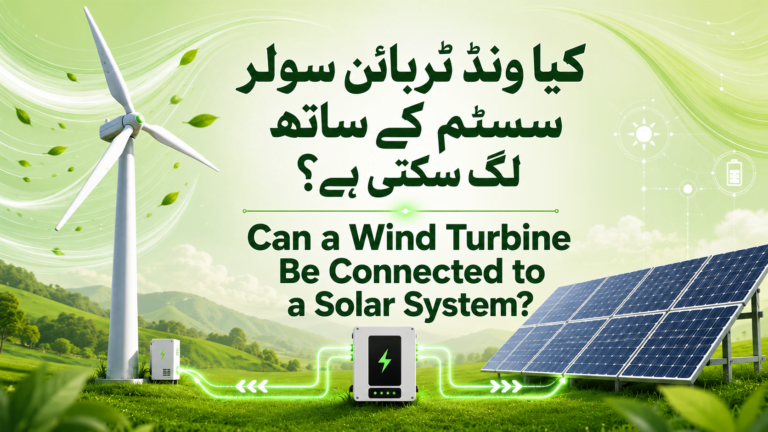
Micro and small wind turbines are a completely different category. They range from 1 kW to around 20 kW in capacity. They are quiet enough to install near homes. These systems are useful in rural areas where grid electricity is unreliable — and when combined with solar panels and battery storage, they can ensure continuous 24-hour power supply.
Turbine sizes available in Pakistan 1–2 kW
Household micro turbine. Cost (installed)PKR 200–350K, PowersLights, fans, phone charging, Tower height6–10 m
Best forSingle family, Sindh coastal, Payback period5–8 years,
★ Recommended for villages
5 kW
Village cluster system, Cost (installed)PKR 800K–1.2M, Powers5–8 homes + a shop, Tower height12–18 m
Best forSmall village, hybrid solar+wind, Payback period6–10 years
10–20 kW
Community micro-grid, Cost (installed)PKR 2–4M, PowersSchool, clinic + 15–30 homes, Tower height20–30 m, Best forLarger village, remote Sindh
Payback period8–12 years
Where Does Pakistan’s Wind Actually Blow?
Not all of Pakistan is windy. In fact, most of the country is not windy enough for micro turbines to work cost-effectively. The viability of small wind depends almost entirely on location. Here is an honest look at each region.
Wind speed suitability by region (annual average, m/s)
Sindh Coast — Gharo-Jhimpir corridorExcellent · 7–8 m/s
Interior Sindh — Thatta, Badin, TharparkarGood · 5–7 m/s
Balochistan Coast — Gwadar, Makran beltGood · 5–7 m/s
KPK highlands — Chitral, Upper Dir, Besham-QilaModerate · 4–6 m/s
KPK valleys — Peshawar, DargaiLow · 3–4 m/s
Punjab plainsPoor · 2–3 m/s
Sindh: The Undisputed Winner
The Gharo-Jhimpir wind corridor in Sindh covers 9,700 km² in Thatta district, with strong wind speeds of 7–8 metres per second — making it Pakistan’s most lucrative wind corridor and the best in South Asia. These wind speeds are not just good for large farms. They are excellent for micro turbines. At 7 m/s, even a small 5 kW turbine performs reliably and efficiently.
Interior Sindh, away from the coast, has lower but still workable wind speeds across parts of Badin, Mirpur Khas, and Tharparkar — the same areas where grid power is most unreliable and where some of Pakistan’s poorest communities live.
One important caveat: recent data from Thatta district shows an alarming decline in wind speeds after 2008, with the lowest summer wind recorded at just 3.6 m/s in 2023 — a trend researchers link to climate change and rapid urbanization. This means feasibility assessments must use recent wind data, not older studies.
KPK: Promising in the Mountains, Weak in the Valleys
KPK is a story of contrasts. Some areas have been identified for hybrid power systems such as solar-wind-hydro, and there is great potential for small-scale wind turbine installations. Areas like Chitral, Upper Dir, and Besham-Qila have been identified in scientific studies as having promising wind speeds in the range of 4–6 m/s.
These are not spectacular numbers — but they are workable, especially when wind is combined with solar panels in a hybrid system. The valleys around Peshawar and the lowland plains, however, typically fall below 4 m/s — too little for economically viable wind installations. In those areas, solar remains the better choice.
The Hybrid Approach: Wind + Solar = 24-Hour Power
One of the most important insights from research on rural electrification in Pakistan is this: neither solar nor wind alone gives villages what they actually need, which is reliable power around the clock.
Solar produces nothing at night. Wind does not blow every day with the same strength. But together, they complement each other remarkably well. A typical hybrid setup for a small village looks like this:
| Time of Day | Primary Source | Role of Wind | Role of Solar |
|---|---|---|---|
| Daytime (6am–6pm) | Solar panels | Supplements or charges batteries | Main power source, charges batteries |
| Evening (6pm–11pm) | Wind turbine | Peak coastal winds, main power source | No output after sunset |
| Night (11pm–6am) | Wind + Battery | Continuous generation from wind | Battery discharge (stored from day) |
| Calm cloudy days | Battery bank | Minimal output | Reduced output |
Research on hybrid microgrid systems for rural communities in Pakistan confirms that a combined PV and wind system can produce stable output voltage, minimizing transients and providing reliable power generation — a technically sound solution for off-grid rural electrification.
What Does It Actually Cost?
Small Wind Turbines for Homes in Pakistan: Prices & Installation (2026). This is the question that matters most for rural communities where average monthly income may be Rs 15,000–30,000. Let’s break it down practically.
| System | Upfront Cost | Per Household | Annual Saving |
|---|---|---|---|
| 1–2 kW micro (1 home) | PKR 200–350K | Full cost | PKR 60–100K vs. diesel |
| 5 kW village cluster (5–8 homes) | PKR1000K–1.2M | ~PKR 130–200K | PKR 150–250K shared |
| 10 kW community grid (15–30 homes) | PKR 2–4M | ~PKR 80–150K | School saves PKR 200K+/yr |
| Diesel generator (ongoing cost) | Low upfront, high running cost | PKR 80–100/kWh in fuel | No saving — costs rise yearly |
Real-world examples from Pakistan include a school in Gharo where a 10 kW turbine powers classrooms and administrative offices, saving over Rs 200,000 annually. A coastal Sindh farm equipped with a 5 kW turbine cut electricity bills by 50% while powering irrigation pumps and lights.
A 5 kW community system financed through a microfinance scheme or community savings group over 5 years translates to roughly Rs 13,000–20,000 per household total — a one-time cost, not a monthly bill. After that, the wind is free.
https://windturbine.pk/prices-of-wind-turbine-in-pakistan/
The Challenges Are Real
No honest article on this topic would skip the serious obstacles. Small wind in rural Pakistan is viable in the right places — but it is not a plug-and-play solution.
Why it can work
- ✓Generates power at night — unlike solar
- ✓Works in dusty, cloudy weather
- ✓Ideal as hybrid with solar panels
- ✓No fuel costs after installation
- ✓Sindh coast has world-class wind speeds
- ✓KPK mountains have consistent highland winds
- ✓Better for evening peak demand than solar
Why it can fail
- ✗Higher upfront cost than solar panels
- ✗Needs consistent wind (≥4 m/s) to be viable
- ✗Most of Pakistan has insufficient wind
- ✗Moving parts require skilled maintenance
- ✗Limited local technicians in remote areas
- ✗Wind speeds declining in some areas (climate change)
- ✗Social/land ownership issues need resolution first
- https://www.windturbine.pk
The Maintenance Problem Is Serious
Unlike solar panels which have no moving parts, wind turbines have gearboxes, bearings, blades, and generators that require regular servicing. In a remote village 100 km from the nearest city, a broken bearing can mean weeks without power. Local technicians need to be trained and supply chains for spare parts established before deployment — not after something breaks.
Land and Community Buy-In Are Non-Negotiable
Installing a tower in a village requires community consensus, clear land ownership, and agreements on who pays for maintenance and who benefits. Projects that skip community involvement tend to fail — not for technical reasons, but social ones. This lesson has been learned repeatedly in rural electrification projects across Pakistan and South Asia.
The Chitral Model: A Real Example from KPK
The northern districts of KPK and Chitral offer one of the most compelling examples of what small-scale renewable energy can do in Pakistan’s rural mountains. Small-scale micro and mini projects for lighting, pumping systems, and power production have been promoted in northern regions and the Chitral district, with individual installations producing power ranging from 30 kW to 800 kW and collectively reducing 80 kilotons of CO₂ emissions.
While many of these installations focus on micro-hydro (using mountain streams), the hybrid wind-hydro-solar approach in highland KPK communities has demonstrated that remote villages can achieve reliable electricity without grid connections. The model is worth scaling. The Pakistan Poverty Alleviation Fund (PPAF) has been active in this region, promoting renewable energy projects that combine technologies based on what each site offers.
“Some areas of KPK have been identified for hybrid power systems such as solar-wind-hydro, and there is great potential for small-scale wind turbine installations. Rural and off-grid communities will benefit from this combined approach.”
Final assessment
So — Is Small Wind a Viable Solution for Rural Pakistan?
The honest answer is: yes, but selectively and intelligently.
Overall, small wind turbines are a genuinely viable solution for rural villages in coastal and interior Sindh, where wind speeds consistently exceed 5 m/s and the need for off-grid power is most acute. Similarly, some highland areas of KPK also offer promising conditions for small wind systems. However, viability is highly location-specific, as mountain regions are good candidates, whereas low-lying valleys usually lack sufficient wind resources.
Furthermore, the most promising model is not a stand-alone wind turbine but a hybrid solar-wind micro-grid designed for village clusters of 20–100 households. In addition, these systems are technically proven and economically practical over a 20-year lifespan. As a result, they can deliver reliable 24-hour electricity that Pakistan’s aging power grid cannot consistently provide.
Nevertheless, technology is not the biggest challenge. Instead, effective government policy remains the missing piece. Therefore, Pakistan should establish a dedicated rural micro-wind program under AEDB with suitable financing, local technician training, and accurate wind resource assessments at the village level. Moreover, strong community participation and long-term maintenance planning will help ensure the success of these projects.
Finally, the turbines already exist, the wind continues to blow, and the communities are ready. In short, Pakistan has the opportunity to transform rural electrification through smart renewable energy investments. Consequently, policymakers, investors, and local communities should work together to make this vision a reality.